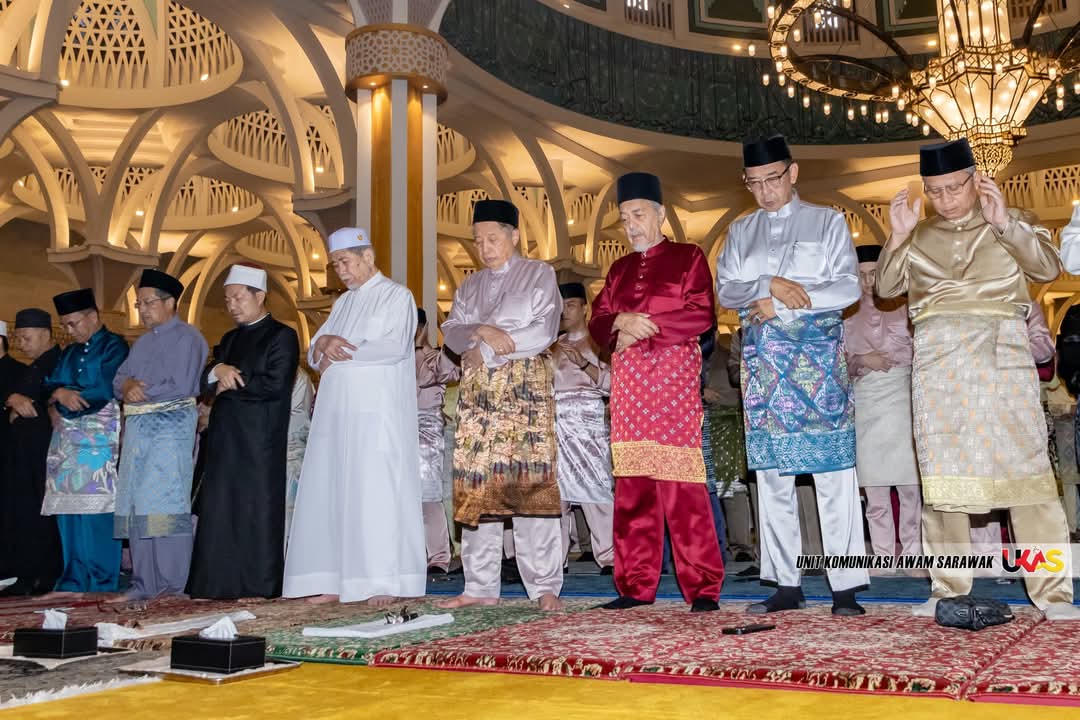
KUCHING: A meaningful opening prayer in nine languages became a highlight at the Parti Pesaka Bumiputera Bersatu (PBB) Women and Youth Wings’ 16th Triennial General Meeting today as Suhaimi Mohamad delivered a unique multilingual recital that resonated deeply with the delegates.
Suhaimi, who is the Bukit Kota Branch Deputy Youth Chief and works as an event crew member, recited the 5-minute prayer in Arabic, Malay, English, Iban, Melanau, Bisaya, Lun Bawang, Bidayuh, and Mandarin.
After the prayer recitation, the 37-year-old, who hails from Limbang, told reporters it was his initiative to learn and recite the prayer in different languages.
“No one asked me to do this—it was my initiative. I realized that in Sarawak, we naturally mix languages in daily life.
“While there are more than nine ethnic groups here, these were the ones I managed to learn in the time I had,” he said at the meeting held at Borneo Convention Centre Kuching (BCCK).
He added that he had never seen anyone recite a prayer in multiple languages at any event like this before.

Suhaimi then shared that it took him about a month to prepare, focusing on pronunciation and accuracy.
“The most challenging was Mandarin because the pronunciation is very different from how it is written. I had to practice repeatedly with my Chinese friends and local business owners to make sure that I got it right,” he said.
He mentioned that he had also learned from native speakers of Iban, Melanau, and Bisaya to ensure the pronunciation was accurate.
“Apart from that, learning Lun Bawang was easier because I often interacted with the community,” he said.
He also emphasized the importance of inclusivity in religious practices, highlighting that Islam transcends ethnicity and language.
“People often mistakenly associate Islam solely with the Malay community. However, there are Muslims among the Chinese, Iban, and other ethnic groups.
“For those outside the faith, there is a common misconception that prayers must be conducted in Arabic. However, if one does not understand the language, it may not be as meaningful,” he said.
Therefore, he said when other languages are included in the prayer, the people would feel appreciated.
He further shared a personal experience where he observed firsthand how language inclusivity could foster appreciation and engagement.
“During an event in Limbang, I included a simple phrase in Mandarin, saying ‘Xiexie’ (thank you) at the end of my speech. To my surprise, the Chinese attendees applauded.
“Therefore, hearing their language being acknowledged makes them feel happy and valued,” he said.