
When Parliament enacted the Online Safety Act 2025 (ONSA) last year, it marked a significant milestone in Malaysia’s journey toward confronting the complexities of digital life.
For millions of citizens who spend much of their day online—whether for work, social connection, or news consumption—the legislation offers cautious optimism.
What was once regarded as a boundless frontier is now recognised as an extension of our shared community. And, as with any community, rules are essential to safeguard its members.
Coming into force on January 1, 2026, the Act places responsibility squarely on digital platforms. For too long, Malaysians were left to fend for themselves against scams, cyberbullying, extremist propaganda and exploitation. The Online Safety Act changes that equation. Platforms must now act swiftly, operate transparently and recognise that their services are not neutral tools but living spaces where real people interact, work and build relationships.
Why It Matters
For families in Sarawak and across Malaysia, the impact is immediate. Parents gain greater confidence that their children are shielded from predatory behaviour and harmful material. Communities vulnerable to misinformation or harassment now have clearer avenues to report abuse. And for everyday users, there is reassurance that regulators are finally holding platforms accountable.
The Act is not a cure-all. The internet will never be entirely risk-free. But it does shift the burden of safety away from individuals, compelling platforms to share responsibility. This profound change could encourage Malaysians to embrace digital services with trust rather than fear.
As the proverb reminds us, “It takes a village to raise a child.” In the digital age, it takes a nation — and its laws — to safeguard its citizens.
The Constraints We Must Acknowledge
No law is without its limitations and Malaysia’s Online Safety Act (ONSA) is no exception. While the legislation represents a significant step forward in protecting citizens in the digital sphere, several challenges remain.
Enforcement is chief among them. The platforms most Malaysians rely on—Facebook, TikTok, YouTube — are global giants headquartered far beyond our borders. Ensuring compliance across jurisdictions is a complex undertaking, one that will require strong international cooperation if the Act is to achieve its full potential.
Another pressing concern is the delicate balance between safety and freedom of expression. Harmful content must be curbed but regulators must tread carefully to avoid suppressing legitimate speech. The challenge lies in protecting users without eroding the democratic values that underpin our society.
Cost is also a factor. Smaller service providers may struggle to meet compliance requirements, raising fears that innovation could be stifled. Policymakers must ensure that the Act does not inadvertently create barriers for local entrepreneurs striving to build digital solutions for their communities.
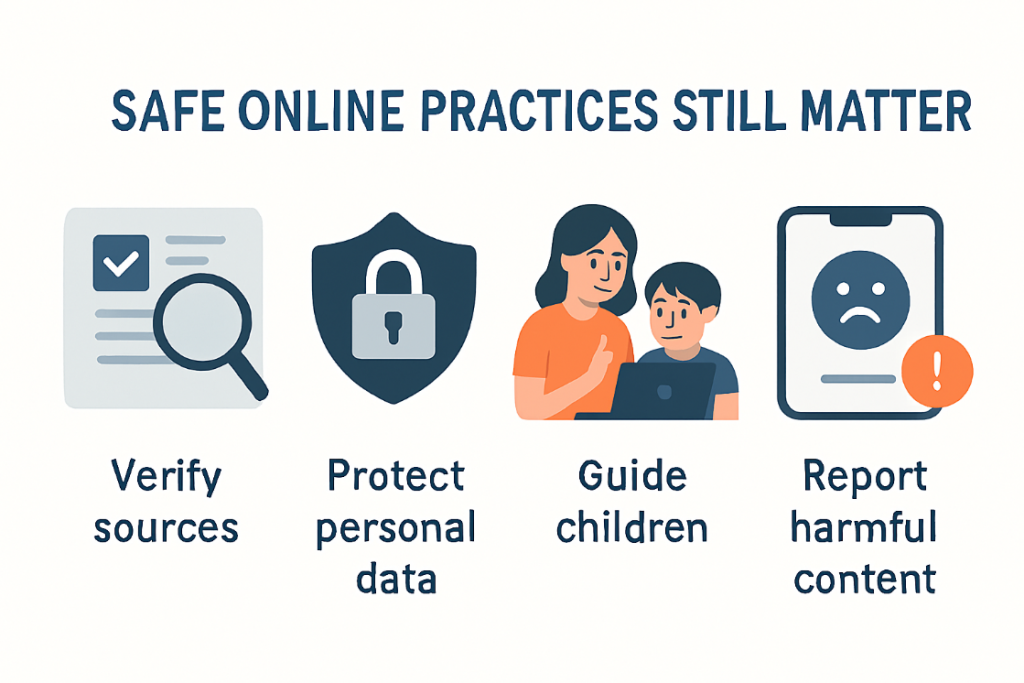
Safe Online Practices Still Matter
Even with ONSA in place, laws alone cannot guarantee safety. Personal responsibility remains vital. Citizens are urged to:
- Verify sources before sharing information, particularly in an era of rampant misinformation.
- Protect personal data by using strong passwords and enabling two-factor authentication.
- Guide children on responsible internet use, encouraging them to question what they encounter online.
- Report harmful content promptly, making use of the streamlined mechanisms provided under the Act.
These may seem like small steps but collectively they make a significant difference. The Act provides the framework, yet it is our behaviour that will ultimately determine how safe Malaysia’s digital community becomes.
As the old saying goes, “Trust in God, but tie your camel.” Laws can provide protection but vigilance and responsibility remain essential in navigating the online world.
A Personal Reflection
The internet is now woven into daily life in Sarawak, from online banking and food delivery to virtual classrooms and community chat groups. What was once a luxury has become a necessity. Yet convenience comes with risks: scams, cyberbullying and misinformation spread quickly, harming individuals and communities.
The ONSA offers hope by signalling Malaysia’s commitment to protecting its people in the digital age. Still, safety cannot rest solely on laws or regulators. It is a shared responsibility — government, platforms and users must work together to ensure our digital spaces remain secure, trustworthy and supportive.
Looking Ahead
The Online Safety Act is undeniably a bold stride into the future but its true measure will lie in enforcement, platform cooperation and the willingness of Malaysians to cultivate safe online habits. If these forces converge, ONSA has the potential to stand as a regional benchmark for digital governance — proving that innovation and security can coexist.
Yet beyond its legal framework, the Act carries a deeper resonance. It is a declaration of values: that safety, accountability and trust are as vital in our digital communities as they are in the neighbourhoods we call home. In Sarawak and across Malaysia, this law represents more than regulation — it is a collective commitment to protect one another in the spaces where we now live, work and connect.
As the proverb reminds us, “A chain is only as strong as its weakest link.” The strength of our digital future will depend not just on legislation but on the unity of platforms, regulators and citizens in forging a safer, more trustworthy online world.
The views expressed here are those of the writer and do not necessarily represent the views of Sarawak Tribune. The writer can be reached at drjohnlau@gmail.com.