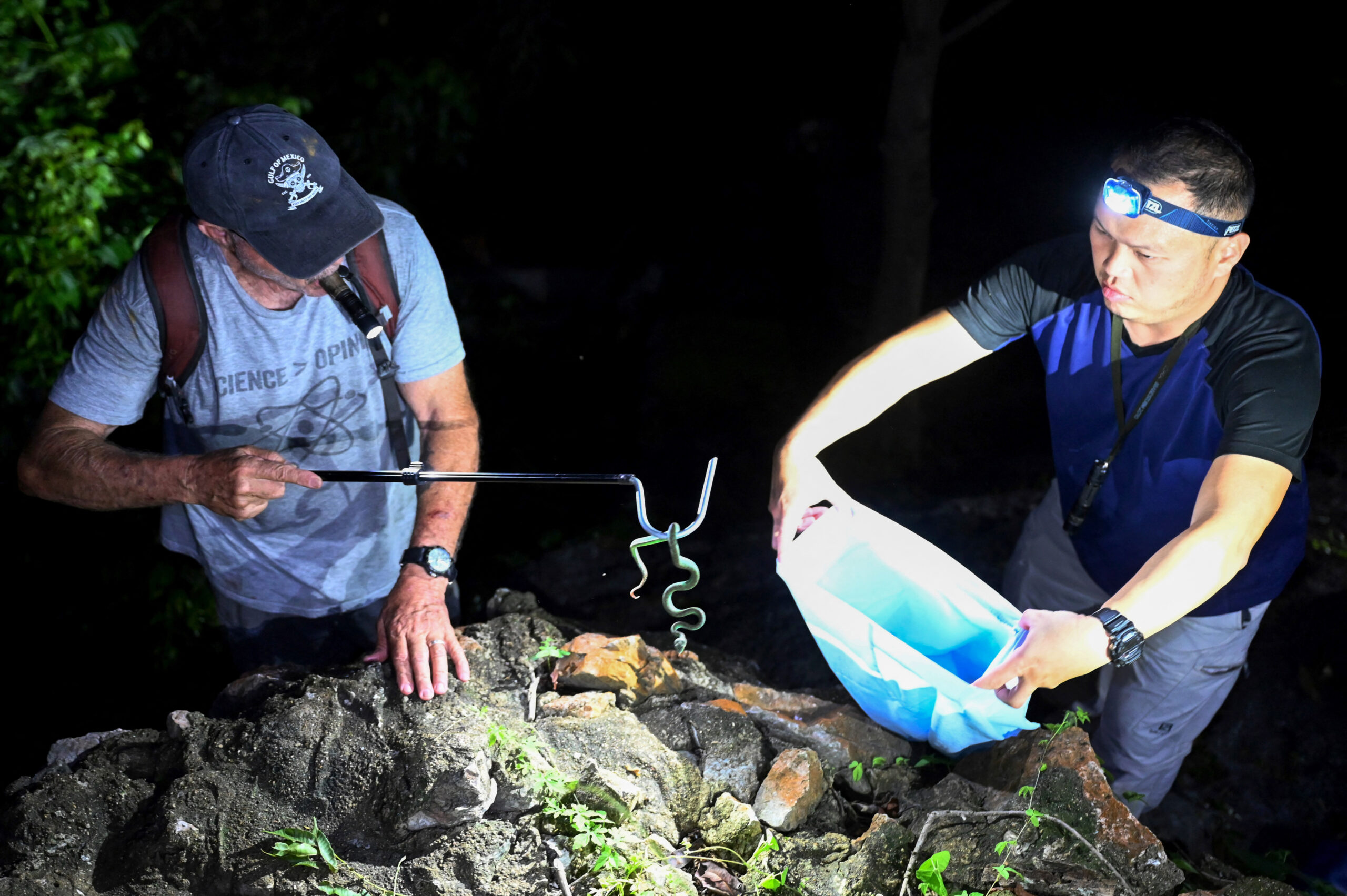
PHNOM PROEK (Cambodia): A team of scientists surveying Cambodia’s limestone karst near the Thai border discovered three new gecko species in a single night, underscoring the region’s extraordinary biodiversity — and the threats it faces from the cement industry.
Karst landscapes, formed millions of years ago from coral and shaped by rain erosion, create isolated “evolutionary islands” where unique species emerge.
“You can quite literally go into a cave, collect a few specimens, and most likely there’ll be some that are new to science,” said Pablo Sinovas, Cambodia country director for conservation NGO Fauna & Flora. Led by veteran herpetologist Lee Grismer, the July expedition faced dangers ranging from sharp rock formations and hidden holes to venomous snakes, unexploded ordnance, and even cross-border fighting that forced the team to relocate.
Night surveys, after bats had left their roosts, involved painstakingly scanning for minute movements or eye reflections.
Each captured animal was bagged for cataloguing the next morning. In their makeshift hotel “studio”, the team photographed specimens against black velvet, then euthanised, measured, and preserved them for DNA analysis. Of roughly 40 animals collected in one night, three stood out as likely new species: a large speckled gecko, a bent-toed gecko with a banded tail, and a web-toed gecko. Grismer, who has discovered dozens of species, described the thrill of such finds as akin to his boyhood fascination with wildlife. But the discoveries also highlight the fragility of these ecosystems. Limestone karst is heavily targeted for quarrying to feed Cambodia’s booming cement industry, which produces 11 million tons annually. Prime Minister Hun Manet has praised the sector’s economic benefits, while urging “responsible” extraction. Local views are mixed. Some villagers believe spirits inhabit the karst but would welcome cement firms for the jobs. Fauna & Flora hopes its research will persuade authorities to protect particularly rare habitats, likening their ecological value to national treasures such as Angkor Wat. “Would you turn Angkor Wat into cement? You wouldn’t because it’s a national treasure. Well, some of these species should be considered national treasures as well,” Sinovas said. The team’s work, combining field science and advocacy, aims to ensure that Cambodia’s ancient karst landscapes — and the unique creatures they shelter — are recognised before they vanish into cement dust. – AFP