
In nature, nothing exists alone.
– Rachel Carson, Silent Spring
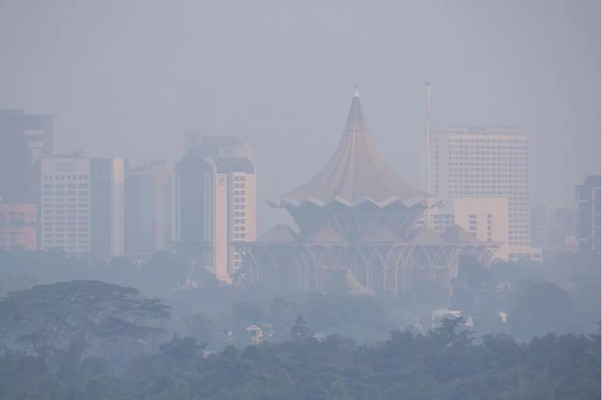
For the past few days, checking the Air Pollutant Index (API) has almost become part of our daily routine. We ask how bad the air is, whether children should stay indoors, whether it is safe to exercise and whether we need a mask. When Kuching recorded an API of 407 on September 1, the air had reached the hazardous category, and the haze quickly became part of everyday conversation.
Naturally, our first concern is human health. We think about our lungs, our children, the elderly and people who still need to work outdoors. But looking outside at the grey sky, I found myself thinking about something else too: what happens to the plants?
We can close our windows, reduce outdoor activities and put on a mask. Plants cannot. The trees along our roads, vegetables in home gardens, pepper vines, fruit trees, paddy fields and forests remain outside, exposed to the same atmosphere.
Plants breathe the same air too
Plants may seem passive, but they are constantly interacting with the environment. Tiny openings on leaves, called stomata, allow carbon dioxide to enter and water vapour and gases to move out. This exchange is closely linked to photosynthesis, the process plants use to capture light energy and support growth.
During severe haze, fine particles can settle on leaf surfaces, while very small particles may interfere with gas exchange. Haze also reduces the amount of sunlight reaching leaves. Anyone who has looked outside during a bad haze day can see that difference immediately: the sky is duller, the sun appears weaker and visibility drops.
For plants, this matters because light is their source of energy. Studies in tropical forests have shown that visibly hazy conditions can substantially reduce the amount of light reaching the forest canopy. This does not mean that a few hazy days will suddenly destroy our forests or crops, but it does remind us that haze is not only a respiratory problem for people. It is also a form of environmental stress.
What about our crops and medicinal plants?
For agriculture, the issue is worth considering. A farmer does not simply need a plant to stay green. Crops must continue growing, flowering and producing fruits, grains, tubers or other harvestable parts. When haze reduces light and occurs together with heat or dry conditions, plants may face several stresses at the same time.
The question becomes even more interesting when we think about Sarawak’s medicinal plants. Our state is rich in plant diversity, and many species are traditionally used by local and Indigenous communities as food, medicine and other resources.
The chemistry of a medicinal plant is not completely fixed. Light, water, temperature, nutrients and environmental stress can influence plant physiology and, in some cases, the natural compounds it produces. This raises an interesting scientific question: could repeated exposure to severe haze affect the physiology or chemical profile of our medicinal plants?
We do not yet have a simple answer, and it would be wrong to claim that haze automatically makes medicinal plants better or worse. But in a biodiversity-rich place such as Sarawak, this is a question worth studying.
Haze is more than an API number
Perhaps this is why we should look at haze beyond the number appearing on our phones. The API is extremely important because it tells us about the air we are breathing and helps protect public health. But haze also reminds us that human health and environmental health are closely connected.
The same air entering our lungs surrounds our crops and forests. The same prolonged dry conditions that make life uncomfortable can also dry vegetation and increase fire risk. Over time, environmental degradation can affect not only biodiversity, but also agriculture, livelihoods and community resilience.
This is where climate resilience becomes important. During a haze episode, we understandably focus on masks, reducing outdoor activities and protecting vulnerable groups. These are necessary responses. But resilience also means asking what can be done before the next haze season arrives.
How do we reduce fire risk? How do we manage forests and peatlands more carefully? How do we restore degraded land and strengthen the role of communities living closest to these landscapes?
Nature-based solutions can be part of this conversation, but not because planting a few trees will magically remove haze from the atmosphere. Rather, healthy forests, restored landscapes and responsible land management can help make ecosystems and communities more resilient to drought, fire and other environmental pressures.
Plants cannot move indoors
Perhaps the grey sky above Sarawak is giving us a simple reminder. Human health, plant health and landscape health are not separate issues.
Our food comes from plants. Our forests support biodiversity and livelihoods. Many traditional remedies and future discoveries may also begin with plants. Their health matters to us.
When the air becomes hazardous, many of us can go home, close our doors and windows and stay indoors. The trees outside remain where they are.
They cannot check the API. They cannot move indoors. And they cannot wear masks. Perhaps that is why their resilience should matter to us too.
The views expressed here are those of the writer and do not necessarily represent the views of Sarawak Tribune. The writer can be reached at ab_fauziah@upm.edu.my.