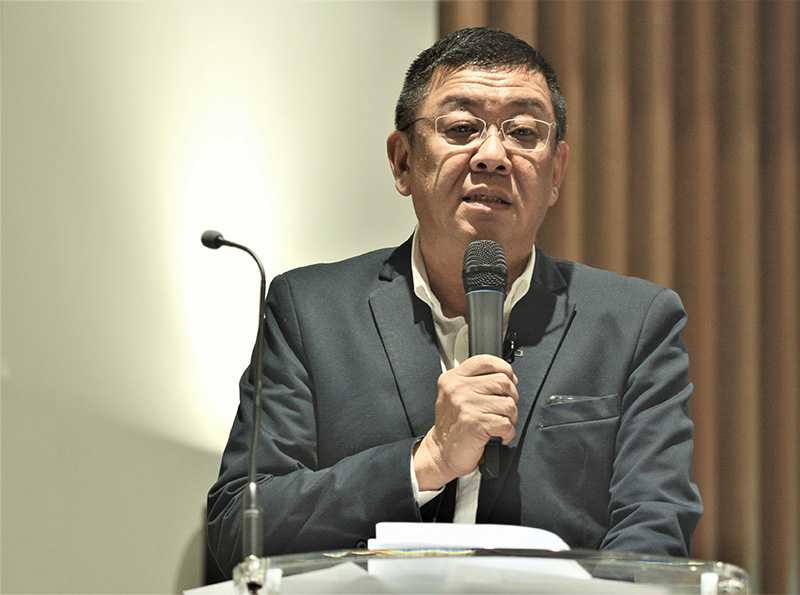
KUCHING: The new federal government politicking among themselves and its lack of clarity and direction in economic strategies has resulted in Malaysia missing opportunities arising from external economic tension, said Federation of Chinese Associations president Datuk Richard Wee.
He said that neighbouring countries had taken advantage of the trade war and benefited while Malaysia had not capitalised on it due to the lack of initiative and experience as well as the slow response of the federal government.
“All these issues have directly or indirectly affected our own efforts to grow Sarawak into a developed region in Malaysia,” he said when speaking at the ‘Talking About What Really Matters’ Forum at the Chemsain Building here on Friday.
“With all of this, Sarawak is currently either experiencing slow growth, no growth, or even downturn in most sectors in our economy,” he said.

Wee believed that the new business landscape in Sarawak would revolve around the state’s new economic initiatives and financial independence.
He did point out that the state was unable to be completely independent from federal economic policies as monetary and fiscal policies of the country were determined by the federal government.
“Many of these policies affect the entire business landscape in Malaysia, and Sarawak is not spared,” he said, adding that the entire business environment in Sarawak was affected whenever the nation faced financial or economic crises.
He said thus, the state government had adopted a different approach and initiatives to manage the state’s own economy.
“Therefore, we can only depend on our Sarawak government’s new economic initiatives in its expansionary fiscal policies, seeking new and additional revenue streams and the embracing of new technology to stimulate our economy,” Wee said.
He said that with the implementation of such strategies, Sarawak will be able to achieve financial independence — in turn fast tracking the overall development of the state without much dependence on the federal government’s ‘uncertain grants and allocations’.