INVESTORS are cautioning startups in artificial intelligence and climate technology to move past hype and focus on building businesses backed by data, discipline and measurable results.
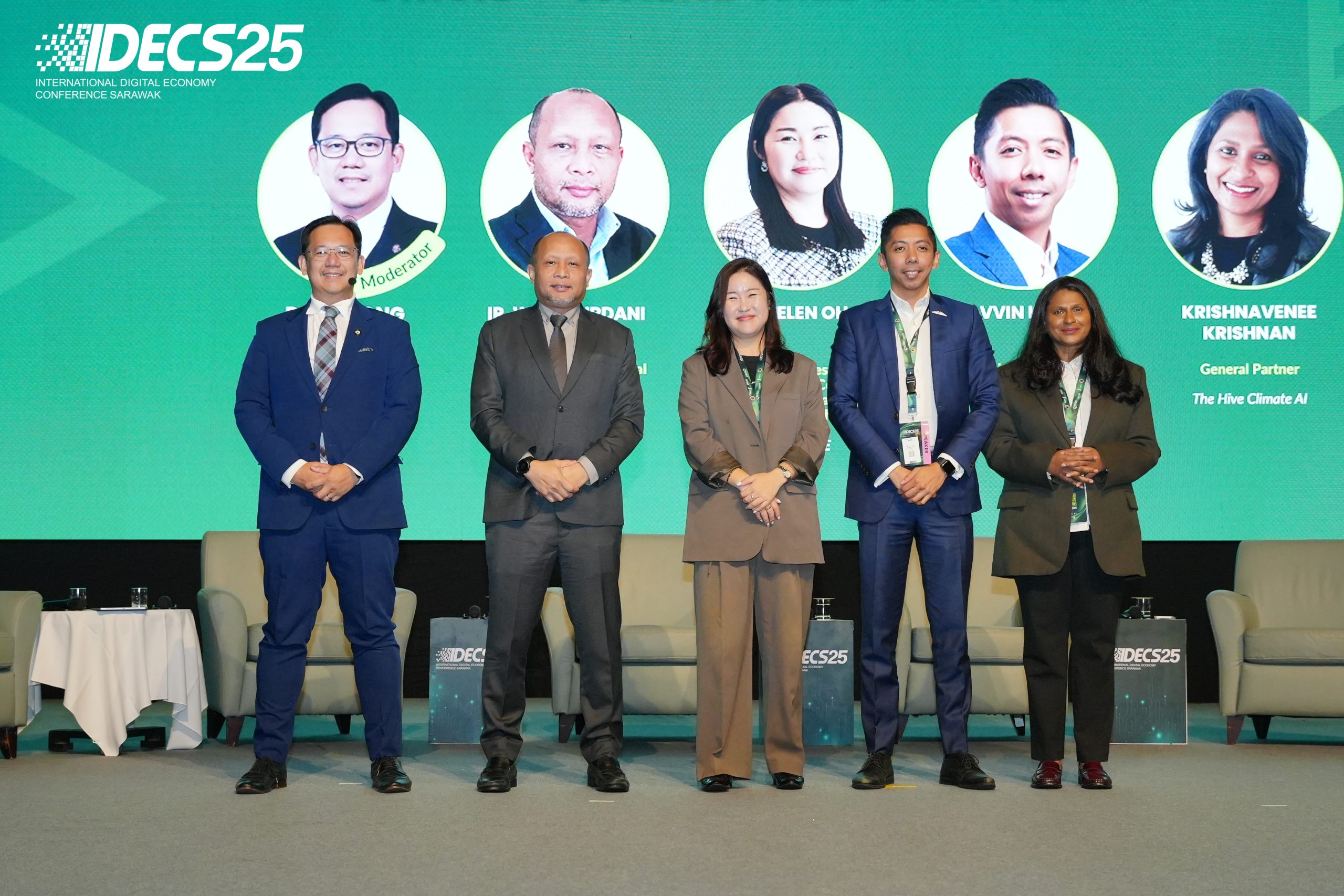
The panel session titled ‘Investing in the Age of AI and Climate Crisis – Where Will Capital Flow?’ at the International Digital Economy Conference Sarawak (IDECS) 2025, held at the Borneo Convention Centre Kuching, brought together Gobi Partners senior director (Investments) Navvin Kumar Kirupanandan; The Hive Climate AI general partner Krishnavenee Krishnan; Malaysia Digital Economy Corporation (MDEC) vice president Wan Murdani Mohamad; and Australian Trade and Investment Commission Trade and Investment commissioner & councillor (Commercial) Helen Oh, moderated by Ministry of Education, Innovation and Talent Development Sarawak Head of Innovation Cheong Yaw Liang.
The panellists said capital is now chasing proof over promises, warning that only startups solving real problems with scalable solutions will attract sustainable investment.

Avoiding hype and chasing fundamentals
Navvin warned against investing in ‘AI for the sake of AI’. He said the recent excitement around the technology mirrors earlier bubbles that left few lasting successes.
“AI companies that are flashy but don’t solve fundamental business problems will not survive. If the business is easily replicated or lacks sound economics, it will fail.
“We saw this in the crypto and blockchain wave where massive investments produced only a handful of sustainable projects,” he said.
He added that Gobi Partners continues to back AI ventures that create tangible value and sustainable returns. “We look for companies that contribute to real ecosystems.
For instance, our investment in semiconductor design house SkyChip supports high-performance computing, which in turn enables AI development.
“In every gold rush, the ones who profit most are those who sell shovels.”
Climate tech must prove measurable impact
Addressing the intersection between AI and climate, Krishnavenee said climate-focused startups must move beyond slogans to demonstrate measurable carbon reductions and reliable data.

“In the age of AI, the greenest bot is the one we don’t use. We see many Me-Too startups that simply label themselves ‘AI-powered’ or ‘climatefocused’ without showing how they actually reduce emissions.
Common sense must prevail,” she said. She explained that genuine climate innovation rests on three principles: meters, math, and think power.
“If you can’t measure it, you can’t prove it. Startups need reliable data, credible baselines, and adherence to global standards such as the GDG protocols.
“If your kilowatt-hour consumption does not go down, it’s not a climate solution, it’s just a demo.”
She urged investors to consider rebound effects, which occur when efficiency gains are offset by increased consumption, and to assess whether startups use renewable energy across their operations.
“If a startup can show measurable reductions, net positive climate impact, and cleaner energy use, it’s investable,” she said, pointing to examples such as BrainBox AI, which reduces building energy use, and Google DeepMind’s AI-driven cooling system that cuts energy by 40 per cent.
Balancing fast profits with deep-tech patience
When asked whether venture funds prefer fast-return software or long-horizon deep-tech projects, Navvin said timing and market maturity determine investment strategy.
“There’s no single answer. Fastgrowth areas like e-commerce demand speed and dominance, while deep-tech sectors such as biotech and health tech require patience and strong moats.
“Venture capital is inherently high risk and high return. Out of 20 companies we invest in, only one to three will deliver outsized returns that cover the rest,” he said.
He said regional expansion is crucial for Malaysian startups to achieve scale.
“If you only serve Malaysia’s 31 million people, of which maybe a third are serviceable, you’ll struggle to achieve 20-times returns.
“Founders must think regionally towards Indonesia, Thailand, Vietnam, and beyond,” he added.
Creative financing and tokenisation
Krishnavenee said funding remains the biggest obstacle for climate and AI ventures, especially during the ‘valley of death’ between early startup and growth stages. She shared her experience as co-founder of a digital tokenisation platform licensed by the Securities Commission Malaysia.
“Startups must first secure customers and cash flow. A project becomes bankable when there is an off-take agreement or buyer committed to purchasing its output.
“We’ve seen how structured financing and tokenisation can crowd in capital and make climate projects viable,” she said.
She noted that Malaysia’s green and Sustainable and Responsible Investment (SRI) bonds are on an upward trend but remain costly to issue.
“Reducing compliance and reporting costs through digitisation can lower financing costs by 20 to 30 per cent.
The more affordable it becomes, the wider participation we can achieve.”
She urged corporates and investors to play a more active role in funding sustainable innovation.
“We need more corporate capital crowding in, similar to the Frontier Project led by Stripe, Meta, and Google. “When large players commit to buying verified climate outcomes, they provide the safety net startups need to scale.”
Government support for AI development
From the policy perspective, Wan Murdani identified three key enablers Malaysia must strengthen to grow its AI ecosystem: computing infrastructure, data accessibility, and talent readiness.
“AI model development requires affordable compute power and trusted data.

The government’s push to attract hyperscalers and open-data policies aims to make these resources more accessible to startups.
“Malaysia has also approved a national data-sharing policy to govern privacy and security while allowing responsible use for innovation,” he said.
He said Malaysia Digital Economy Corporation (MDEC) works closely with practitioners to define emerging skills and coordinate talent development programmes aligned with Malaysia’s goal of raising the digital economy’s contribution to 30 per cent of Gross Domestic Product (GDP) by 2030.
He also pointed out that slow financial processes discourage foreign venture capital.
“Bringing Venture Capital (VC) funds into Malaysia can take 40 to 50 days. If we can make this faster and more transparent, we’ll attract more capital and strengthen our ecosystem,” he said.
Bridging investment and promotion gaps
Representing Australia’s perspective, Oh said the country’s strong superannuation funds have helped sustain its domestic investment base, but emerging sectors such as hydrogen, batteries, and maritime decarbonisation still struggle with promotion.
“We don’t have a shortage of money.
What we need is better storytelling and promotion for our new industries.
Some of the challenges faced by Malaysian and Sarawakian startups are similar, good ideas that are not well communicated,” she said. Oh noted that many Asian founders fail to tailor their pitches to global markets.
“Some founders are excellent, but others talk for an hour and you still don’t know what they are selling.
“The best founders understand their target customers, localise their message, and show how their solution scales.”
Her team runs boot camps for Australian firms expanding into Southeast Asia, helping them understand local competition, investor expectations, and cultural nuances. “A good pitch tells a story, not a list of technical features.
Communication is what connects innovation to capital,” she said.
The RISC framework for global founders Sharing advice for founders seeking to internationalise, Oh introduced her RISC framework: Risk, Interoperability, Scalability, and Communication.
“Understand your risk profile and be proactive in managing it. Ensure your product is interoperable across markets, think about scalability beyond a single use case, and communicate clearly without jargon.
“Investors and customers must immediately see how your product fits into their environment,” she said.
Proof, purpose, and perseverance
Advising founders navigating a complex funding landscape, Wan Murdani urged entrepreneurs to focus on solving genuine problems.
“Venture capitalists (VCs) have different mandates, but they all seek clarity of purpose and market relevance. Founders must demonstrate how their solutions address real challenges,” he said.
Krishnavenee emphasised that innovation thrives where risk-taking is supported.
“In Silicon Valley, people wear failure as a badge of honour. We need policy safety nets that allow our entrepreneurs to take risks and recover. Malaysia has the talent; we just need the enablers,” she said.
She added that founders must know their purpose, understand their profit model, and have perseverance.
“Building a company is a marathon. It takes endurance.”
Navvin concluded with one word: proof. “When you meet investors, don’t just tell a story. Prove it.
Prove that you have traction, validation, and a scalable model. When there is proof, capital flows.”