KUALA LUMPUR: As the water cannons disappeared into oblivion and the crowds have dispersed from Bukit Bintang, the Rain Rave Water Music Festival 2026 has left behind far more than viral videos and drenched streets.
The three-day festival, held from April 30 to May 2 in conjunction with the Labour Day holiday and Visit Malaysia 2026, has since evolved into a broader national conversation on tourism, economic opportunities, public sensitivities, and the realities of balancing entertainment with cultural expectations in a multicultural society.
Featuring live music performances, water-themed activities, cultural showcases, food vendors and entertainment acts, the festival transformed one of Kuala Lumpur’s busiest commercial districts into a massive open-air celebration that drew huge crowds throughout the extended weekend.
Despite criticism from certain quarters, Tourism, Arts and Culture Minister, Datuk Seri Tiong King Sing, proceeded with the event, maintaining that the programme was intended to stimulate tourism, support businesses, and inject vibrancy into the city centre during what is typically considered a slower tourism period.
Since then, tourism industry players have largely viewed the festival as a success from an economic perspective.
Bukit Bintang-KLCC Tourism Association’s Chairman, Ng Yih Chen, said the unusually large turnout welcomed spillover effects to businesses operating within the city’s tourism belt.
“We usually see such crowds only during peak seasons, which begin in November right up to Hari Raya Aidilfitri. The current month is relatively low, so the increased footfall was a welcome boost,” he said.
According to Ng, food and beverage operators were among the biggest beneficiaries from the festival, while nearby hotels, convenience stores and retailers also experienced increased activity throughout the three-day programme.
Meanwhile, Malaysian Inbound Tourism Association’s President, Mint Leong, claimed the festival attracted approximately 180,000 visitors and generated more than RM200 million in tourism revenue while also recording 1.4 billion social media impressions globally.
“If this form of traffic-driven economy can be effectively transformed into tangible outcomes in the short term, its impact on Malaysia’s national branding, international visibility, and future tourist conversion potential should not be underestimated,” she said.
The Malaysian Artistes’ Association (Karyawan) also defended the festival, noting that events of such scale played an important role in attracting both domestic and international visitors while strengthening Malaysia’s tourism and entertainment ecosystem.
Online reactions throughout the festival reflected the wide spectrum of opinions Malaysians hold regarding large-scale public entertainment events.
Some social media users praised Tiong for proceeding with the programme despite criticism, viewing the move as an example of decisive leadership in pushing tourism-driven initiatives.
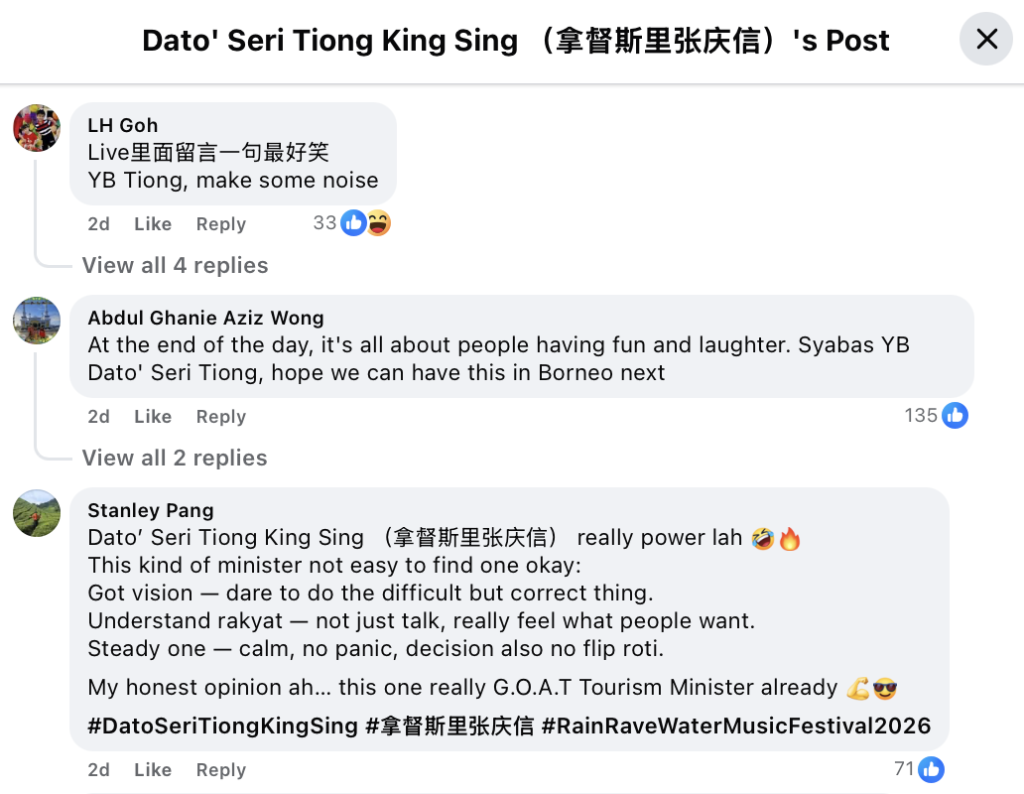
A user identified as Stanley Pang described Tiong as a minister with vision who understood the rakyat and was willing to make difficult decisions.
“This kind of minister is not easy to find. Got vision, understands the rakyat and remains steady,” he wrote, even describing Tiong as the “G.O.A.T Tourism Minister”.
Others focused on the economic ripple effects generated by the festival.
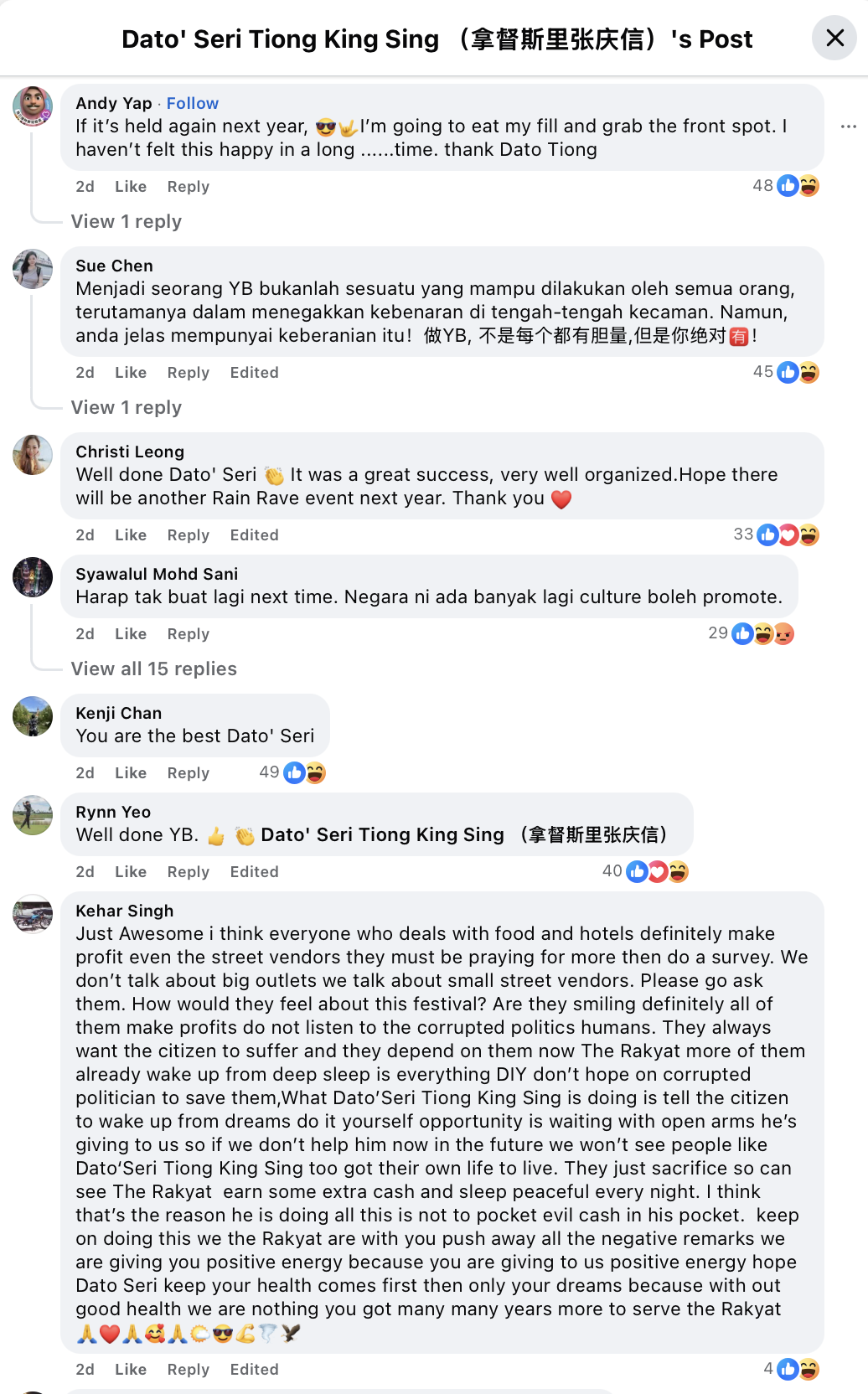
A social media user identified as Kehar Singh argued that many small traders, food vendors and street operators likely benefited significantly from the crowd turnout.
“Everyone who deals with food and hotels definitely made profit, even the street vendors. Go ask them how they feel about this festival. I believe many of them are smiling because they made profits,” he commented.
Meanwhile, attendees such as Gloria G, who travelled from Sarawak for the event, praised the multicultural atmosphere created during the festival.
“I saw locals and tourists vibing together and simply enjoying the atmosphere. I would love to come again and relive it,” she said.
Similarly, Dorothy Kam congratulated organisers for what she described as a well-coordinated programme involving agencies, performers and stakeholders.
However, criticism surrounding the festival also remained strong.
Some Malaysians questioned whether such programmes were suitable within Malaysia’s cultural and religious landscape, particularly when organised openly in highly public urban spaces.
Several social media users even suggested that such events would be more acceptable in Sabah and Sarawak, which they described as being generally more open towards social and entertainment-based programmes.
A user identified as Imran Jamaluddin commented that such events should instead be organised in Sarawak, while another user, Janice Yee, remarked that people in Sabah and Sarawak were generally “more open” towards such activities.
Ultimately, the Rain Rave Water Music Festival 2026 became more than just a tourism event.
For supporters, it represented economic opportunity, multicultural celebration, and a modern approach towards tourism promotion.
For critics, it raised deeper questions surrounding morality, public behaviour and the direction of entertainment culture in Malaysia.
Yet perhaps the clearest takeaway from the festival is how tourism today extends far beyond visitor numbers and hotel occupancy rates.
It now sits at the intersection of economics, identity, culture, public comfort and societal values – all of which continue to shape the evolving conversation on what modern Malaysian tourism should look like moving forward.