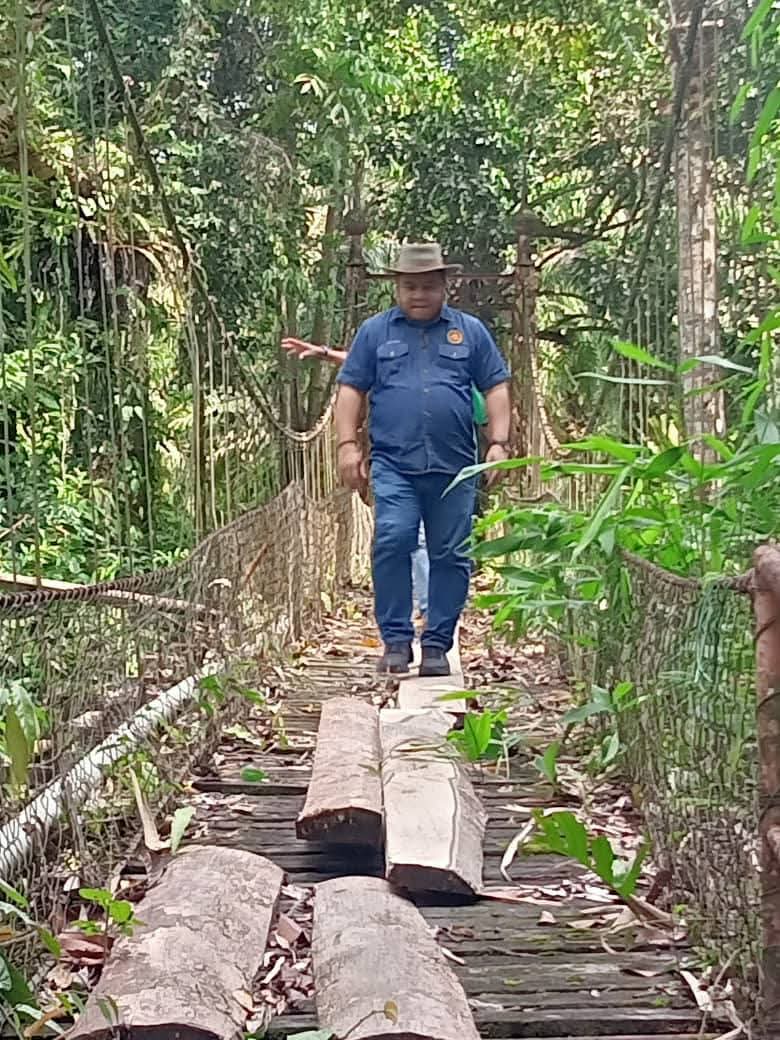
THE century-old Red Bridge at Dahan Estate, Kampung Seropak, Bau, is set to take on new life as a tourism destination, following fresh plans to preserve and promote the landmark as part of Bau’s cultural and eco-tourism circuit.
Hidden amid the lush greenery of Kampung Seropak, the bridge has quietly stood for more than 120 years.
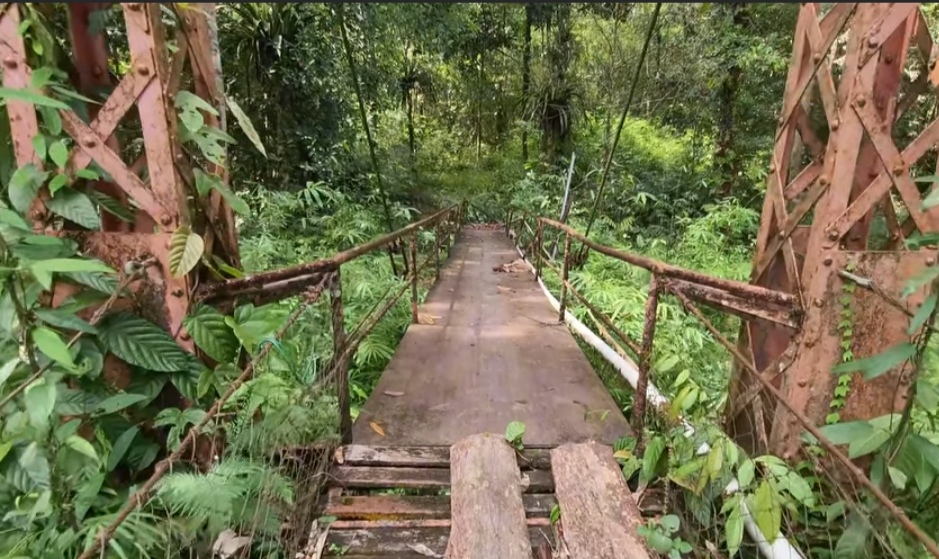
Believed to be built by Harpers Limited of Aberdeen, the steel suspension bridge was designed by British engineer Louis Harper to connect the former Dahan and Puak rubber estates along Tegora Road.
For decades, the bridge served as a vital crossing for estate workers travelling between the mines, plantations, and settlements around Bau — an area once known for its gold and rubber production during the colonial era.
Serembu assemblyman Dato Miro Simuh said according to Dr Douglas Harper, one of the grandchildren of the engineer behind its construction, the hanging bridge was built between 1903 and 1904.
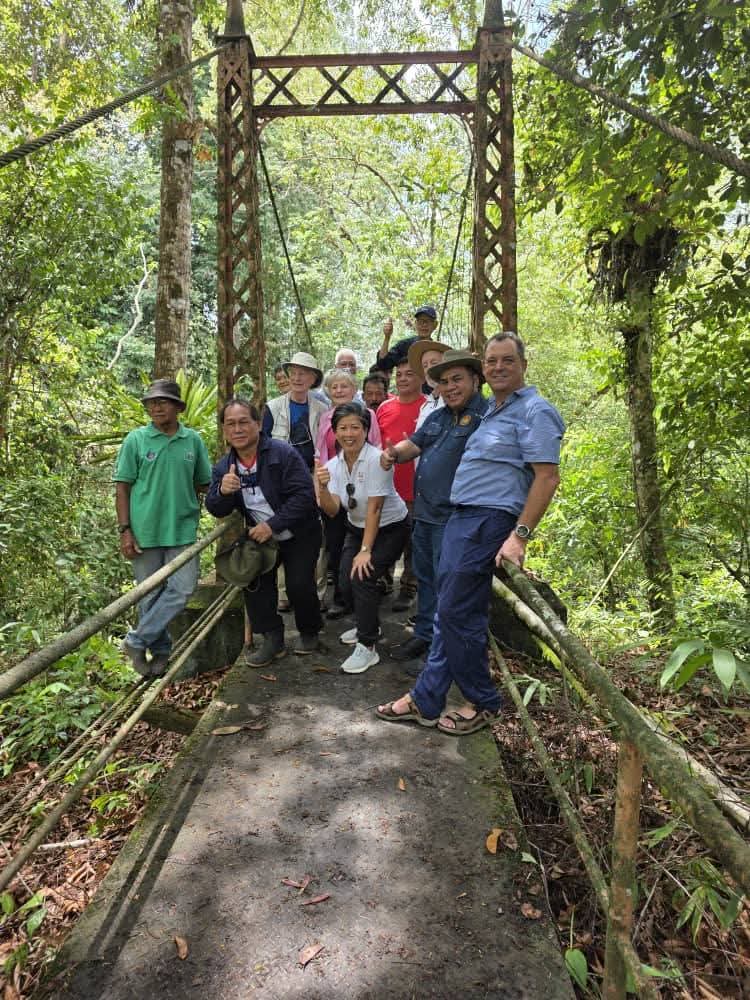
He said he had accompanied Harper, who came over to Kuching recently, to the site to see the current condition of the bridge.
He said the bridge was built to enable people to go to the other side of the river to do gold and antimony or mercury mining as well as to manage the rubber plantation.
“Initially, the Birtish had opened up the area called Tegora to do antimony and gold mining; the bridge then was used to go across the river to get to the mining site.
“However, there was not much gold and antimony there to turn the place into an industrial area and so then they opened up the rubber plantation under Dahan Estate,” he said.
In the early1940s, the Japanese occupied Sarawak, and during the Japanese occupation, the bridge was said to have been refurbished to facilitate access to the Tegora Mine, where mining operations were briefly revived under wartime control.
Miro said the Japanese took over the mine because they was a lot of antimony or mercury for them to make bombs.
“Mercury is a very good injector or device for bomb; it’s explosive. So the Japanese dug for a lot of antimony because they wanted to use it as a device for bombs.
“After the Japanese occupation, the Red Bridge was used to go to the Dahan rubber estate, which is about five kilometres from Tegora, the former antimony mining area,” he said.
Miro said its sturdy iron frame, a marvel of early twentieth-century engineering, allowed the bridge to withstand the test of time, even surviving World War II.
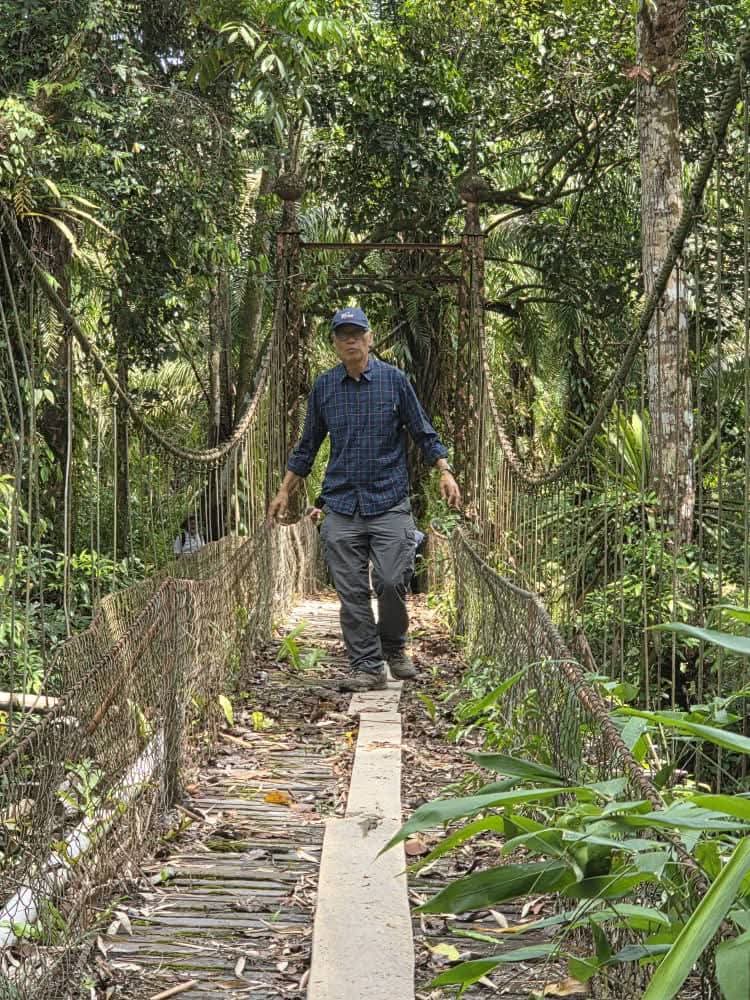
Today, the weathered red structure remains largely intact, bearing silent witness to more than a century of Bau’s industrial and social evolution.
“This bridge is more than just steel and rivets — it’s a living monument to the people who built Bau’s early economy.
“Turning it into a tourism or heritage site will allow visitors to appreciate the area’s history while supporting our community’s livelihood,” he said.
Miro said he first visited the site where the bridge was located about 10 years ago when he was still the personal assistant to the late Deputy Tourism Minister Datuk Seri Dr James Dawos Mamit.
He recalled that from that visit, he saw the potential to turn the century-old bridge into a tourism product.
“With the government allocation for Dawos, we repaired the bridge. But now, it’s back to a dilapidated condition.
“After visiting the bridge with Harper and some representatives from Sarawak Heritage Society, we want to conserve the original bridge while enhancing its surroundings for visitors,” he said.
“From our discussion on that day, I might need about RM300,000 to refurbish it. I will allocate some funds under my rural transformation programme (RTP) to get it done next year, may be not to turn it into a historical site but just another tourism product for people to see,” he said.
Miro, however, also did not rule out the possibility of rebuilding the bridge under the State Heritage Act because anything that is built before 1940 is considered heritage in Sarawak.
He noted that the Red Bridge is considered a heritage and thus should fall under the State’s Heritage Act.
He assured that even if the bridge were to be refurbished under the Heritage Act, the kampung people can still use it to go across the river to their farmland.
Miro said after they refurbished it, they may create a good jungle track to Tegora, which is another historical site.
“Aside from the Red Bridge, we will also have to build another new small bridge in front there; after that we will think of how to promote it into a tourist destination or a heritage tourism product,” he said.
“I know heritage tourism is growing rapidly, and we believe the Red Bridge can be a key part of Bau’s tourism identity.
“Whatever it is, we hope this development will bring jobs for our community especially youth, from guiding visitors to selling local crafts and food,” he said.
Miro said the original was special given that it was a fabricated bridge – fabricated in Scotland, adding that the parts were brought in to Sarawak by ship and installed at the site.
“I was told that it took them about six months to install the parts into a bridge. Imagine there was no road during that time. It is quite impossible to see, but they made it possible.
“Personally, I trust all the steel during those days. After over 100 years, even though without maintenance, it still stands tall; still can be used,” he said.
The revitalisation of the Red Bridge is seen as part of the broader plan to position Bau as Sarawak’s “Heritage Gateway.”
The district already boasts a rich collection of natural and cultural sites, including the Gua Hantu (Ghost Cave), the Old District Officer’s Bungalow, the Bau Reservoir, and the Old Gold Mining Museum.
By connecting these places through thematic heritage trails, Bau can create a unique visitor experience that blends history, culture, and nature.
Once restored, the Red Bridge could attract a new generation of visitors, historians, and photographers eager to explore Bau’s lesser-known heritage corners.