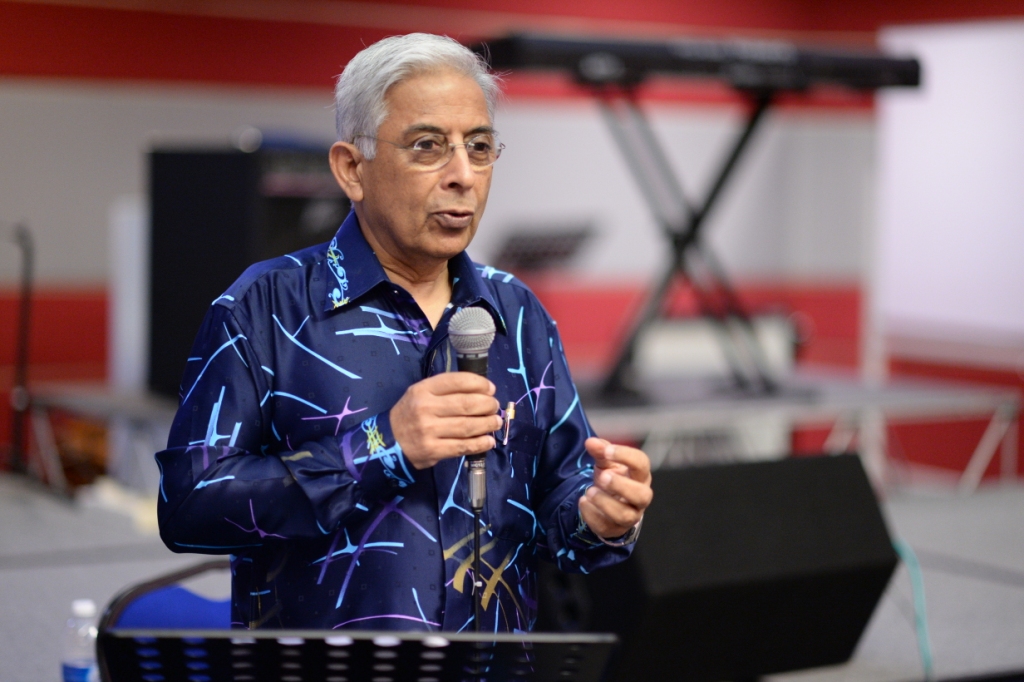
KUALA LUMPUR: Sabah’s constitutional entitlement to 40 per cent of federal revenue derived from the state remains intact, despite recent legal developments, according to constitutional expert, Emeritus Professor Datuk Dr Shad Saleem Faruqi.
He said the decision by the Court of Appeal to stay earlier High Court directives does not negate Sabah’s rights but instead provides the federal government additional time to determine the appropriate amount through proper mechanisms.
“Sabah is indeed entitled to this 40 per cent claim. The Court of Appeal has not denied Sabah’s right.
“Basically, what it has done is it has given the federal government more time to negotiate, calculate and pay,” he said in a telephone interview on ‘Malaysia’s Sabah’s Revenue Claim: Process Principles and the Way Forward’ on BERNAMA World programme, hosted by Gerard Ratnam on BERNAMA TV.
He explained that the federal government is not disputing Sabah’s entitlement, which is rooted in Articles 112C and 112D of the Federal Constitution, which outline Sabah’s entitlement to 40 per cent of net revenue growth derived from the state, benchmarked against a 1963 base year, but is seeking time due to the complexity of the fiscal calculations involved.
However, Shad cautioned that the provision is often misunderstood.
“It is widely believed that Sabah is entitled to 40 per cent of total federal earnings from the state. That is not entirely correct. It is an oversimplification,” he said.
He clarified that the entitlement is based on revenue growth compared to a 1963 baseline, rather than total revenue, with prior payments to the state taken into account.
“Sabah is entitled to 40 per cent of the net revenue growth when compared to the base year 1963,” he said, adding that “the amounts already received by the state… are allowed to be deducted”.
He stressed that the Constitution requires structured negotiations and periodic reviews.
He stressed that the Constitution requires structured negotiations and periodic reviews.
“The federal government must sit down and negotiate with Sabah on the amount due, with reviews conducted every five years. If no agreement is reached, an independent assessor may be appointed,” he said.
On historical implementation, he noted that past practices may not have fully adhered to constitutional requirements.
“For reasons that remain unclear, federal revenue was no longer distinctly segregated. From 1974 to 2021, Sabah instead received fixed annual grants,” he said.
Looking ahead, Shad expressed optimism that resolving the issue in accordance with constitutional principles would strengthen Malaysia’s federal system.
“A federal system that remains loyal to the Constitution has a far better chance of survival and progress,” he said, adding that any similar claims by other states must also be grounded in constitutional provisions.
On October 17 last year, the Kota Kinabalu High Court ruled that the federal government had acted unlawfully by failing to fulfil Sabah’s 40 per cent revenue entitlement between 1974 and 2021.
The court allowed a judicial review application by the Sabah Law Society and ordered both the federal and Sabah governments to review the entitlement within 90 days and reach a final agreement within 180 days.
However, the Court of Appeal has since granted a stay of that order pending the outcome of an appeal, with a three-member bench led by Judge Datuk Mohamed Zaini Mazlan ruling that special circumstances justified the decision.
“We are satisfied that special circumstances have been established. The applicant (federal government) would suffer prejudice if a stay is refused, and the appeal may be rendered nugatory,” he said in the judgment. – BERNAMA