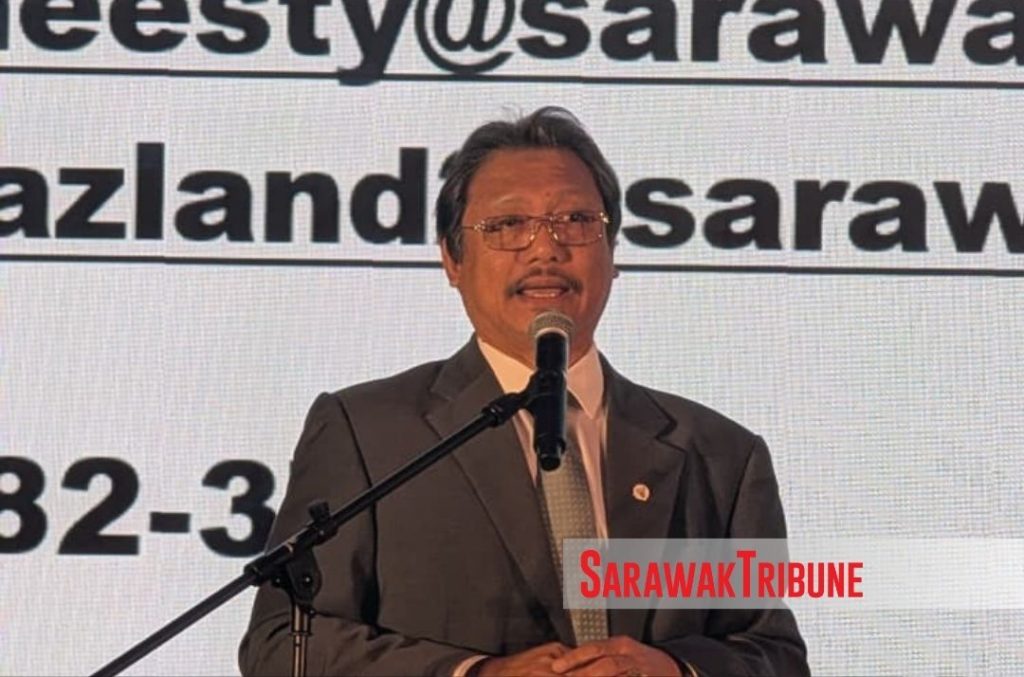
KUCHING: Sarawak’s shift towards a fully green economy is anchored on four fundamental frameworks that must be firmly in place before any major initiative can move forward, said Deputy Minister of Energy and Environmental Sustainability Datuk Dr Hazland Abang Hipni.
He said these frameworks, namely legal, technical, financial and human resource development, collectively form the architecture of Sarawak’s long-term sustainability strategy.
The legal framework, he said, forms the backbone of Sarawak’s green push, noting that amendments to existing laws such as the Forests Ordinance and Land Code are necessary, alongside the creation of new legislation.
“We have to amend our laws, our forest ordinance, our land code, and create new laws such as the Environment (Reduction of Greenhouse Gases Emissions) Ordinance 2023.
“We also need new rules, new verification and certification bodies, and even new subsidies. This is one of the latest subsidies, especially for solar, which is offered by Sarawak Energy.
“A subsidy of up to RM12,000, which is the highest in Malaysia for anybody to fix their rooftop solar through the net energy metering” he said in his speech at the Green Energy Dialogue & Dinner at UNIFOR Complex here on Wednesday.
Moving on to the technical framework, Dr Hazland said Sarawak has proven its engineering capabilities since constructing its first hydroelectric dam in 1985.
Where expertise is lacking, he said collaboration with technical partners — such as those involved with — remains essential.
The financial, taxation and business framework, however, remains one of the biggest hurdles.
“A lot of financial institutions are still quite reluctant to finance green projects. But my ministry is working on new ideas, including blended financing, to assist those who want to participate in the green economy.”
He added that the final pillar — the human resource development framework — is crucial to prepare Sarawak’s youth for future roles in hydrogen production, autonomous rapid transit systems and solar installation.
Sarawak, he said, is working closely with the local universities such as Centre for Technology Excellence Sarawak (CENTEXS, i-CATS University College and others to increase the number of skilled installers and technicians.
“Sarawak is ready. We have prepared all these frameworks with the common intention of mitigating climate change while creating new revenue for the state and its people,” he said.