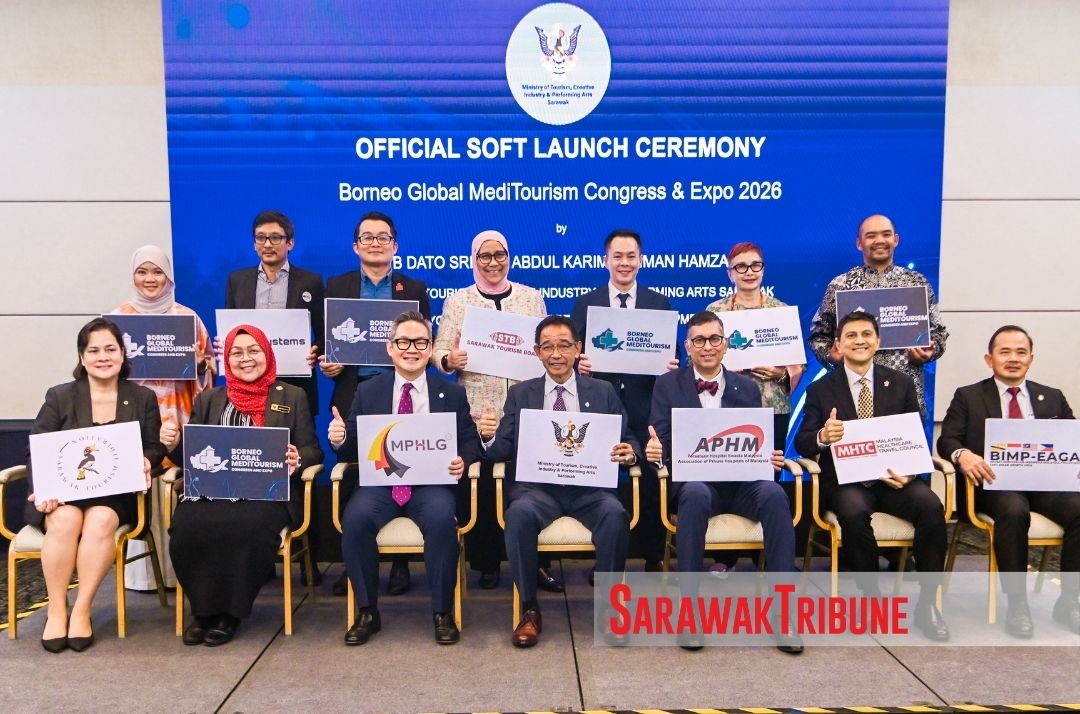
KUCHING: Sarawak is positioning itself as a regional gateway for healthcare services as the state records a steady rise in international patients seeking treatment, particularly from neighbouring Indonesia and Brunei.
Minister for Tourism, Creative Industry and Performing Arts, Datuk Seri Abdul Karim Rahman Hamzah, said the state has seen strong growth in medical tourism over the past few years, reflecting growing confidence in Sarawak’s healthcare facilities.
He said the Borneo Global Medical Tourism Congress and Expo 2026, scheduled to be held on October 12-13 at the Borneo Convention Centre Kuching (BCCK), aims to further strengthen Sarawak’s position in the medical tourism sector.
“This is an inaugural event. Sarawak is becoming an important destination for medical tourism, and we can clearly see the growth in the number of patients coming here,” he said during a press conference after the soft launch of the Borneo Global Medical Tourism Congress and Expo 2026 at BCCK today.
Abdul Karim noted that despite Kuching having a relatively small population of about 700,000, or around 800,000 including Samarahan, the city already has several private hospitals.
“Kuching alone has about five private hospitals. The reason is not just to cater for the local population but also for patients coming from outside Sarawak and Malaysia,” he said.
He said the number of medical tourists visiting Sarawak has increased significantly over the past few years.
“In 2023, Sarawak recorded 64,393 medical tourists seeking treatment in Kuching, Miri, Bintulu and Sibu.
“In 2024, the number increased to 76,796, and in 2025 it jumped to more than 104,000,” he said.
According to him, the growing demand reflects strong confidence in Sarawak’s medical facilities among both locals and foreign patients.
“When people seek treatment for their parents or loved ones, they always want the best facilities.
“If they feel the treatment elsewhere is not suitable, they will look for better options, and Sarawak is becoming one of those choices,” he said.
Abdul Karim said medical tourism contributes not only to hospitals but also to the broader tourism and hospitality ecosystem.
“When a patient comes for treatment, they are usually accompanied by family members. They may stay for weeks or even months for treatment and recovery.
“This benefits hotels, service apartments, restaurants, transport companies and other tourism-related businesses,” he said.
He added that the sector also aligns with Sarawak’s broader tourism strategy, which emphasises high-value tourism segments including wellness, long-stay travel and business events.
Globally, medical tourism has become a multi-billion-dollar industry, with Malaysia emerging as one of Asia’s leading healthcare travel destinations.
Abdul Karim said Sarawak has a strategic advantage due to its geographical proximity to Kalimantan and strong regional connectivity with Indonesia.
“Our proximity to Kalimantan places Sarawak in a unique position to serve as a medical gateway for Borneo,” he said.
He added that improving connectivity, including regional air links and transportation infrastructure, will further support the sector’s growth.
He also stressed the importance of collaboration between hospitals, tourism stakeholders, facilitators and policymakers to build a strong medical tourism ecosystem.
“Medical tourism thrives on partnerships. Hospitals, tourism players and policymakers must work together to create an integrated ecosystem that attracts international patients,” he said.