KUCHING: Sarawak will capitalise on both its natural resources and strategic strengths to strengthen its position as a leading renewable energy producer, particularly in green hydrogen, while reducing dependence on oil and gas amid growing global energy and geopolitical challenges.
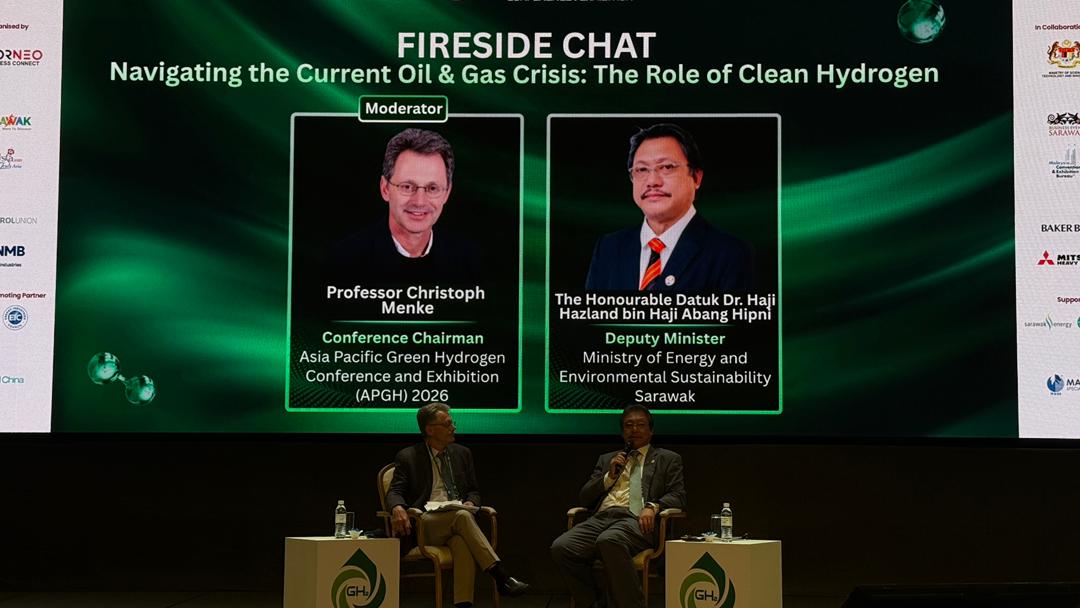
Deputy Minister of Energy and Environmental Sustainability Datuk Dr Hazland Hipni said the state is well positioned to leverage its abundant hydropower resources, vast landmass, forests, rivers and biomass to support its long-term energy transition agenda.
He said the world is facing an energy crisis and increasing geopolitical tensions, which are affecting economies and creating disruptions to people’s livelihoods.
“We need to strategise. If possible, the whole world will need to strategise, and to learn, unlearn and relearn from the latest energy crisis, and to reduce our dependency on oil and gas,” he said this during the Fireside Chat titled “Navigating the Current Oil and Gas Crisis: The Role of Clean Hydrogen” held in conjunction with the Asia Pacific Green Hydrogen Conference and Exhibition (APGH) 2026 at the Borneo Convention Centre Kuching (BCCK) here today (June 9).
The session was moderated by Professor Christoph Menke, conference chairman of APGH 2026.
While acknowledging that Sarawak and several other nations are both petroleum and electricity producers, he stressed the importance of reducing reliance on hydrocarbons to mitigate the impact of future geopolitical and geo-economic uncertainties.
He said the oil and gas industry should expand research into alternative uses of petroleum products, including petrochemicals, composite materials, fabrics and cosmetics, to diversify the sector while lowering carbon emissions.
On Sarawak’s energy strengths, Dr Hazland said the state is blessed with abundant natural resources, including extensive forests, rivers and land suitable for renewable energy development.
He said that Sarawak’s major hydroelectric dams currently generate about over 3,000 megawatts (MW) of electricity, with plans to further increase hydropower capacity through cascading dams and pumped hydro projects.
“It is possible for us to increase our installed capacity from the current 5.8 gigawatts to 10 gigawatts by 2030, and eventually to 15 gigawatts by 2035,” he said.
Apart from hydropower, he said Sarawak is also exploring biomass energy from municipal, agricultural and food waste, with waste-to-energy projects expected to be implemented within the next two to three years.
According to Dr Hazland, these resources enable Sarawak to play a dual role as both a petro-nation and an electro-nation, giving it a unique advantage in the global energy transition.
“We will capitalize on both strengths, on both the natural resources and on both the strategies,” he said.
He added that countries in the Asia-Pacific region should adopt a common geo-strategy centred on renewable energy, particularly hydrogen, noting that Sarawak’s abundant water resources and hydropower capabilities place it in a strong position to produce green hydrogen on a larger scale than many other countries.