BY NATASHA JEE & SHARIFAH NONG-JASIMA
KOTA SAMARAHAN: The courage of Sarawak’s leadership in fighting for its rights as enshrined in the Malaysia Agreement 1963 (MA63) is seen as a symbol of the state’s dignity and integrity, not an excessive demand.
Head of State, Tun Pehin Sri Dr Wan Junaidi Tuanku Jaafar, said Sarawak’s demands regarding the implementation of MA63 under the leadership of Premier Datuk Patinggi Tan Sri Abang Johari Tun Openg are efforts to reclaim long-neglected rights.
“Our sadness is not because of anything, but that the federal government has failed to assist to implement MA63 since 1963.
“So, people questioned why (Sarawak is) demanding so much now. That is not the case, because over the last 60 years, we never asked for it,” he said.
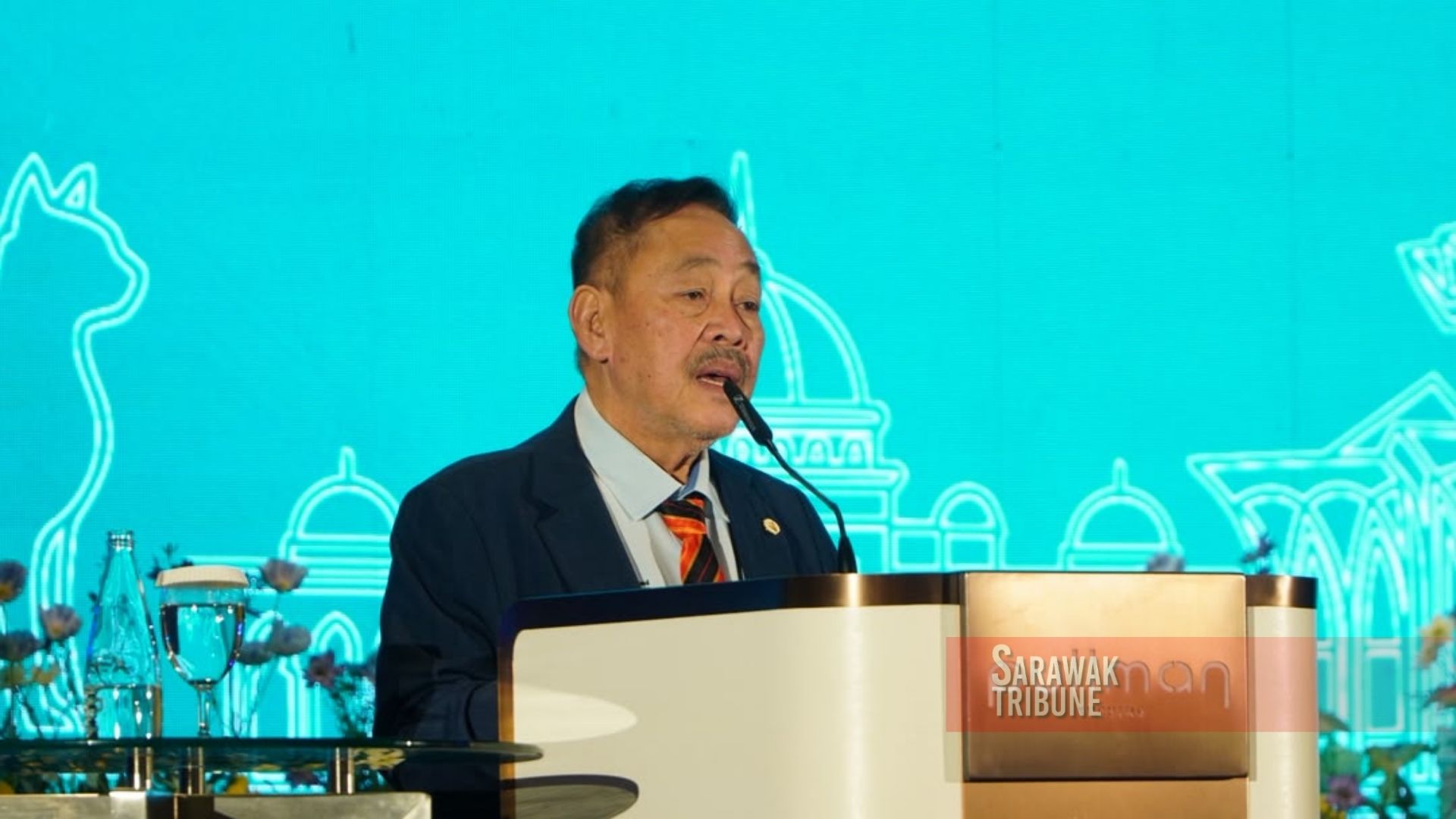
He said this when delivering his Statesman Speech entitled ‘Malaysia Agreement 1963: The Key to Federal Harmony’ at Universiti Malaysia Sarawak (UNIMAS) today.
Wan Junaidi further explained that delays in implementation also stemmed from technical reasons that caused MA63 not to be recognised as it should have been.
“The question often asked of me is, why now and what is the validity of MA63? So, I give you the reason, as in the saying my mother used to tell me, ‘Bila palak matok, baru ekor membelit’.
“This means that if the ‘palak’ (a leader) is truly firm, the people under him can act decisively at any time without worry.
“When the leader shows the way, everyone becomes courageous,” he stressed, noting that the courage of the state’s top leadership has inspired the entire machinery to move in unison.
He added that awareness of MA63 peaked around 2017 and 2018 when the late Chief Minister, Pehin Sri Adenan Satem, boldly raised the issue.
“At that time, awareness was created, but the foundation had not yet been laid. After the foundation was laid, it became clear why some in Peninsular Malaysia were uneasy, because this was something that could not be done for the past 60 years,” he said.
Wan Junaidi also explained that the initiatives also focused on the devolution of powers, whereby certain powers were transferred to the state at its request.
“During the late Adenan’s time, there were 12 devolutions of power,” he said.
He added that the date February 22, 2022, marked a historic milestone that opened a new chapter in federal-state relations.
“For the first time, MA63 was recognised and gazetted as part of the Federal Constitution, and whatever is contained in the IGC Report, we can now state that it is part of the Constitution.
“You cannot deny our rights through that, and that is what our ministers are working on now,” he said.
During a question-and-answer session, Wan Junaidi was asked about the role of youths in sustaining the MA63.
In response, Wan Junaidi said it was vital for young people to understand that the MA63 was an agreement guaranteeing Sarawak’s rights within the federation.
He highlighted several examples of powers that had been taken away over the years, including tourism, the environment, and judicial appointments, and stressed that they must be constitutionally restored.
“Before 1985, the power to appoint a judicial commissioner was given to the Head of State, on the advice of the Chief Minister of Sarawak, both Sarawak and Sabah. But in 1985, they amended the Constitution to centralise it.
“So, the appointment must get a consent from the Head of State. But in 2021, the government agreed and implemented through an administrative arrangement that appointments must have the consent of the Head of State.
“The process is discussed with the Cabinet and once the Cabinet agrees, the Head of State is advised by the Cabinet, then the Head of State will agree, based on the Constitution,” he said.
However, Wan Junaidi said issues may arise through administrative arrangements.
“My explanation is this, if tomorrow they appoint a judicial commissioner in Kuching without going through the proper process, and the Prime Minister says to the Chief Justice, ‘can you just appoint this one’, and recommend the person to be appointed in the commission of the judicial commissioner.
“Once it is endorsed, then I just make a presentation to the Agong. So, there is nothing wrong, no legal implication, nothing wrong legally for that, because the thing is only done administratively,” he said.
“That’s why I insist it must be back to the way it was before 1985, by amending the Constitution, so that nobody can override. Because everybody, when appointed by the government, promises to protect the Constitution.”
Wan Junaidi further pointed out that several constitutional amendments had been made without the consent of Sarawak over the years.
“As I mentioned before, many times have been amended without our consent, and this means ignoring the Constitution.
“Therefore, if you are talking about sustainability, to me, we will have to continue to fight until we get everything promised to us,” he said.