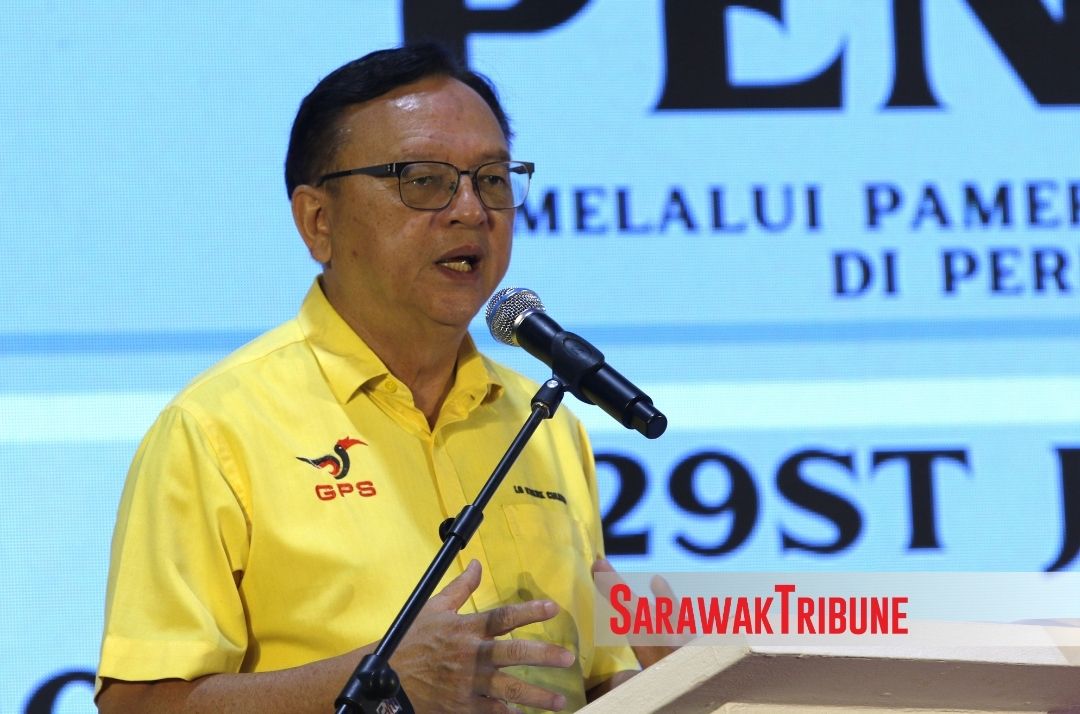
KUCHING: Sarawak United Peoples’ Party (SUPP) Deputy Secretary-General, Datuk Lo Khere Chiang, said the debate over the word “divorce” used by Works Minister, Datuk Seri Alexander Nanta Linggi, should not overshadow Sarawak’s long-standing constitutional concerns under the Malaysia Agreement 1963 (MA63).
Lo made the remarks in response to comments made by former Sabah Chief Minister, Datuk Seri Salleh Said Keruak, on Nanta’s choice of words, emphasising that the focus should remain on Sarawak’s broader constitutional issues.
“To reduce Sarawak’s grievances to semantics is intellectually dishonest and politically evasive. The frustration expressed by Nanta is not rhetoric; it is the accumulated reality of more than 60 years of broken promises,” Lo said in a statement on Sunday (Feb 1).
He stressed that Nanta spoke not out of hostility towards Malaysia, but from a sense of responsibility and historical duty as the grandson of Tun Datuk Patinggi Temenggong Jugah Barieng, who was one of the leaders signing the MA63 on behalf of Sarawak.
“Those who signed the MA63 did not envision Sarawak as a subordinate partner. Yet today, that is precisely what Sarawak has become in practice,” Lo added.
Lo, who is Batu Kitang state assemblyman and SUPP Batu Kitang Branch chairman, highlighted parliamentary representation as a clear sign of structural imbalance, noting that Malaya holds roughly 75 per cent of seats while Sabah and Sarawak together account for barely 25 per cent – a distribution he said blatantly undermines the spirit of the MA63.
“What exactly is there to negotiate? Equal partnership was never meant to be conditional, delayed or diluted,” he said.
He also criticised successive federal administrations for repeatedly pledging to honour the MA63 during election seasons, only for the issue to stagnate once power is secured.
“This cycle of promises has become a political ritual, faithfully recited when votes are needed, and quietly abandoned thereafter,” he said, likening it to other long-standing federal commitments that have yet to materialise.
Beyond constitutional matters, Lo warned against the spillover of racial and religious polarisation from Peninsular Malaysia into Sarawak, stressing that the state protects its harmony deliberately.
“Our harmony is not accidental. It is protected through restraint, moderation and a leadership that refuses to weaponise race or religion for political gain,” he said.
He also revisited historical grievances, highlighting the Petroleum Development Act 1974, which was imposed without the consent of the Sarawak legislature and allegedly stripped the State of control over its oil and gas resources.
“These were not administrative oversights but deliberate centralising decisions that weakened Sarawak’s autonomy,” he said.
Lo said this history explains why Sarawak asserts its rights firmly but lawfully today, anchored in constitutional safeguards, written agreements and documented history rather than emotion or threats.
He reiterated SUPP’s full support for the push by Sarawak Premier, Datuk Patinggi Tan Sri Abang Johari Tun Openg, to institutionalise the study of Sarawak’s history, the MA63 and the Inter-Governmental Committee (IGC) Report in state universities.
“A people who do not understand the agreement that formed this country will never be able to defend it. Education is our long-term defence against distortion and denial. We are not interested in quarrels or distractions.
“Sarawak will defend its constitutional position firmly, lawfully and without apology,” he said.
Lo concluded by echoing Nanta’s call: “We won’t waste time with quarrels. We have only one responsibility: to build a Sarawak that is stronger, fairer and more dignified for generations to come.”