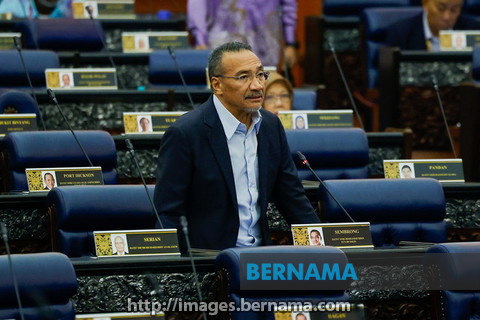
KUALA LUMPUR: The federal financial grants to states must be recognised as a constitutional obligation rather than discretionary assistance, with funding formulas reflecting the differing development realities across Malaysia.
Senator Datuk Ahmad Ibrahim said the grant provided under the Capitation Grant Bill 2026 (D.R. 2/2026) is mandated under the Federal Constitution and forms part of the Federal Government’s responsibility to the states.
“The grant is not a goodwill payment. It is a constitutional responsibility of the Federal Government to the states as provided under Article 109(1)(a) of the Federal Constitution, read together with Part I of the Tenth Schedule,” he said during the debate on the Bill in the Dewan Negara on Wednesday.
He explained that the grant is paid from the Federal Consolidated Fund to assist state governments in carrying out their administrative responsibilities and delivering public services.
However, Ahmad said the current formula, which is based largely on population size, raises questions about whether a simple per capita approach is fair in a federation as geographically and economically diverse as Malaysia.
He noted that states differ widely in terms of geography, population density and development challenges, citing Selangor with over seven million residents and Penang with about 1.8 million, while Sarawak spans roughly 124,450 square kilometres with 2.9 million people, and Sabah covers 73,904 square kilometres with around 3.9 million.
“The cost of building one kilometre of road in an urban centre is very different from constructing roads in remote areas such as Baram, Belaga or Ulu Kapit.
“Similarly, the cost of providing healthcare facilities or infrastructure in remote communities that are accessible only by river or logging roads is significantly higher,” he said.
He stressed that fiscal fairness does not necessarily mean equal allocations, but ensuring that every state has the capacity to deliver comparable levels of basic services to its people.
Ahmad also highlighted that the financial relationship between the Federal Government and the states is rooted in the historical agreements surrounding the formation of Malaysia.
He said these arrangements were shaped through negotiations prior to the formation of Malaysia, particularly the Inter-Governmental Committee (IGC) Report 1962, which laid the groundwork for the constitutional framework governing Sabah and Sarawak when Malaysia was formed in 1963 under the Malaysia Agreement 1963 (MA63).
Under the Federal Constitution, Special Grants are provided to Sabah and Sarawak under Article 112C, while Article 112D requires these grants to be reviewed periodically through negotiations between the Federal and state governments.
Looking ahead, Ahmad proposed that Malaysia consider strengthening its system of fiscal federalism by reviewing the current per capita grant formula to include factors such as state size, service delivery costs and rural development needs.
He also suggested studying fiscal equalisation models used in other federal countries, citing Australia’s Horizontal Fiscal Equalisation, which ensures states have comparable capacity to deliver public services, and Canada’s Equalization Program, which supports provinces with lower fiscal capacity and territories facing higher service delivery costs.
“These models could offer useful insights for strengthening Malaysia’s fiscal federal framework,” he said.
He added that the strength of a federation should not be measured solely by federal spending, but by how fairly development and prosperity are shared across all regions of the country.
“Malaysia was founded on the spirit of partnership. A strong federation is not one that centralises power in one place, but one that balances the needs of all its regions – Peninsular Malaysia, Sabah and Sarawak,” he said.