● This is the first of a two-part series showcasing SMK Medamit, Limbang’s international success with their invention and the role played by Tabung Ekonomi Gagasan Anak Sarawak (TEGAS) in making it possible.
WHAT started as a concern over food waste and the lack of food among the underprivileged in Limbang’s local communities quickly evolved into a solution-driven idea – one that eventually propelled SMK Medamit’s students onto the world stage with their invention.
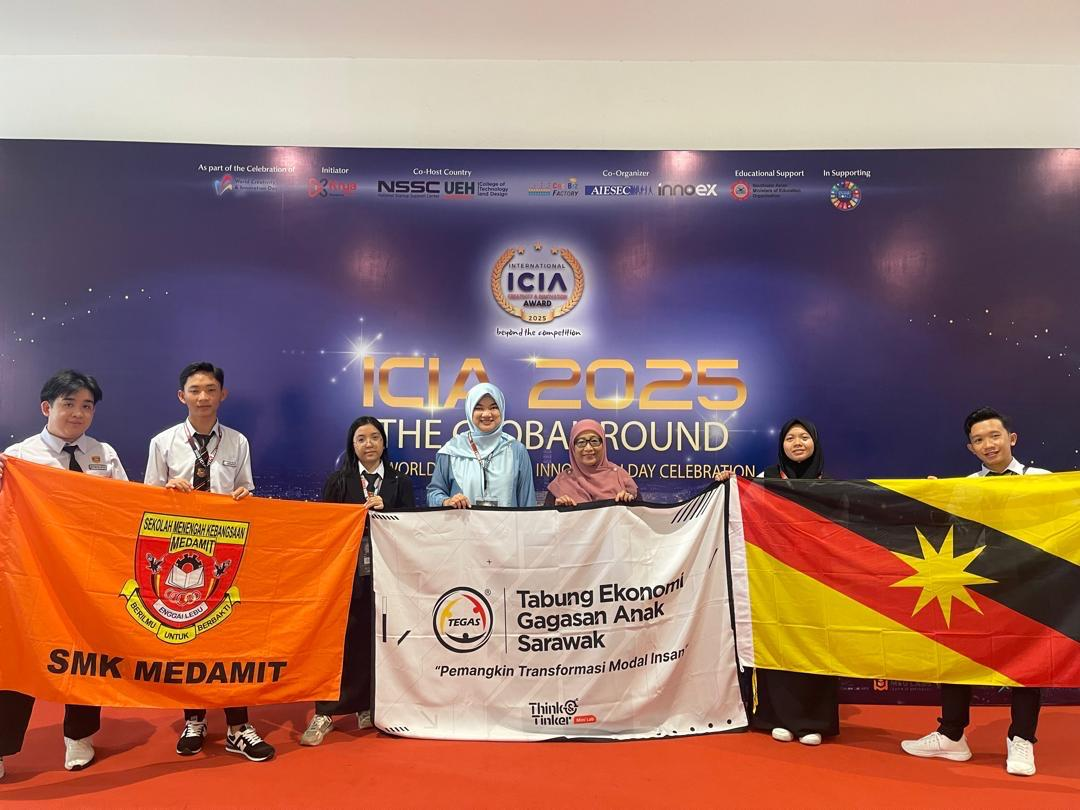
This is the story of how students and a teacher from SMK Medamit, Limbang, came together in a shared effort that brought pride to Sarawak at the International Creativity and Innovation Award (ICIA) 2025 in Vietnam, where they won Bronze and Silver in the Innovation Challenge category.
How it all started
For teacher Nur Izzaitul Fitri Zambia, the idea came quite naturally through her students’ everyday experience in the village.
She noted that her students were highly observant and often discussed the struggles faced by their families and community. During one STEM club session, their concerns sparked a meaningful conversation that set things in motion.
“It was simple, meaningful and driven by their desire to help; that’s how the project began,” she told Sarawak Tribune.
Meanwhile, Devxron Sylvio Simon, one of the students, shared that the team was motivated to participate by their desire to raise awareness about food waste and hunger in their local communities.

“We believe that technology could help solve this problem. Our project was a food exchange platform; a mobile and web-based system that connects individuals, restaurants and stores with surplus food, to those in need. It helps reduce food waste and supports the underprivileged,” he said.
What began as a raw concept eventually evolved into a refined, competition-ready innovation – thanks to careful guidance and structured support provided by Nur Izzaitul and her fellow colleagues.
The team’s journey started with a simple brainstorming session. From there, students were introduced to key problem-solving techniques such as design thinking, sketching, and basic research.
“We guided them step by step – from shaping their initial idea to helping them visualise and improve it. We didn’t want them to just compete; we wanted them to grow through the process,” she said.
With the help of mentors and regular mini pitch sessions, Devxron and his team members gradually sharpened their concept.
Each week, their confidence grew along with the clarity of their innovation – eventually leading them to represent Sarawak on the international stage.
TEGAS as the support system
Nur Izzaitul credits Tabung Ekonomi Gagasan Anak Sarawak (TEGAS) as a vital force behind her students’ success in international innovation competitions, especially the recent ICIA 2025.
“TEGAS really came in as a strong backbone for us,” she said.
“They didn’t just support the students – they supported us teachers too. From resources and mentorship to simply checking in on our progress, we felt their presence.””
According to Nur Izzaitul, the TEGAS Digital Innovation Hub and Think & Thinker Mini Lab (T&T Mini Lab) helped bridge the digital gap for the rural school.
Despite limitations in internet access and tools, the programmes brought hands-on workshops directly to their school in Limbang.
“The T&T Mini Lab was tailored specifically for rural schools like ours. What’s even more impactful is their decision to appoint student ambassadors, empowering our pupils to lead and inspire others,” she added.
Beyond technical training in coding, electronics and design thinking, she said TEGAS programmes nurtured confidence, communication, and resilience among the students.
“I watched shy students blossom into presenters who could pitch their ideas to a panel of judges. They learned to work as a team, accept feedback, and keep improving – and that’s priceless,” she enthused.

She also stressed the mindset shift that TEGAS helped instill in the students.
“TEGAS believed in them before they believed in themselves. They taught them to be proud of who they are and where they come from. That confidence showed in how they carried themselves in Vietnam,” she added.
The students participated in several TEGAS-led workshops and an intensive innovation bootcamp.
According to Devxron, the sessions were both engaging and eye-opening, covering areas such as digital entrepreneurship, sustainable innovation, and effective presentation skills.
“It was exciting to meet other passionate students and innovators,” he said. “We learned so much, not just about tech, but about how to communicate our ideas and make a real impact.”
Beyond training, TEGAS’ support extended to facilities, funding, and networking, all of which helped turn the team’s idea into a fully functional prototype.
The students were given access to mentorship that sharpened their technical skills, while funding enabled development of their app. Through TEGAS’ network, the team even connected with NGOs interested in scaling their project.
“Everything from mentorship to equipment made a big difference,” Devxron added. “It wasn’t just about building an invention, it was about becoming innovators who could represent our community on the world stage.”
Sparking a wave of innovation and pride in school
The international success has created a ripple effect across the school community, said Nur Izzaitul.
She said the achievement has been nothing short of transformative, extending far beyond the group of students who competed in Vietnam.
“It’s not just about the students who went to ICIA – the whole school has felt the impact. More students are now coming forward to join robotics clubs, pitch their ideas, and represent the school in competitions. It has sparked a culture of innovation that continues to grow,” she added.
“The win also placed SMK Medamit on the national and international map, a rare milestone for a rural school.
“People now associate our school with student innovation, creativity, and potential. It has opened doors for collaborations, national programmes, and increased interest from education stakeholders.”
According to her, the journey also led to stronger support from parents, the local community, and education authorities, instilling a new sense of belief among students who once lacked confidence.
“Some of these students are now mentoring their juniors and presenting ideas in front of panels and international audiences. That’s a huge shift,” she said.
Beyond student development, the achievement has also sparked broader awareness on the importance of STEM and digital innovation.
“It changed the mindset. Innovation is no longer seen as a privilege for city schools. It’s a right and opportunity for every student, regardless of where they’re from,” she shared.
Nur Izzaitul said the school takes great pride in how its students have turned a moment of achievement into a lasting legacy, laying the foundation for a more empowered, vibrant, and forward-looking learning environment.
For Devxron, the experience of competing on the international stage not only shaped his views on innovation but also deepened his sense of identity and purpose.
“This experience showed us that creativity and innovation can start small but grow big,” he said.
“It inspired some of us to pursue careers in tech and social entrepreneurship. We now believe that innovation should always focus on solving real-life problems and helping the community.”
Representing Sarawak abroad, he added, made the team prouder of their roots.
“Representing Sarawak at an international level felt like a huge responsibility, but also a great honour. It showed that our project had the potential to make a real impact and that rural students like us could stand out on a global stage,” he said.
“We were proud to showcase our culture, values, and ideas on an international platform. It reminded us that our purpose is to use our knowledge to help others and represent Sarawak with pride.”

Continue nurturing innovation among rural students
Following their impressive showing at the ICIA 2025, Nur Izzaitul said the school has embraced innovation as part of its identity and is making it a permanent part of student life.
“Innovation is not just about competitions or winning awards – it’s about shaping mindsets and preparing our students for the future,” she added.
“We’ve learned that students don’t have to be top of the class to innovate. They just need exposure, encouragement, and a safe space to explore ideas.”
To maintain momentum, she said the school now conducts weekly innovation sessions open to all students, regardless of academic performance.
Former team members have taken on roles as peer mentors, and SMK Medamit continues to work closely with TEGAS and the T&T Mini Lab through workshops, mentoring, and student ambassador programmes.
Teachers have also integrated project-based learning into their lessons to encourage creativity in the classroom.
According to Nur Izzaitul, this effort is slowly changing mindsets, even among parents and the broader community, who now view innovation and STEM as essential, not just urban-centric knowledge.
“Our goal isn’t just to produce inventors. We want to open minds, build character, and spark curiosity. That’s the kind of continuity we’re committed to,” she said.
Calls for Stronger Innovation Support in Rural Schools
Drawing from their own journey, Nur Izzaitul is calling for urgent improvements to support systems in rural schools, especially in the fields of innovation and technology.
“Innovation can flourish anywhere but only if students and teachers have the right tools and support,” she said.
“Right now, many rural schools struggle with poor internet, outdated equipment, and limited access to innovation ecosystems.”
To close the gap, several recommendations are needed for key changes: improving digital infrastructure, establishing mobile innovation labs or outreach units, and providing consistent long-term mentorship for rural students.
“Many of our students have great ideas, but they need guidance beyond just the competition period. Pairing them with mentors or innovation coaches over time would help sustain their growth,” she added.
She also highlighted the need to empower rural educators through targeted training, peer support networks, and recognition.
In addition, flexible funding schemes would give schools the freedom to experiment and explore without fear of resource wastage.
“Rural schools need to be recognised and celebrated on mainstream platforms. This builds confidence and shows our communities that innovation is not just for urban centres,” she said.
Above all, she emphasised a mindset shift: “Innovation is not a luxury – it’s a necessity for all students. With the right support, rural students can thrive, and we’ve seen that first-hand at SMK Medamit.”
● The second instalment of this story will spotlight TEGAS Chairman, Datuk Len Talif Salleh, and his insights on how the organisation empowers youth in rural communities.