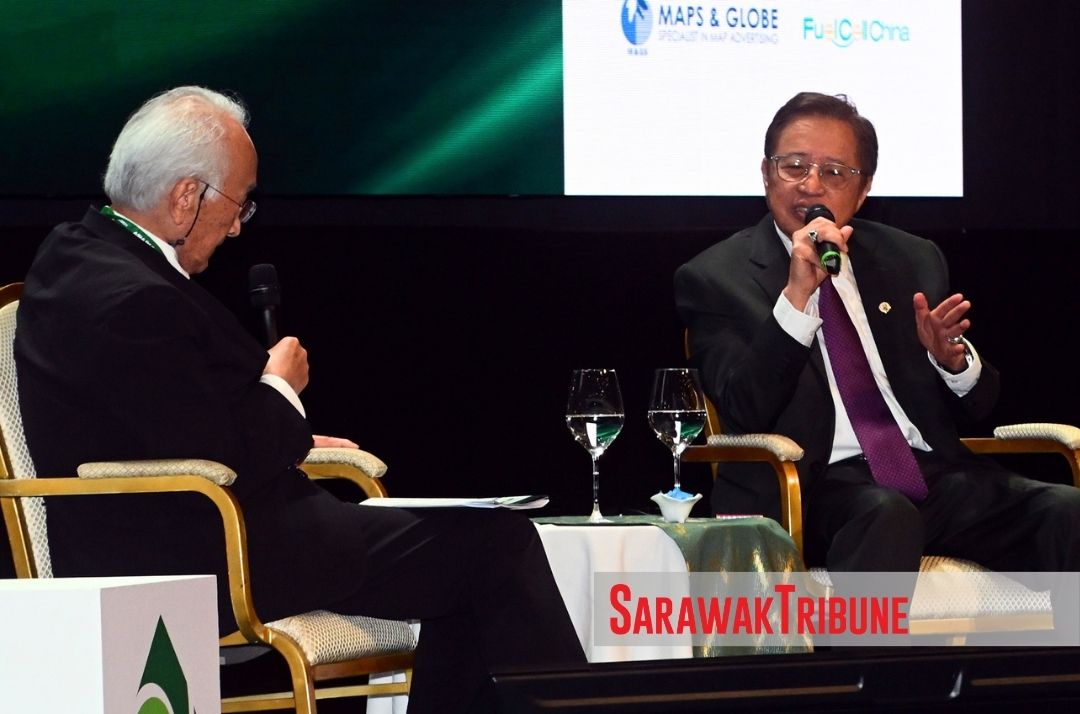
KUCHING: Sarawak remains confident in the long-term viability of its flagship hydrogen projects despite the scaling down of initial production targets, with efforts focused on reducing production costs and overcoming logistics challenges to meet future market demand.
Premier Datuk Patinggi Tan Sri Abang Johari Tun Openg said issues surrounding hydrogen transportation can be addressed through various technological and commercial solutions, including ammonia production and hybrid energy approaches within the hydrogen value chain.
“We discussed this in detail because the main issue with hydrogen now is logistics. But logistics can be addressed through ammonia production, among other methods, as well as hybrid solutions.
“So from the logistics perspective, I do not see it as a problem. Whether it involves liquefied hydrogen or other methods, these are technical matters that experts will handle. What is important is that there is a complete value chain in place,” he told reporters after officiating the Asia Pacific Green Hydrogen Conference and Exhibition (APGH) 2026 here today (June 9).
Abang Johari said the more important consideration is the cost of producing hydrogen, which he believes is becoming increasingly competitive compared with conventional fossil fuels.
“What is important is the price of hydrogen. Based on what I see, the cost of hydrogen production is declining when compared to fossil fuels,” he said.
His remarks come amid reports that Sarawak’s hydrogen venture involving local and Japanese investors has been scaled down due to funding constraints and high transportation costs.
The initiative, jointly developed by SEDC Energy and Japanese companies Sumitomo Corporation and Eneos, was originally designed to produce 90,000 metric tonnes of green hydrogen annually by 2030 using Sarawak’s hydropower resources, primarily for export to Japan.
However, SEDC Energy chairman Tan Sri Abdul Aziz Husain told Nikkei Asia that the original target is no longer achievable due to the high cost of transporting hydrogen.
“The original idea of transporting all green hydrogen from Sarawak is not viable because of the high transport costs,” he was quoted as saying, adding that the Japanese partners had “suspended the original idea”.
He noted that while Sarawak’s low-cost hydropower allows hydrogen to be produced at less than RM20 per kilogramme, the costs of compression, cooling and shipping increase the price substantially.
“When it gets to Japan, it’s like RM50 per kilogramme,” he said.
Earlier this year, the Energy Industries Council (EIC), in its April 2026 APAC Hydrogen Insight Report, reported that both the H2biscus and H2ornbill projects had reduced their planned production capacities amid weak demand signals and uncertainty over securing offtake agreements.
Despite the revision, Abang Johari previously told Nikkei Asia that the projects remain on track and are being restructured to better align with market realities.
“The project is still on, but it is scaled down, and it is more market-oriented,” he was quoted as saying, adding that there is potential for hydrogen to be traded in the open market as the global green transition gains momentum.