
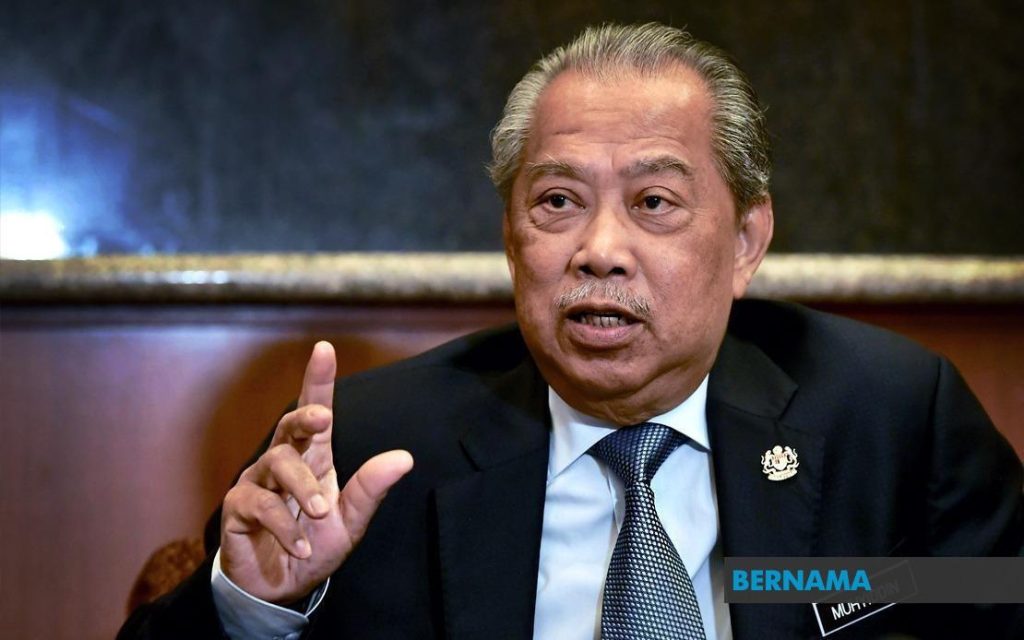
Tan Sri Muhyiddin Yassin’s sudden resignation as chairman of Perikatan Nasional (PN) is being read by many as a dignified exit from a coalition mired in internal conflict. In reality, it may turn out to be one of the most consequential strategic miscalculations in Malaysia’s opposition politics since the 2022 general election.
It was not a political necessity. It was not inevitable. And in stepping aside when he did, Muhyiddin did not merely vacate a position. He surrendered a crucial stabilising role that could have reshaped the opposition into a more credible, inclusive and electorally viable force.
At a moment when PN was already struggling with identity, coherence and direction, Muhyiddin’s resignation has compounded uncertainty rather than resolved it. Instead of defusing tensions, it has exposed deeper structural weaknesses inside the coalition, particularly the unresolved power imbalance between Bersatu and PAS. And it has accelerated a slow internal unravelling that now threatens PN’s relevance itself.
The immediate trigger, of course, was the Perlis crisis. Bersatu’s manoeuvre into the menteri besar’s post after PAS’s Mohd Shukri Ramli stepped down, officially for health reasons, but politically under a cloud, shattered what little trust remained between the two dominant partners.
PAS perceived the episode as a betrayal, a confirmation of long-held suspicions that Bersatu was unreliable, opportunistic and unfit to lead. Bersatu, for its part, saw itself as merely asserting institutional legitimacy within a coalition it helped found.
That clash did not merely involve Perlis. It symbolised a fundamental struggle over who truly controls PN, what PN stands for, and where it is going. Muhyiddin’s resignation was supposed to calm this storm. Instead, it has made it worse.
By stepping down, Muhyiddin removed the one figure who had both the stature and the political temperament to mediate between ideological rigidity and pragmatic politics. He was not merely PN’s chairman; he was its ballast.
His leadership represented a centrist Malay nationalism that was conservative enough to reassure Malay voters, yet moderate enough to remain compatible with Malaysia’s multiracial political reality.
Had he remained, Muhyiddin could have resisted the slow but steady ideological capture of PN by PAS. That did not mean confronting PAS head-on, but containing it; limiting its dominance over narrative, candidate selection, and coalition direction.
This containment strategy would have been politically uncomfortable, even risky. It might have pushed PAS to the brink of exit. But paradoxically, that would not necessarily have been a loss.
A PAS-free PN, or at least a PAS-decentred PN, would have been more palatable to the non-Malay electorate, especially Chinese and Indian voters, who increasingly feel politically homeless and alienated. It would also have been far more acceptable to MCA and MIC, now diminished but still symbolically important as carriers of moderate, multiracial politics within Barisan Nasional’s traditional framework.
Such a realignment, meaning Bersatu anchored by a moderate Malay core, supported by MCA, MIC and perhaps other centrist forces, could have formed the nucleus of a new middle-ground coalition. Not one defined by religious identity or racial grievance, but by governance, economic competence, institutional reform and social stability.
That coalition could have challenged Pakatan Harapan (PH) not on moral superiority or ideological purity, but on performance. And there is no shortage of public dissatisfaction with PH’s delivery, especially among non-Malay voters disillusioned with DAP’s compromises and among Malays uneasy with PH’s internal contradictions.
Muhyiddin was uniquely positioned to lead such a recalibration. He had already been prime minister. He had governed across coalitions. He understood both the mechanics of power and the fragility of political legitimacy. His continued presence could have kept PN strategically flexible, ideologically open, and electorally competitive.
Instead, his departure has done the opposite!

The cascade of resignations that followed, Datuk Seri Mohamed Azmin Ali stepping down as secretary-general, relinquishing his Selangor leadership, and other state chiefs following suit, reveals how deeply Muhyiddin’s authority anchored PN’s internal cohesion. His exit has exposed that cohesion as personal rather than institutional, relational rather than structural.
Without him, PN is no longer a coalition negotiating its differences. It is a battlefield in which those differences now openly compete.
PAS, as the numerically dominant party within PN, is already positioning itself as the natural inheritor of leadership. It contributes the majority of PN’s parliamentary seats. It has a disciplined grassroots machinery. It has ideological clarity, however polarising that clarity may be.
But PAS’s strength is also PN’s greatest strategic liability. A PAS-led PN may consolidate the Malay base, but it will almost certainly alienate urban voters, minorities, professionals, business communities, and younger Malaysians uneasy with ideological rigidity. It would struggle to expand beyond its current ceiling, and Malaysian elections are won not by consolidation alone, but by expansion.
This is why Muhyiddin’s resignation is not merely a personal decision; it is a strategic surrender. He did not just step away from leadership. He stepped away from the one platform that could have rebalanced PN away from ideological dominance and towards political breadth.
The irony is that this happens at a time when Prime Minister Datuk Seri Anwar Ibrahim’s own government is far from stable. His unity government is held together more by mutual fear than mutual vision. Umno is resentful and restless.
Public patience with reform is thinning. Economic anxieties persist. Institutional reform is slower than promised. And DAP is increasingly trapped between its principles and its compromises. In such a climate, a coherent, moderate, credible opposition would not merely be viable; it would be dangerous to the government.
Instead, Anwar now enjoys an unexpected reprieve. PN’s turmoil shifts attention away from the government’s weaknesses and towards the opposition’s dysfunction. It reduces electoral pressure. It fractures momentum. It allows Anwar to govern not as a leader facing a formidable challenger, but as one presiding over a divided alternative.
Analysts are right when they say PN’s crisis is largely self-inflicted. But it is not simply a failure of trust between Bersatu and PAS. It is a failure of strategic imagination.
The central question is not who controls PN. It is what PN is for. Is it a vehicle for ideological assertion? Or is it a vehicle for winning power in a plural society? Is it meant to mobilise the already convinced? Or persuade the undecided? Is it a movement of identity, or a coalition of governance?
Muhyiddin, for all his flaws, understood that winning power in Malaysia requires managing diversity, not denying it. His resignation tilts PN away from that logic and towards a narrower, louder, more doctrinal politics that may excite supporters but repel swing voters.
The tragedy here is not that PN may split. It is that it may decay. A split at least clarifies positions. Decay simply dissolves relevance.
As factions compete, resignations multiply, and leadership contests simmer, PN risks becoming less a government-in-waiting and more a cautionary tale, of how coalitions collapse when strategic patience is replaced by ideological impatience.
Muhyiddin’s continued influence within Bersatu means he has not entirely left the stage. But leadership without authority is not leadership; it is commentary. The space he vacated will not be filled by compromise, but by competition. And competition inside a coalition rarely produces renewal. It usually produces rupture.
In the end, Muhyiddin’s resignation will not be remembered as an act of humility. It will be remembered as a missed opportunity to reshape PN, to broaden its appeal, to redefine opposition politics, and to offer Malaysia a credible alternative grounded not in identity, but in governance.
Malaysia does not suffer from a lack of political noise. It suffers from a lack of political coherence. Muhyiddin could have helped build that coherence within the opposition. Instead, he walked away from it.
And in doing so, he may have secured short-term peace within PN, but at the cost of long-term relevance for the coalition, and long-term competitiveness for the opposition itself. That is why his resignation was not a necessity.
It was a strategic retreat. And Malaysian politics is poorer for it.
The views expressed here are those of the writer and do not necessarily represent the views of Sarawak Tribune. The writer can be reached at rajlira@gmail.com