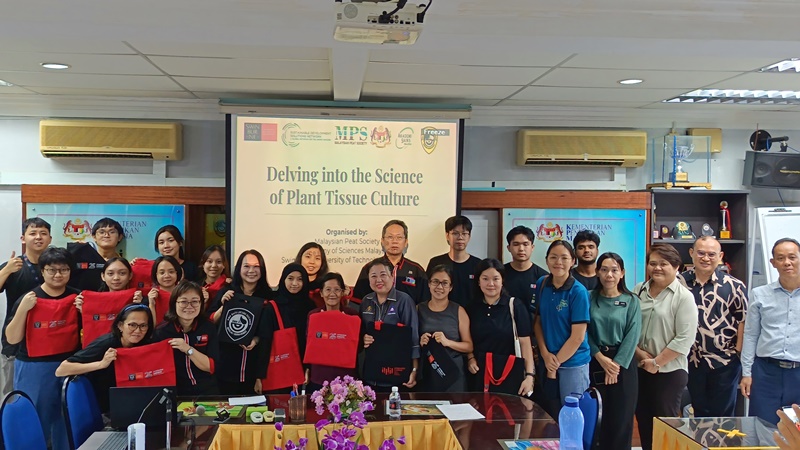
KUCHING: Swinburne University of Technology Sarawak Campus (Swinburne Sarawak) recently conducted a hands-on workshop titled ‘Delving into the Science of Plant Tissue Culture’ at SMK Batu Lintang.
The workshop demonstrated how cutting-edge biotechnology, which traditionally requires advanced laboratory equipment, can be explored using simple household tools, showing that scientific exploration can begin at home.
The workshop brought together 49 Form Four and Form Six students and 14 science teachers for an immersive experience in plant tissue culture, a technique used to propagate plants in sterile conditions on nutrient media.
According to a Swinburne Sarawak statement on Wednesday, the session was led by Academy of Sciences Malaysia (ASM) fellow, Datuk Dr Sim Soon Liang, who guided participants through the plant cloning process.
“The workshop exemplified meaningful knowledge transfer, turning complex concepts into hands-on learning, and planting the seeds of scientific curiosity among young Sarawakians.
“The event also aimed to spark student interest in real-world applications of biotechnology and sustainable development.
“By demonstrating that plant tissue culture can be taught with basic tools, the programme not only demystified science but also empowered students to see themselves as future innovators in food security, environmental restoration, and sustainable development,” he said.
Besides, experts from the Agriculture Research Centre, Forest Department Sarawak, Malaysian Pepper Board, and Swinburne Sarawak enriched the session with their valuable insights.
The presence of officials from the Kuching District Education Office highlighted the significance of this initiative in supporting national education priorities.
The programme was co-organised by Cassandra Lau (School of Foundation Studies, Swinburne Sarawak), Dr Daniel Tan (Faculty of Engineering, Computing, and Science, Swinburne Sarawak), and Dr Herman Umbau (Sarawak Tropical Peat Research Institute – TROPI), with the goal of aligning scientific learning with the Malaysian school curriculum.
In a parallel session titled ‘Effective English in Scientific Communication’, facilitated by Swinburne Sarawak’s School of Foundation Studies’ Ngu Chai Sia, students also learned how to articulate their findings in clear, concise English – supporting Malaysia’s Dual Language Program (DLP) and reinforcing the importance of communication in science.
This initiative was co-coordinated and sponsored by the Malaysian Peat Society (MPS), under the leadership of senior fellow of the Sustainable Development Solutions Network (SDSN), fellow of ASM, and chairperson of ASM Sarawak Chapter, Datuk Dr Lulie Melling.
Her commitment to youth education and science outreach played a pivotal role in the programme’s success.
The event drew support from nine partner organisations, including UN-SDSN, MPS, TROPI, and SMK Batu Lintang.