KUCHING: In many parts of Sarawak, seeing a doctor may mean a short drive to the nearest clinic or hospital.
For communities deep in the interior, however, accessing healthcare can involve long journeys by river, difficult terrain and considerable travelling time.
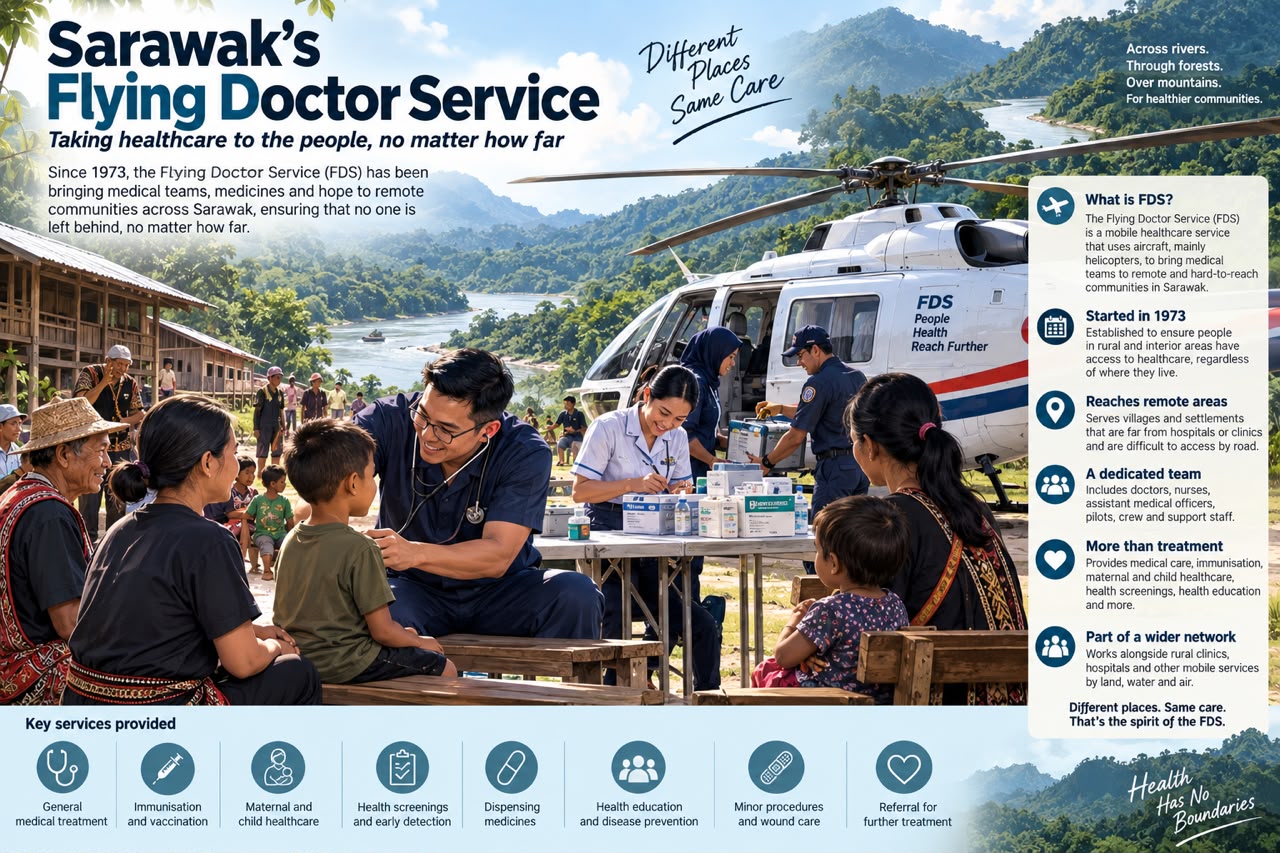
For more than five decades, the Flying Doctor Service (FDS) has helped bridge that distance by taking healthcare directly to communities that are difficult to reach through conventional means.
The service came into renewed public attention following Tuesday’s (Sept 8) helicopter crash near Long Lellang, Baram, involving an aircraft conducting an FDS flight.
Beyond the incident, the FDS represents a longstanding component of rural healthcare delivery in Sarawak, helping ensure that geographical distance does not become a barrier to basic medical services.
Healthcare that comes to the community
The FDS, or Perkhidmatan Doktor Udara, is essentially a mobile healthcare service that uses air transport to bring medical personnel, medicines and equipment to remote locations.
Its purpose is straightforward: where it is difficult for patients to regularly travel to healthcare facilities, healthcare services are brought closer to them.
Such an approach is particularly important in Sarawak because of the state’s vast geographical size and widely dispersed rural population.
Some settlements are connected by road, while others may require lengthy river journeys. For locations where travelling by land or water is less practical, air transport provides another means of reaching communities.
Serving Sarawak since 1973
The FDS has a long history in Sarawak, dating back to 1973.
Its introduction reflected the challenge of extending healthcare coverage across a large state where permanent medical facilities could not always be located within easy reach of every settlement.
Over the decades, the service has complemented rural clinics, hospitals and other forms of mobile healthcare.
Ministry of Health records provide an indication of its reach over the years.
In 2013, the FDS covered 134 villages in Sarawak and recorded 27,713 patient attendances.
By 2018, the ministry reported coverage of 109 localities, with 21,664 attendances recorded that year.
These historical figures reflect how the service’s coverage has evolved alongside improvements in roads, healthcare facilities and accessibility across rural Sarawak.
More than flying doctors
Despite its name, the FDS is not simply about transporting a doctor by helicopter.
When an FDS team arrives at a designated location, the service can effectively function as a mobile clinic.
Services provided have included general outpatient treatment, minor procedures and wound care, dispensing medicines, antenatal care, child health services and immunisation.
Medical teams can also conduct health screenings, monitor existing conditions and identify patients who may require further investigation or referral to larger healthcare facilities.
This is particularly important for preventive healthcare.
A routine examination may identify a condition before it becomes more serious, while regular monitoring allows healthcare workers to follow the progress of patients with existing health concerns.
Maternal and child healthcare is another important component.
For mothers and young children living far from permanent healthcare facilities, scheduled visits provide opportunities for antenatal checks, child growth monitoring and immunisation.
Health education is also provided, including information on disease prevention, hygiene, nutrition and maternal and child health.
An FDS visit can therefore cater to several generations of the same community during a single stop.
It takes a team
While “doctor” may be in its name, every FDS mission depends on a wider group of professionals.
Doctors may work alongside nurses, assistant medical officers and other healthcare personnel, depending on the requirements of the mission.
Before the aircraft leaves its base, medicines, equipment and other supplies have to be prepared according to the locations scheduled for the visit.
Pilots, crew and aviation support personnel are another essential part of the operation, responsible for transporting healthcare teams and their supplies between locations.
Planning also has to take into account factors such as routes, weather conditions and the time available at each destination.
The result is a service in which healthcare and aviation work together towards the same objective — reaching patients who might otherwise have difficulty accessing routine medical care.
Part of a wider healthcare network
Sarawak has changed considerably since the FDS was introduced more than 50 years ago.
Road networks have expanded, more healthcare facilities have been established and communications technology has opened new possibilities for delivering and coordinating medical services.
The FDS forms part of this broader healthcare network rather than replacing permanent clinics or hospitals.
Different communities require different approaches
.
Where road connections are available, healthcare can be accessed or delivered by land. Rivers remain important transport routes for other communities, while air services provide another option where geography and travelling time make access more challenging.
Together, these approaches allow healthcare services to extend beyond major towns and population centres.
The FDS also demonstrates how healthcare delivery in Sarawak has had to adapt to the state’s distinctive geography.
A model that works in an urban centre may not necessarily be suitable for a settlement several hours from the nearest road or medical facility.
Bridging the distance
Ultimately, the FDS is perhaps best understood not by the helicopter itself, but by the distance it helps overcome.
For residents of remote communities, a scheduled FDS visit can mean access to a medical examination, medicines, immunisation, maternal healthcare or an opportunity for a health problem to be detected and referred for further treatment.
For more than half a century, it has been one of the practical ways healthcare services have been extended across Sarawak’s vast interior.
Infrastructure and the way healthcare is delivered will continue to develop, just as they have since the service began in 1973.
Yet the principle behind the FDS remains straightforward — where distance presents a barrier to healthcare, the service helps bring healthcare closer to the people.