The 72-Hour Education” – Part One of a three part series
KUCHING: Joseph Romey Dures had never been more proud to watch someone finish eighth.
The Kuching native, now the first Sarawakian to lead Malaysia’s national skateboarding team, stood ringside as his athletes competed at SEA Games 2025 against regional powerhouses with superior facilities, structured programmes and years more institutional support.
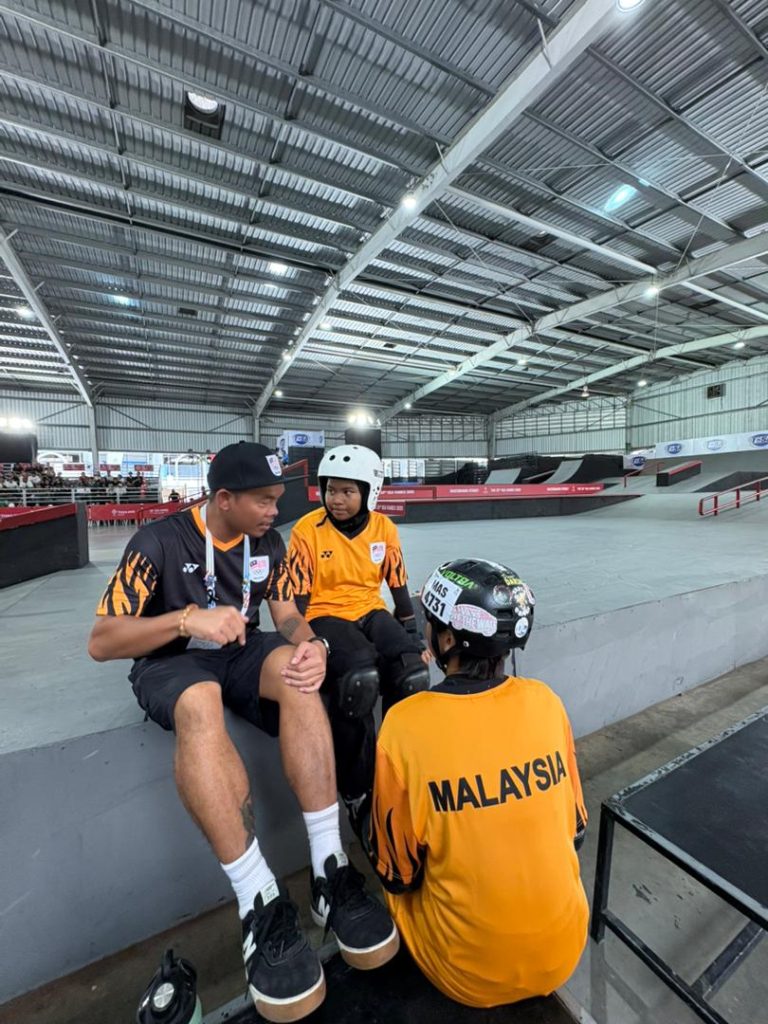
His skaters, some as young as 10, most still in secondary school, had spent three frantic days learning to skate a competition bowl unlike anything back home. The kind of world-class layout that exists in Bangkok, Manila and Jakarta but not yet in Malaysia.
By competition day, they were pulling off tricks that take most skaters months to master. No medals came home. But what Joseph witnessed wasn’t failure; it was proof of what Malaysian athletes can achieve when given access to proper facilities.
I’ve known Joseph for years. We skated together in Kuching when the scene was smaller, scrappier.
When fellow Sarawakian Extreme Sports advocate and Sports Carnival president, Nik Suhaili, whose Canroll event last June made waves to Barcelona, mentioned Joseph was leading the national team, I rang him immediately.
We talked for two days about tricks and politics, infrastructure and identity, about what it means when your region finally gets national representation.
FEAR AND CONCRETE
“They were pretty scared, man,” Joseph recalled of that first training day.
The Bangkok bowl measured seven to eight feet deep with curved transitions designed to launch skaters into aerial manoeuvers. Most of his Malaysian team had never skated anything similar.
Back home, even Malaysia’s newest skateparks are built for recreational use – gentler slopes, shallower depths, layouts prioritising accessibility over athletic challenge.
Thailand, Indonesia and the Philippines have invested heavily in Olympic-grade skateboarding infrastructure since the sport entered the Summer Games in Tokyo 2020.
Their athletes train year-round on layouts that mirror international competition specifications. Malaysian skaters learn on recreational infrastructure then attempt to apply those skills on proper competition bowls they’ve never encountered.
“The majority of our athletes has never skated that kind of layout before,” Joseph explained. “So the first time, the first day, they were pretty scared.”
By Day One’s end, his athletes managed tentative airs. By Day Three, they were executing perfect 45-second runs.
THE SPONGE EFFECT
What happened wasn’t magic. It was education by immersion – watching, absorbing, attempting, failing, trying again.
“They’re like sponges,” Joseph said. “They’re watching others skating, those who have skated that kind of layout before. And our athletes managed to absorb their skills, figure out how they do those tricks. And then they nailed it.”
Arina Fikri Abdul Rahman epitomised this learning curve. His standout moment came during a frontside Smith grind – tail grabbed on curved coping, a technical trick requiring intimate knowledge of the bowl’s geometry.
Three days earlier, Arina was simply trying to maintain speed. By competition, he was grabbing his board mid-grind like he’d skated this layout for months.
For the women’s park category, the transformation proved even more dramatic. Nurhidayah Mohd Shafiq Affandy and teammates learned to launch big airs off coping they’d barely memorised.
These tricks typically require weeks of daily repetition. They had hours.
“It’s really amazing how they can manage to do those kind of tricks in a very short time period,” Joseph said, adding that what everyone in Malaysian skateboarding knows but rarely says aloud: “Just imagine if we have this kind of layout in Malaysia, in Sarawak. I have no doubt that we can create international level skaters.”
The potential exists. The facilities do not.

THE RESULTS
Objectively, the placements weren’t medal-worthy. Arina Fikri finished 8th out of 11 in men’s park. Ahmad Adlan Anaqi took 9th. Nurhidayah placed 8th of 10 in women’s park.
In street skating, results were slightly stronger but still outside podiums: Adelia Haziqah (“Yaya”) finished 6th of 10 in women’s street, Alya Zahra Muhammad Arif took 7th. The men, Nor Mahathir Daniel and Muhammad Mer Nullah Khan (“Momo”), placed 7th and 8th.
But during best trick rounds, Joseph witnessed something transcending placement numbers. The Malaysian boys went full send, trick flip 50-50 down the biggest hubba ledge, kickflip backside 5-0 down the same obstacle. These weren’t safe attempts. These were “go big or go home” tricks. They didn’t land them.
“But seeing how they have that willingness to try and their confidence of trying to do it,” Joseph said, “that was a win for us.”
BREAKING NEW GROUND
Joseph’s role carried historic weight. He became the first Sarawakian to lead Malaysia’s national skateboarding team, not as an assistant but as chairman of skateboarding under the Malaysian Skate Federation and selected team manager.
East Malaysia has long been under-represented in national sports leadership, particularly in newer Olympic disciplines where infrastructure and administrative power concentrate in peninsular urban centres. That a Kuching native now helms the national programme represents both progress and pressure.
“Yes, I am the first Sarawakian to lead skateboarding for Malaysia,” Joseph said. “And I will strive to be leading it in a better way going forward.”
The timing is notable. The same week, another Sarawakian, Ummi Mashitah Hassan, claimed gold for Malaysia in pencak silat.
The parallel is instructive: Sarawak consistently produces elite athletes. The question isn’t whether Sarawak has talent but whether that talent receives equitable infrastructure investment.
WHAT COMES NEXT
When competition ended, Joseph gathered his team: “Even though we didn’t bring back any medals, we have already won just by trying the best we can.”
The sentiment transcends consolation once you understand what “trying your best” meant in Bangkok, mastering world-class skating in 72 hours, representing a nation whose infrastructure is generations behind regional competitors, proving Malaysian athletes can compete internationally when given proper access.
“You don’t try, you don’t know,” Joseph said simply.
They tried. And revealed both Malaysia’s talent and its infrastructure gap.
In two years, Malaysia hosts SEA Games 2027. The question facing sports administrators isn’t whether Malaysian skaters can compete. Bangkok proved they can. The question is whether Malaysia will build the facilities before the region competes here.
Joseph and his team showed what’s possible with three days and a world-class skatepark. Imagine what they could achieve with three years and one of their own.
For now, a Sarawakian led Malaysia’s skateboarding team into international competition. The first, not the last. The foundation is laid. Whether infrastructure follows remains to be seen.
The clock is ticking toward 2027. The potential is proven. The question is whether investment will match ambition.
NEXT WEEK: Part 2 — “The Rebel vs. The Reformer”: Why professionalising skateboarding sparked backlash and why structural change was necessary anyway.