There is a quiet contradiction at the heart of the global climate conversation. Governments and corporations are racing to announce net-zero targets, investing billions into carbon markets and technological solutions, yet some of the most powerful natural climate systems on Earth remain poorly understood, inconsistently measured and dangerously undervalued.
Along coastlines across the world, mangroves, seagrasses and salt marshes are quietly absorbing carbon at remarkable rates. These ecosystems, collectively known as blue carbon systems, store vast amounts of carbon not just in vegetation but deep within sediments where it can remain locked away for centuries.
And yet, despite their immense potential, they continue to sit on the margins of climate policy, not because they lack importance but because we still struggle to measure them with confidence.
The science is both promising and unsettling. Estimates suggest that blue carbon ecosystems store between 10 and 20 billion tons of carbon globally, making them among the most efficient carbon sinks on the planet.
Unlike terrestrial forests, where carbon is largely visible in tree biomass, these coastal systems bury carbon beneath layers of soil and water, rendering it invisible and far more difficult to quantify.
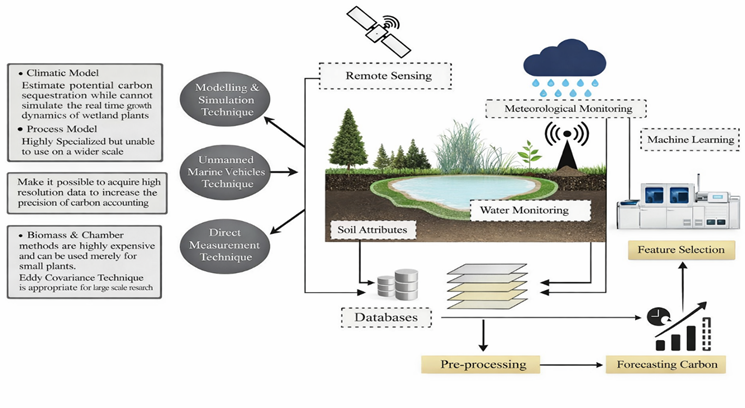
Scientists attempting to measure this carbon must rely on a combination of methods digging sediment cores, analysing plant biomass, measuring gas fluxes, and increasingly, interpreting satellite data.
Each method offers a partial glimpse of reality but none provides a complete picture. The result is a complex and often fragmented understanding of how much carbon is actually being stored.
This uncertainty is not just a scientific inconvenience; it is a structural problem with real consequences. Climate policy today is built on numbers of carbon budgets, emissions targets and offset calculations. If those numbers are uncertain, then the policies built upon them are equally fragile.
Overestimating blue carbon storage risks creating a false sense of progress, allowing emissions elsewhere to continue unchecked. Underestimating it, on the other hand, means neglecting one of the most effective and immediate natural climate solutions available.
As recent research makes clear, variability in environmental conditions, measurement techniques and greenhouse gas emissions such as methane and nitrous oxide introduces significant uncertainty into blue carbon accounting, raising serious questions about how these ecosystems should be integrated into carbon markets.
The global response, so far, has been fragmented. Countries are beginning to recognise the importance of blue carbon but they are doing so in isolation, each developing its own methodologies and standards.
Australia is generating carbon credits through wetland restoration, Japan has introduced marine carbon certification systems and the United States is expanding coastal carbon inventories. China is investing heavily in advanced monitoring technologies.
These efforts are encouraging but they lack coordination. What counts as carbon storage in one country may be calculated differently in another, making it nearly impossible to compare results or build a unified global framework. In a crisis that transcends borders, this inconsistency undermines the very purpose of climate action.
Technology is often presented as the solution to this problem and in many ways, it is. Drones now map mangrove forests with extraordinary detail, satellites monitor changes in coastal vegetation, and machine learning algorithms analyse vast datasets to improve predictions. Underwater robots are beginning to explore seagrass ecosystems that were previously inaccessible.
These innovations are transforming our ability to observe and measure blue carbon systems. But they are not a silver bullet. Technology can refine measurement but it cannot eliminate uncertainty. Data gaps remain, environmental variability persists and even the most advanced models depend on assumptions that may not hold in a rapidly changing climate. There is a growing risk that technological optimism is outpacing scientific reality.
What is needed is not just better tools but better alignment. Blue carbon accounting requires a coordinated effort that bridges science, policy, and finance.
It requires standardised methodologies that can be applied across regions, enabling consistent measurement and comparison. It requires long-term investment in monitoring systems that can reduce uncertainty over time.
And perhaps most importantly, it requires a willingness to acknowledge uncertainty rather than obscure it.
Too often, climate solutions are presented with a level of certainty that the underlying science does not fully support. Blue carbon deserves a more honest conversation, one that recognises both its immense potential and its current limitations.
Blue Carbon Accounting Models
While policymakers debate measurement frameworks, coastal communities are already experiencing the realities of ecosystem loss and restoration.
In parts of the world such as Kenya, community-led mangrove restoration projects are demonstrating what blue carbon can achieve when combined with local engagement.
These initiatives are not just storing carbon; they are protecting coastlines, supporting fisheries and generating income through carbon credits. They offer a model of climate action that is both practical and inclusive.
Yet even these successes face challenges when it comes to scaling. Without reliable measurement and standardised frameworks, it remains difficult to integrate such projects into global carbon markets or national climate strategies.
At its core, the challenge of blue carbon is also a question of priorities. Are we willing to invest in solutions that are complex, difficult to measure and inherently uncertain, but potentially transformative? Or will we continue to favour approaches that are easier to quantify even if they deliver less impact?
Mangroves, seagrasses and salt marshes may not fit neatly into financial models or policy frameworks but they are already performing a critical function. They are absorbing carbon, stabilising coastlines and sustaining biodiversity all without recognition or reward.
There is a temptation in climate policy to wait for perfect data before taking action. In the case of blue carbon, that would be a costly mistake. These ecosystems are disappearing at an alarming rate due to coastal development, pollution, and climate change itself. Every hectare lost represents not only an ecological loss but also a lost opportunity for climate mitigation. The absence of perfect measurement should not be an excuse for inaction; if anything, it should be a reason to act more urgently.
The path forward is clear, even if it is not simple. We need integrated approaches that combine field measurements, remote sensing and advanced modelling to improve accuracy. We need global standards that enable consistent reporting and verification. We need investment in research and capacity building, particularly in regions where blue carbon potential is high but resources are limited. And we need a broader shift in how we think about climate solutions one that recognises the value of natural systems alongside technological innovation.
In the end, blue carbon is not just a scientific concept; it is a test of our ability to recognise and act on the solutions that already exist.
These ecosystems are not waiting for policy frameworks or financial incentives to begin their work. They are already capturing carbon, quietly and efficiently, beneath the surface of our oceans and along the edges of our continents.
The real question is not whether they matter but whether we can learn to measure, protect and value them before it is too late.
DISCLAIMER:
The views expressed here are those of the writer and do not necessarily represent the views of Sarawak Tribune. The writer can be reached at khanwaseem@upm.edu.my.