Why Future Beats in the Care Economy
WE measure what we value. Economic indicators such as GDP growth, foreign direct investment and export volumes are tracked with meticulous precision.
Yet, there exists a multi-billion-ringgit engine that powers our nation daily – largely invisible in national statistics and policy discourse: the care economy.
The care economy encompasses all paid and unpaid work related to caregiving. This includes raising children, supporting the elderly and persons with disabilities, domestic work, and the professional services rendered by nurses, teachers and caregivers.
It is the foundational labour that enables all other sectors to function. Without it, our offices, factories and institutions would simply cease to operate.
The Department of Statistics Malaysia projects that by 2030, 14.3 per cent of the national population will be aged 60 and above, with Sarawak recording an even higher proportion at 16 per cent.
This demographic shift underscores the urgent need to strengthen not only early childhood care but also elderly care infrastructure as the nation prepares to embrace an ageing society.
Recognising and investing in the care economy is therefore more than a social responsibility – it is a strategic economic imperative. A resilient care system ensures that families thrive, workers remain productive and communities stay cohesive.
By valuing caregiving as essential economic activity, Malaysia can unlock new opportunities for inclusive growth, create sustainable jobs and safeguard the well-being of all generations.
In Sarawak, with its distinctive socio-cultural fabric, the care economy must be seen as the backbone of development, enabling both social progress and economic resilience in the decades ahead.
The Silent Pillar of Our Prosperity
For generations, caregiving has been disproportionately shouldered by women, often without remuneration or recognition. A mother staying home to nurture her children, a daughter sacrificing her career to care for an ageing parent or a neighbour tending to a bedridden elder – these acts of compassion are also acts of economic significance.
They fill critical gaps in our healthcare and social protection systems, effectively subsidising both the state and private sectors.
However, this model is under strain. Malaysia is ageing rapidly. The care economy’s market potential is projected to reach RM114 billion by end of 2025, driven by demographic shifts and rising demand for eldercare services.
In Sarawak, the outmigration of youth to urban centres exacerbates this trend, leaving many rural communities with a growing elderly population and limited caregiving support.
At the same time, aspirations for dual-income households are rising. Yet, the infrastructure to support working families – such as affordable childcare, eldercare services and equitable parental leave – remains underdeveloped.
This “double burden” on women is a key factor behind the persistent gender gap in labour force participation.
The Sarawak Context: Community and Modernity
Sarawak’s strength lies in its communal ethos. The longhouse tradition, where multiple generations cohabit and care for one another, has long served as a natural care network. But as modernisation accelerates, these traditional structures are being disrupted.
Young Sarawakians are pursuing education and employment opportunities in Kuching, Peninsular Malaysia and beyond, leaving behind an ageing population with fewer familial caregivers.
This presents a critical juncture: how do we preserve our cultural values while adapting to modern realities?
The solution lies in building a care infrastructure that honours tradition while embracing progress. Establishing community-based eldercare centres in rural and semi-urban areas and training local caregivers would not only provide essential services but also generate dignified employment and retain talent within communities.
A Strategic Investment, Not a Cost
Reframing care as a strategic economic investment unlocks transformative potential. A forward-looking care economy strategy should include:
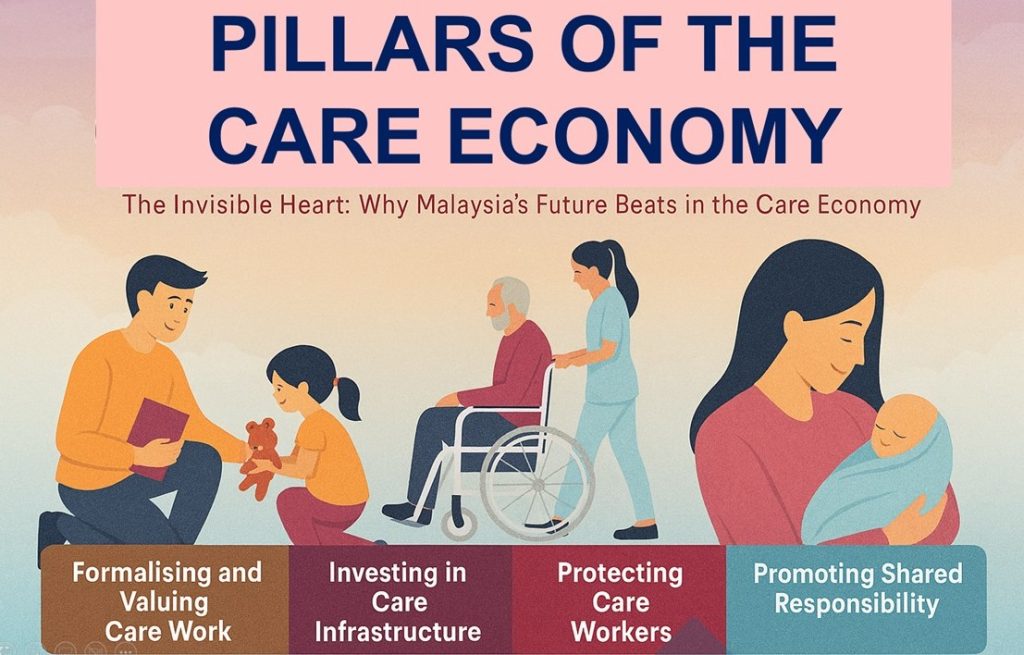
• Formalising and Valuing Care Work: Incorporate unpaid care work into national accounts. What is not measured is often ignored. Accurate data is essential for sound policymaking.
• Investing in Care Infrastructure: Allocate public funds for accessible, high-quality childcare and eldercare facilities. In cities like Miri and Sibu, such services can determine whether parents remain in the workforce.
• Protecting Care Workers: Ensure fair wages, social protections and safe working conditions for paid caregivers. Professionalising the sector enhances its appeal and sustainability.
• Promoting Shared Responsibility: Encourage equitable caregiving through policies like paternity leave and “use-it-or-lose-it” quotas for fathers. This helps redistribute unpaid care work and supports women’s economic participation.
The Heart of the Matter: Conclusion
The COVID-19 pandemic underscored what truly matters: health, family, and community. At the centre of these pillars lies the care economy – an invisible system that sustains our daily lives and underpins national resilience. It is not a peripheral concern but the invisible heart that drives prosperity and social cohesion.
If Malaysia is to achieve a high-income status and Sarawak to realise its vision of inclusive development, care must be placed at the core of policy, planning and progress.
The choices we make today will determine whether our ageing society becomes a burden or a source of renewed strength. By recognising caregiving as both a social responsibility and an economic infrastructure, we can transform invisible labour into visible value.
Investing in care is investing in people – their dignity, productivity and potential. It is the foundation upon which innovation, industry and progress rest. When caregivers are supported, families flourish; when families flourish, communities thrive and when communities thrive, nations prosper.
The invisible heart beats strongest when we value it, nurture it and allow it to shape the rhythm of our nation’s growth. The future will not be defined by how much we produce but by how well we care.
The views expressed here are those of the writer and do not necessarily represent the views of Sarawak Tribune. The writer can be reached at drjohnlau@gmail.com