As work and home increasingly blur, cafés and co-working spaces across Malaysia are emerging as modern “third places” — offering connection, comfort and community for a generation seeking spaces that feel more like home than home itself.
Cafés, co-working and the search for belonging
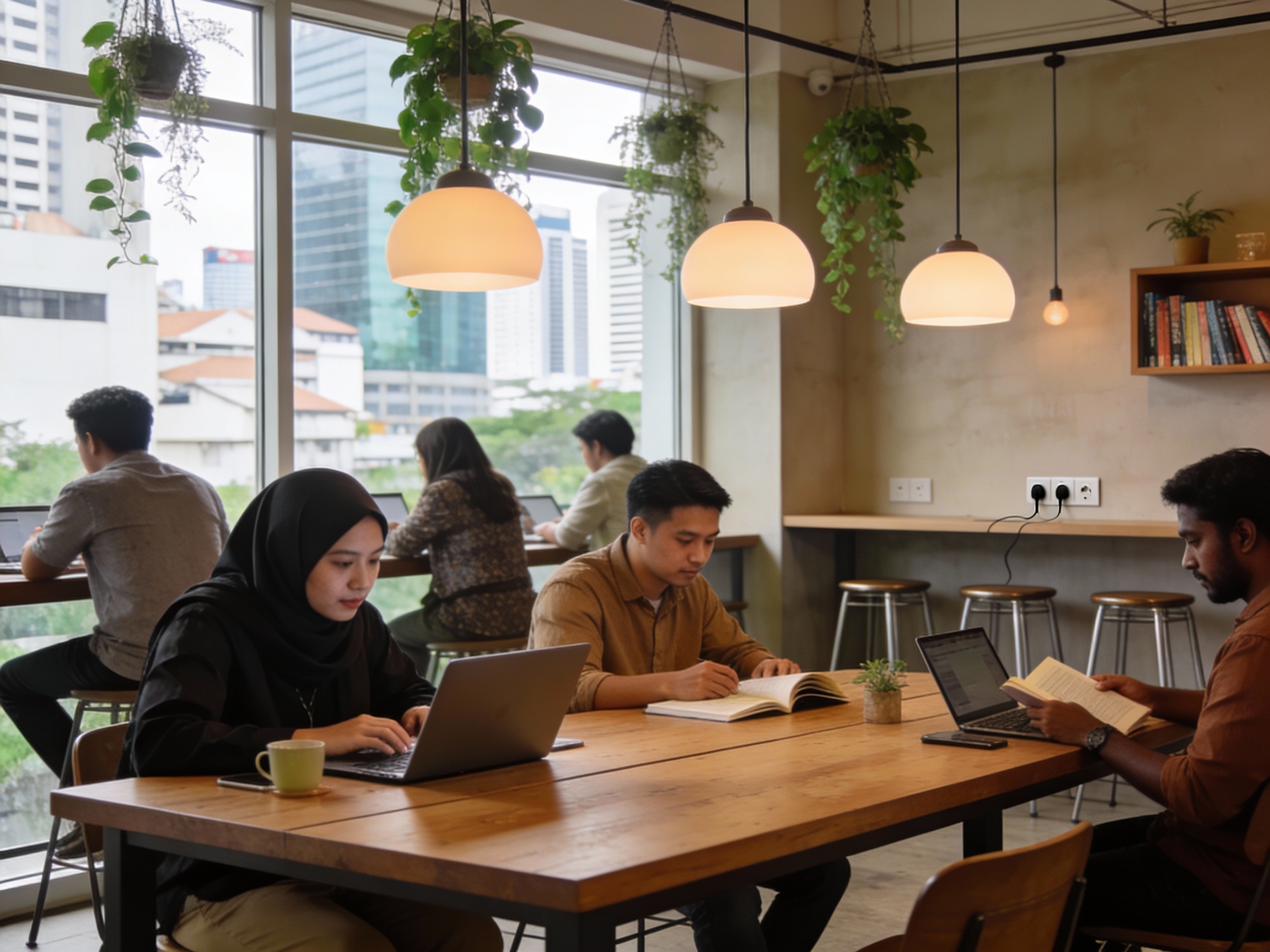
On a weekday afternoon in Kuala Lumpur, it can be harder to find a seat at a neighbourhood café than at your own dining table. Laptops glow under warm pendant lights, headphones are firmly in place, and flat whites sit beside half-finished presentation slides. A few streets away, a co-working space hums quietly — phones in use, hot desks fully occupied, and the pantry doubling as a social hub. For many Malaysians, these places have quietly become a “third home”: not the house, not the office, but the space where life genuinely feels lived.
The idea of a “third place” is not new. It refers to the social spaces where people traditionally spend time between home and work — kopitiams, mamak stalls, libraries, surau compounds, or community clubs. What is new is how strongly younger Malaysians are gravitating towards modern cafés and co-working spaces as their preferred third places. Coffee culture has surged, with under-35s choosing minimalist cafés, specialty coffee bars and Instagram-friendly “healing” spaces to study, work and decompress. At the same time, co-working spaces have evolved from a niche option into a significant part of Malaysia’s work culture, particularly in the Klang Valley and other urban centres.
Part of this shift is practical. Flexible work is no longer reserved for start-ups and freelancers. Hybrid schedules, remote days and side hustles have blurred the line between office and home to the point where it has almost disappeared. Working from home may sound ideal, but the reality for many Malaysians is cramped apartments, multi-generational households and constant background noise. Cafés and co-working spaces step in as neutral ground — places where one can focus without feeling isolated, and be around others without having to host anyone. That balance is powerful.
Cafés, in particular, have become emotional spaces rather than purely commercial ones. Coffee culture has evolved from traditional kopi O and kopitiam breakfasts into a full-fledged lifestyle, with young people describing cafés as “healing” places to unwind, speak honestly and escape the intensity of city life. These spaces are carefully curated to feel cosy: soft lighting, touches of greenery, and music that is just loud enough to fill the silence without overwhelming the mind. Some newer cafés even borrow camping or nature-inspired aesthetics, offering outdoor seating, canvas tents and simple wooden stools to create a sense of escape from the surrounding concrete.
The rise of specialty coffee and aesthetic cafés speaks as much about connection as it does about taste. Many Gen Z and millennial Malaysians now meet friends at cafés rather than in one another’s homes, especially in dense urban areas where privacy is limited and commutes are long. A café table becomes the new living room — a place to celebrate small wins, have difficult conversations, or simply sit beside someone in comforting silence. Social media amplifies this culture, as people document their “new favourite spot” or weekend “café hunt”, turning a simple drink into a ritual of identity and belonging.
Co-working spaces, meanwhile, have taken on the role of community for a different crowd: freelancers, start-up teams, remote corporate employees and students working on projects. In Malaysia, these spaces now offer far more than just Wi-Fi and a desk. Many feature communal lounges, event areas, wellness rooms and shared pantries where strangers can easily become collaborators. The design is intentional — ample natural light, flexible seating, and dedicated zones for both deep focus and casual conversation — because the goal is not merely productivity, but a sense of belonging to something larger than one’s laptop screen.
Economics also plays a role. Office rents are high, and committing to a traditional lease can be risky for small businesses or independent professionals. Co-working spaces allow companies and individuals to maintain a professional address and access facilities while cutting overheads by a significant margin compared with conventional offices. For solo workers, a day pass or a few coffees can function as a manageable “membership fee” for a better working environment. For start-ups, co-working spaces become launchpads — places to meet fellow founders, encounter mentors, attend community events and grow within an ecosystem designed for early-stage hustle.
Beyond cost, however, the real draw is how these spaces make people feel. At home, you may be a child, a parent or a spouse first, and a worker second. At the office, you are often an employee before anything else. In a third place, you get to choose. You are simply another person trying to focus, relax or connect. There is comfort in being surrounded by strangers who share the same need to get things done — or to unwind from doing too much. Sociologists describe third places as “level ground”, where status matters less and the atmosphere is more conversational and equal. In a Malaysian context, this might look like an engineer and a designer sharing a table in a co-working pantry, or a student and a corporate manager reading quietly in the same café corner.
There is also a cultural layering taking place. Malaysia’s coffee landscape now stretches from old-school kopitiams with marble-top tables and kaya toast to third-wave cafés serving single-origin beans and oat milk lattes. In many cities, both can be found on the same street. Some co-working spaces intentionally incorporate local design elements — rattan chairs, batik prints or kampung-inspired greenery — to retain a sense of Malaysian identity in spaces that might otherwise feel generic. The result is a new kind of urban culture: global in style, local in flavour.
Naturally, this shift raises questions. If cafés and co-working spaces feel more like home than actual homes, what does that say about how Malaysians are living? For many urban young adults, housing is expensive, living spaces are small, and long commutes drain energy. Hosting friends at home is complicated by shared living arrangements, lack of privacy or sheer exhaustion. As a result, social life migrates to neutral territory. There is a quiet loneliness in that reality, but also a form of adaptation — rather than giving up on connection, people relocate it.
Access remains an issue. Not everyone can afford regular café visits or co-working memberships, particularly outside major cities. Yet the desire for third places is universal. Libraries, community centres, youth hubs and even revitalised kopitiams can fulfil this role if they are properly invested in and treated as essential social infrastructure rather than optional luxuries. As work becomes more flexible and more people drift away from traditional office structures, the demand for shared, informal and welcoming spaces will only increase.
Still, the return of third places — reshaped for a Malaysian, post-pandemic reality — carries a sense of hope. Whether it is a barista who remembers your usual order, a community manager who asks about your latest project, or the quiet solidarity of others tapping away on their laptops, these spaces meet a deeply human need: to be around others without constantly having to perform. They remind us that “home” is not only where we sleep, but also where we feel seen, at ease and quietly part of something larger.
For Malaysia, the cafés and co-working spaces filling up in Kuala Lumpur, Penang, Johor Bahru and beyond are more than lifestyle trends. They are the new living rooms of urban life — the in-between spaces where the boundaries between work and rest, stranger and friend, solitude and community are gently blurred. In a world where so much is changing, these third places offer something remarkably steady: a chair, a table, a warm drink and the reassuring presence of people nearby. Sometimes, that is all it takes for a city to feel like home.