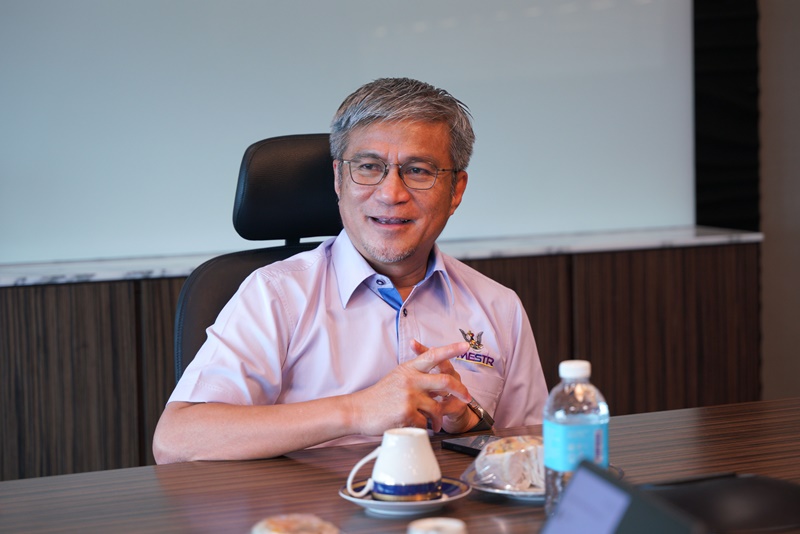
From saving lives as a cardiologist to shaping futures as a politician, Datuk Dr Annuar Rapaee’s journey is nothing short of inspiring.
Guided by his belief in the transformative power of education, the Education, Innovation and Talent Development Deputy Minister has dedicated his career in public service to uplifting lives and communities – a mission deeply rooted in his personal experiences.
Coming from a modest background, Dr Annuar credits his success to his parents’ unwavering emphasis on education.
Their dedication to providing him and his siblings with the opportunities to learn instilled in him a lifelong passion for education to break the cycle of poverty and enable progress for families and nations alike.
This personal connection to education drives his efforts as a policymaker.
“Education is more than infrastructure or access—it’s about creating opportunities and equipping individuals with the tools to thrive in an increasingly competitive world,” he told New Sarawak Tribune in an exclusive interview.
Can you share how you started your journey in politics and transitioned from being a cardiologist?
Dr Annuar: My interest in politics began during my secondary school and university years. At Universiti Malaya (UM), I was actively involved in student leadership and even served as a president of my residential college. Those experiences shaped my leadership skills and interest in public service.
Before my nomination as a candidate for the Nangka constituency, I wasn’t directly involved in political parts but I maintained close ties with people at the grassroots in Sibu and often engaged in discussions about political matters.
The local community was familiar with my aspirations and ideas for improving Sibu, so this connection perhaps contributed to the party’s leadership to choose me as a candidate.
The transition from a cardiologist to a politician came unexpectedly. In 2011, I was selected to contest in the state election for Nangka constituency while I was still serving as a consultant cardiologist at Serdang Hospital.
Although the shift was sudden, my longstanding interest in politics made the transition smoother.
Are there any similarities between being a doctor and a politician?
Dr Annuar: Absolutely, both roles require a commitment to solving problems although the scope of those problems differ significantly.
As a doctor, I dealt with medical issues, and served people who are in hardship – focusing on diagnosing and treating patients. In politics, the challenges are broader and often more complex, encompassing education, infrastructure, healthcare and socioeconomic issues.
Despite these differences, the approach remains similar. In medicine, you identify the root causes of a problem through physical examinations and investigations before prescribing a treatment plan.
Similarly in politics, understanding the root causes of societal issues is crucial for drawing up effective policies and solutions.
Whether it’s addressing healthcare disparities or improving educational outcomes, the process of analysing the problems and implementing targeted solutions is something I have carried over from my medical career.
What does education mean to you?
Dr Annuar: Education is one of the most powerful tools for transforming lives and communities. It provides individuals will the skills and knowledge to uplift themselves from poverty and enables families as well as nations to progress.
Personally, education played a pivotal role in my life. Coming from a modest background, my parents emphasised the importance of education which allowed me and my siblings to achieve success.
This belief in the transformative power of education is why I view my role in this sector (education) not just a professional responsibility, but as a deeply personal mission.
Education is not merely about infrastructure or access; it is about creating opportunities and equipping individuals with the tools to succeed in an increasingly competitive world.
What are some of Sarawak’s key initiatives to improve education?
Dr Annuar: Sarawak has implemented a comprehensive strategy to improve its education system, addressing both immediate challenges and long-term goals.
A cornerstone of this effort is the Sarawak Education Enhancement Programme (SEEP) which was introduced to improve academic performance, particularly for students sitting for the SPM examination.
SEEP takes a holistic approach by focusing on several critical areas such as targeted support for students and provide them with additional tuition and resources.
Teachers are provided with continuous professional development opportunities to enhance their teaching capabilities and career growth.
In terms of infrastructure and learning tools, SEEP ensures schools especially in rural areas are equipped with the necessary teaching materials and digital tools to improve the learning experience.
At the same time, SEEP addresses systemic issues such as the GPN – the state average grade gap in SPM. We want this to be on par with the national grade average.
Sarawak aims to bring its average performance on part with or surpassing the national average by monitoring student progress and teacher performance closely.
How does Sarawak plan to align its education system with its long-term development goals?
Dr Annuar: Education plays a central role in the state’s long-term development under the Post Covid-19 Development Strategy (PCDS) 2030.
Our initiatives are designed to develop a knowledgeable and skilled workforce capable of driving economic growth.
We place a strong emphasis on STEM education with a target of 60 percent STEM enrolment by 2030. This focus ensures that our students are equipped for careers in high-technology industries like aerospace, renewable energy and artificial intelligence.
We also recognise the importance of TVET in creating a skilled workforce with industry demands. As such, we have partnered with industries to ensure TVET programmes are relevant and provide hands-on training in fields like engineering, IT and agriculture.
By introducing vocational training earlier in the education system, students can streamline their paths into TVET or academic tracks based on their strengths and interest.
What approaches does Sarawak employ to address challenges within the national education policy?
Dr Annuar: The national education policy has undergone numerous changes over the years and unfortunately, these changes are often influenced by political shifts.
This inconsistency has hindered progress and created challenges for states like Sarawak.
Sarawak recognise the importance of English as a global lingua franca and a language of knowledge.
Despite pressures from certain quarters to reduce the emphasis on English, we remain firm in our commitment to empower our students with strong English proficiency.
For instance, Sarawak’s Dual Language Programme (DLP) is implemented across all schools.
This inclusive approach ensures that all students have access to high-quality English education, preparing them for opportunities on the global stage.
How about the approaches in improving rural education?
Dr Annuar: Rural education in Sarawak faces unique challenges, including small school populations, poor infrastructure, and teacher shortages.
Federal funding is currently allocated based on student population, which disadvantages rural schools with fewer students. This model fails to account for the higher costs associated with serving remote areas.
To address this, we advocate for a need-based funding model that considers the specific challenges of rural schools.
Programmes like SEEP are also tailored to support rural students, ensuring they benefit from initiatives like free tertiary education, which will be fully implemented by 2026.
In the recent 2025 Sarawak Budget, Premier Datuk Patinggi Tan Sri Abang Johari Tun Openg announced the pocket money assistance scheme of RM1,200 for IPTA and IPTS students. This complements the free laptop, book vouchers, flight ticket subsidy and PTPTN discount scheme. What are the impacts of these initiatives?
Dr Annuar: The initiatives introduced under the 2025 Sarawak Budget, including the RM1,200 pocket money assistance scheme for students in IPTA and IPTS, are transformative.
These measures, complemented by free laptops, book vouchers, flight ticket subsidies, and PTPTN discount schemes, reflect the state government’s commitment to prioritising education and student welfare.
Such comprehensive support is unprecedented in Malaysia, as no other state provides an equivalent range of initiatives. These efforts aim to alleviate the financial burdens faced by students and their families, particularly those from rural areas.
By addressing issues like transportation costs, access to learning materials, and technological barriers, these initiatives enable students to focus on their education without undue stress or distractions.
The broader impact extends beyond individual students. These measures contribute to the development of Sarawak’s human capital, a key pillar in achieving the state’s Post-Covid Development Strategy 2030 (PCDS 2030).
Students equipped with the necessary tools and support are more likely to succeed academically, which in turn strengthens the state’s workforce and economic potential.
These initiatives are more than just financial assistance—they represent the government’s vision for a knowledge-driven and equitable society.
They ensure that no student, regardless of their background, is left behind in Sarawak’s journey toward progress and development
It’s important to highlight that the state government’s ability to implement such initiatives is directly tied to its strategic financial management and increased revenue.
For instance, the introduction of the five percent state sales tax (SST) on oil and gas has been pivotal, generating the funds necessary to support these programmes.
Despite being a nominal amount, this has enabled the state to provide these substantial benefits.
Imagine the possibilities if Sarawak were to gain full control over its oil and gas resources. The potential revenue could unlock even greater opportunities for the state, not just in education but across other sectors.
This is why the push for greater autonomy and resource control is not merely about reclaiming rights but about ensuring a brighter and more prosperous future for every Sarawakian.
What are your hopes for Sarawak’s education development in the long-term?
Dr Annuar: My hope is for Sarawak to develop a world-class education system that prepares our youth for high-income and technology-driven industries.
We must focus on building strong foundations in STEM education, fostering critical thinking and embracing innovation.
Countries like Singapore, Germany and Finland offer valuable lessons in education reform, vocational training and teacher development.
If we can emulate and adopt these best practices to Sarawak’s context, I believe we can create an education system that can be a model for others, empowers our youth and further drive our state’s development.
Lastly, what advice would you give to young Sarawakians?
Dr Annuar: My advice to young Sarawakians is to embrace education as a pathway to success and to prioritise STEM subjects.
The future will be shaped by advancements in science, technology, engineering, and mathematics, and those who are equipped in these fields will thrive.
I encourage our youth to take inspiration from nations like China, which transformed its economy by prioritising STEM education.
Similarly, Sarawak has immense potential, and I urge our young people to seize the opportunities available and contribute to building a prosperous future for our state.