IN the world of Malaysian art, few names resonate as profoundly as the late Raphael Scott AhBeng, a pioneering Bidayuh artist from Bau, whose dynamic brushwork and bold abstractions immortalised the Sarawak landscape.
His influence lives on through two generations of Sarawakian artists: his mentee Sylvester Jussem, and Sylvester’s mentee-turned-collaborator, Dr Mohammad Faizuan Mat.
Their collective works, displayed at the latest exhibition ‘The Continuum: 3 Generasi’, reveal not just a lineage of artistic expression but a cultural dialogue that continues to evolve.

The Master: Raphael Scott AhBeng (b. 1939 – d. 2019)
Raphael Scott AhBeng’s name is synonymous with the visual identity of Borneo, which is recognised for his evocative landscapes and signature use of colours.
AhBeng’s career spanned over six decades.
He was a three-time winner of the Sarawak Shell Open Art Competition (1959, 1982, 1983) and placed in national art competitions such as the Natural Malaysia Art Competition in Kuala Lumpur.
Ahbeng was educated at Bath Academy of Art in the UK from 1964 to 1967, and he furthered his studies in drama and broadcasting in London, supported by British Council grants.
His exposure to European art giants during travels across France, Spain and Germany left a lasting impression on his aesthetic.
His works have been exhibited at major exhibitions, including Alpha Gallery in Singapore, PETRONAS Gallery, and Bank Negara Malaysia’s art spaces.
His painting ‘Passage to Endau’ made headlines when it was sold at Christie’s Hong Kong in 2015.
Today, his pieces are housed in prominent collections, including the National Art Gallery of Malaysia and the Sarawak Museum.
The Disciple: Sylvester Wielding Jussem
Sylvester Jussem, a Bidayuh artist and senior lecturer at Universiti Malaysia Sarawak (UNIMAS), remembers cycling to Raphael’s home in Berjaya Garden, Batu Kawa, during his school days just for a few precious hours of artistic mentorship.
“He taught me discipline, especially in watercolours.
“The stint was short, but the impact was profound. Raphael taught me not just technique – but attitude,” Sylvester shared with the Sarawak Tribune .
Today, Sylvester is a respected educator, having taught for over four decades.
His artworks often blend semi-abstract styles with deep-rooted cultural storytelling.
A strong believer in mastering fundamentals, Sylvester studied visual arts rigorously, earning bachelor’s and master’s degrees.

His pieces, such as ‘Tetilip Bird Paradise II’ , were inspired by the Melanau custom of weaving ‘nipah’ birds for the Pesta Kaul in memory of the MH370 tragedy in 2014.
“When I created this piece, I was deeply emotional. The work depicts birds made from hand-woven ‘nipah’ palm, a traditional craft I encountered during a visit to Pesta Kaul.
“At some of the stalls, I noticed these delicate woven birds hanging as part of the cultural displays, and I found them profoundly meaningful. In many indigenous traditions, these birds symbolise healing and the journey of departing souls.
“At the time, the tragedy of MH370 had just occurred. It struck me how fragile and unpredictable life can be. This artwork became my quiet tribute to those lost: an expression of grief, remembrance, and hope for peace,” he said.
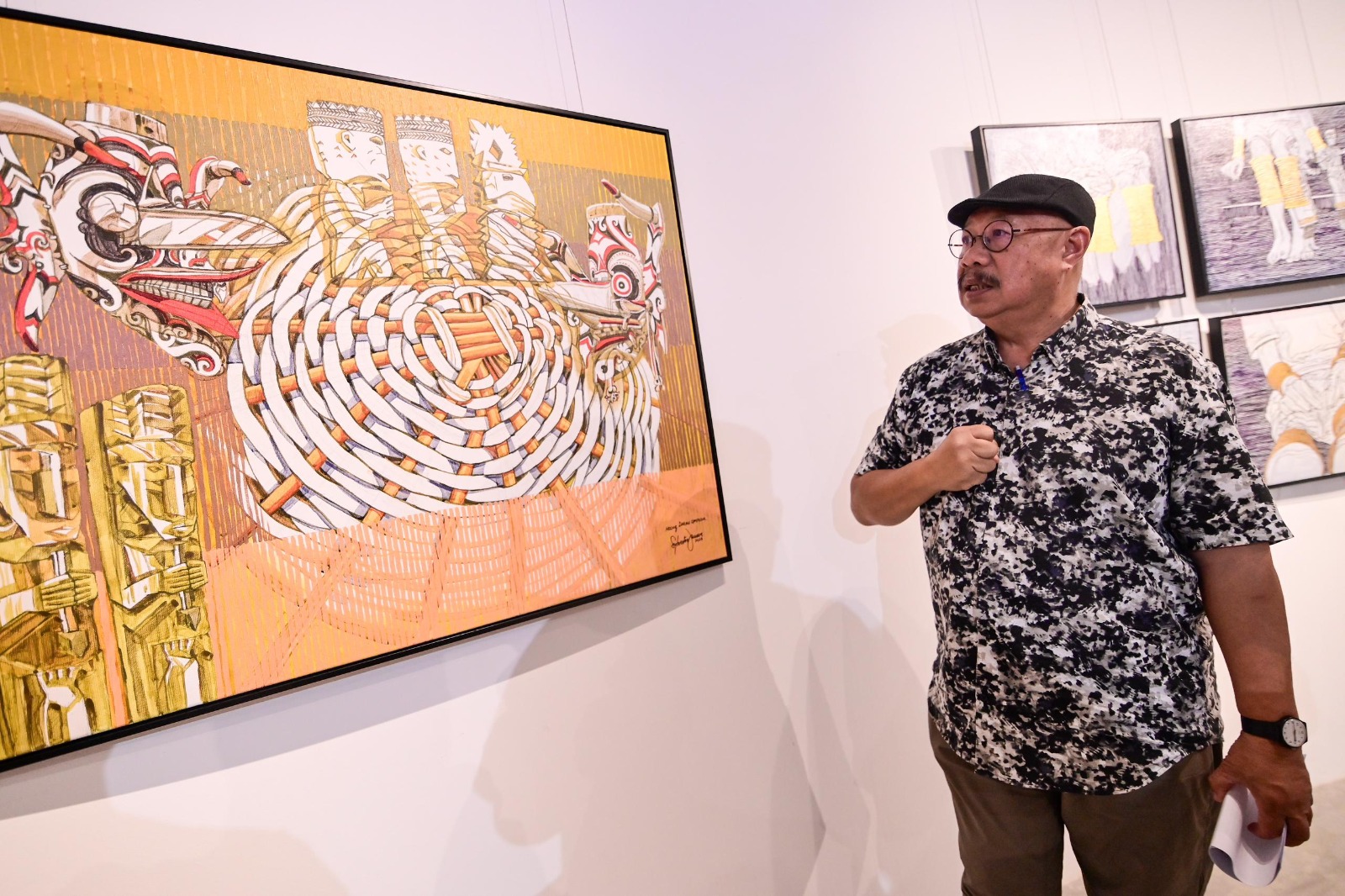
Another of his signature works explores the cultural identity of the Ring Ladies of Kampung Semban.
Rendered in white, his figures appear ghostlike yet dignified, set against a background of hand-woven textures that echo traditional kasah mats.
“I chose to depict them in white to give the piece a soulful, almost X-ray quality.

“It’s not necessary to show everything. Sometimes suggestion is more powerful than detail,” Sylvester explained.
The artwork features iconic rasunk’ng (forearms rings) and ruyank’ng (calves rings), along with Bidayuh bamboo shoot motifs that traditionally decorate sarongs .
Additionally, Sylvester shared that the woven background used as a canvas represents a traditional kasah mat, symbolising the commitment, connectedness, and resilience of the community.
“The background is woven to represent the kasah , or traditional weaving mat, which symbolises the commitment, connectedness, and resilience of the people.
“The weaving may have slowed the process down, but it adds meaning. Every line, every gap, tells a story,” he said.
Through minimalism and metaphor, Sylvester preserves not just an image, but a way of life; woven carefully into canvas for future generations to remember.
The Successor: Dr Mohammad Faizuan Mat
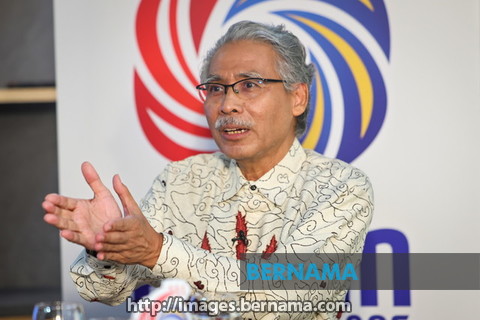
Representing the youngest of the trio is Dr Mohammad Faizuan Mat from Kabong, who studied fine arts in Shah Alam and later pursued a PhD at USM, and the curator of ‘The Continuum: Tiga Generasi’ exhibition.
Dr Faizuan is now a lecturer at UNIMAS, and he credits Sylvester as his long-time mentor and inspiration.
He describes his style as abstract expressionism, an emotionally driven approach that prioritises energy and movement over literal meaning, inspired by pioneers like Jackson Pollock and Willem de Kooning.
“My approach to painting is rooted in abstract expressionism, and for those unfamiliar with the style, it can be difficult to interpret what’s being painted, as it doesn’t follow traditional forms or narratives.
“Abstract expressionism isn’t about literal meaning, it’s about emotion, energy, and movement. Artists like Jackson Pollock and Willem de Kooning were pioneers of the style.

“Pollock, for example, channelled his pain and inner turmoil directly onto the canvas. It’s a form of expression that we were taught and encouraged to explore during our university training,” he explained.
Inspired by the natural environment of Sarawak, especially the tidal forces and coastal waters of his hometown, Faizuan’s recent works include ‘Alun-Alun Kalas’ (2025), painted in soft pinks to reflect the gentle ebb and flow of the sea.
“‘Alun’ means wave, while ‘Kalas’ is pink in the Sarawak dialect.
“While my earlier works like ‘Gelora’ were more intense, ‘Alun-Alun Kalas’ carries a feminist softness. It’s calm, yet layered with energy,” he described.
Faizuan primarily works with acrylics and mixed media, often incorporating materials such as river water, bitumen, sand, or palm sugar to create texture.
He embraces experimentation, even using masking tape to create sharp lines and geometric contrasts, elements subtly influenced by Sylvester’s earlier styles.
One of his earliest works, a semi-abstract piece painted in response to the 2004 tsunami in Aceh, reflects the devastating impact of the tragedy that occurred on December 26, 2004.
“At that time, I was still learning, and I was given the task of studying the disaster and translating it into art.
“On the painting, you can see elements like a damaged house and a wooden bridge destroyed by the tsunami, visual traces of that devastating event,” he said.
According to Dr Faizuan, his latest art piece was in search of artistic identity and symbolism of his homeland.
“After returning to Sarawak, I started looking for identity, something that truly reflected where I come from, which led me on a journey to ‘Hornbill’ ,” he shared.
The painting was part of ‘Rethinking Abstraction’, a 2017 duo exhibition with his mentor Sylvester, which challenged both artists to express Sarawakian identity.

“I used to work mainly in blue, but for ‘Hornbill’ , I broke that habit and used yellow, red, black, and white, colours that represent what I call ‘Sarawak-ness’,” he added.
While the hornbill bird is not depicted literally, its essence is suggested through dark tonal layers and a strong abstract composition.
Dr Faizuan shared that the work is a study in colour relationships, symbolism, and scale.
“It was a study, an exploration of how colour and identity connect. There are larger works out there, but ‘Hornbill’ was big for us, in terms of meaning and material,” Dr Faizuan shared.
The piece stands as a visual expression of Sarawak’s cultural spirit, reinterpreted through the lens of abstract expressionism, but for Dr Faizuan, ‘Hornbill’ remains a personal milestone in redefining what it means to be a Sarawakian artist.

A Legacy That Lives On
Despite their different techniques and generational approaches, all three artists share a common commitment: exploring Sarawak’s soul through visual art.
“Artists are like fireflies. They glow in dark places, lighting up spaces that would otherwise remain unseen.
“You work hard, you produce, and eventually, you shine,” said Sylvester while explaining the story behind one of his lost but found artworks, ‘Sorin Bikorup’ (Home of the Fireflies).
As for the next generation, Dr Faizuan encourages them to pursue art fearlessly, explore diverse paths, and embrace their creative identity, emphasising that the world needs more imaginative minds.

“Don’t be afraid to pursue art, as there are so many pathways you can take, even with a background purely in the arts. The possibilities are there, you just need to start,” he said.
The exhibition ‘The Continuum: 3 Generasi’ not only celebrates Raphael Scott AhBeng’s lasting legacy but also presents a visual narrative of how Sarawak’s artistic identity continues to evolve through mentorship, innovation, and cultural reflection.
It is a poignant reminder that while a master may pass, the light they spark in others never fades.