KUCHING: Sarawak recorded total trade of RM198.7 billion and a trade surplus of RM71.1 billion in 2024, reflecting resilience amid global uncertainties such as market volatility and geopolitical tensions.
According to the Sarawak External Trade Statistics 2024, chief statistician Datuk Seri Dr Mohd Uzir Mahidin said the state’s trade performance was primarily supported by firmer global demand and higher commodity prices, particularly for crude palm oil.
“Palm oil, liquefied natural gas (LNG), and crude petroleum remained Sarawak’s main exports,” he said.
Total trade expanded by 2.7 per cent from 2023, with exports rising 3.1 per cent to RM134.9 billion.
Imports grew at a slower pace of 1.9 per cent to RM63.8 billion, boosting the trade surplus by 4.2 per cent to RM71.1 billion.
Japan and China remained Sarawak’s largest export destinations, accounting for a combined 35.1 per cent of total exports valued at RM47.3 billion.
Exports to Japan rose 1.4 per cent year-on-year to RM29.1 billion, led by LNG (RM25.4 billion), wood products (RM1.4 billion), and iron and steel (RM0.8 billion).
Exports to China, however, fell 1.7 per cent to RM18.2 billion.
LNG made up the bulk at RM13.5 billion, followed by metal products (RM1.1 billion) and palm oil (RM0.9 billion).
The ASEAN region accounted for 12.5 per cent of Sarawak’s exports, declining 2.8 per cent to RM16.9 billion due to weaker demand for electrical and electronic products (-70.9 per cent), crude petroleum (-17.9 per cent), and timber products (-64.9 per cent).
Within ASEAN, Thailand was the top destination (RM6.7 billion), followed by Brunei (RM2.9 billion) and Vietnam (RM2.8 billion).
Mining products dominated Sarawak’s export basket, contributing 58.5 per cent or RM79.0 billion. The increase was driven by LNG (+3.7 per cent) and petroleum condensates (+13.0 per cent).
Manufactured exports fell 1.4 per cent to RM35.4 billion, making up 26.2 per cent of total exports. The decline was led by a sharp drop in electrical and electronic products (-33.4 per cent), chemical products (-24.0 per cent), and wood products (-4.6 per cent).
Agricultural exports surged 14.1 per cent to RM20.0 billion, accounting for 14.8 per cent of total exports. Palm oil and related products led the charge, rising 16.6 per cent to RM18.7 billion.
Intermediate goods, which made up 50.2 per cent of total imports, declined 2.8 per cent to RM32.0 billion. The contraction
was due to lower imports of processed industrial supplies, fuel, lubricants, and food ingredients for industry.
In contrast, consumption goods rose 16.4 per cent to RM13.2 billion, driven by higher imports of processed food, household items, and non-durables.
Capital goods imports increased slightly by 0.2 per cent to RM8.7 billion, supported by a 4.0 per cent rise in capital goods excluding transport equipment.
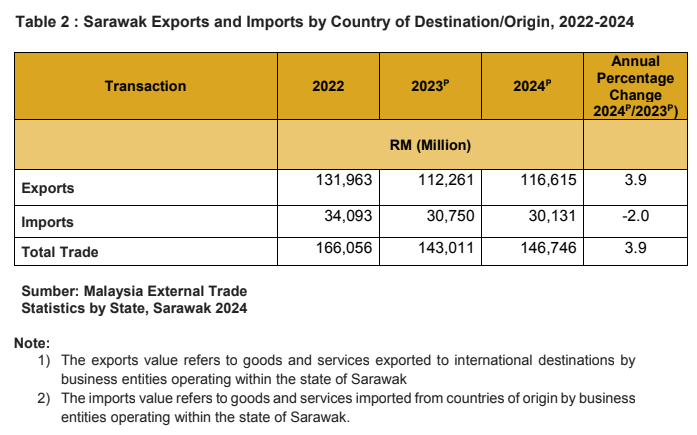
The Statistics Department also released the Malaysia External Trade Statistics by State, which excludes trade via Peninsular Malaysia and Sabah.
Under this framework, Sarawak’s total trade stood at RM146.7 billion in 2024, up 2.6 per cent. Exports rose 3.9 per cent to RM116.6 billion, while imports declined 2.0 per cent to RM30.1 billion. The department clarified that the two publications differ in scope: one focuses on trade performance based on company location, while the other captures macro-level flows based on physical points of entry and exit.