
AS the year-end monsoon season is approaching, the rising waters and overflowing drains are more than just a familiar inconvenience – they are a mirror reflecting our collective habits, priorities and responsibilities.
While Environmental, Social, and Governance (ESG) principles are often confined to corporate boardrooms and sustainability reports, their true power lies in the hands of everyday citizens.
In fact, ESG begins not in policy documents, but at the drain outside your home.
Floods are not merely natural disasters. They are social stress tests. And ESG offers a framework for how we, as Sarawakians, can respond – not with resignation or blame, but with resolve and action.
The idea that citizens – people like you and I – can take meaningful ownership of ESG principles came into sharp focus after the recent floods and landslides in Sabah.
When power outages swept through Sandakan and Tawau, and water supply was reduced to rationing, it became painfully clear: ESG is not just a corporate checklist – it’s a community lifeline.
Amid that crisis, my friend Stanley sent me a text. His message was simple but powerful: “You may write about how everyday people can contribute to ESG.”
That prompt stayed with me because if ESG is to matter in Sarawak, it must begin not in boardrooms, but in our homes, our streets, and our shared responsibilities.
Environmental: From Household Habits to Community Resilience
The environmental dimension of ESG starts with the choices we make every day. Blocked drains and flash floods are often the result of small acts of neglect – used cooking oil poured into sinks, plastic wrappers tossed into monsoon drains, and unchecked development that ignores natural water pathways.
These seemingly minor actions accumulate into major consequences. But the solutions, too, begin at the grassroots:
● Install rainwater harvesting systems to reduce surface runoff and ease pressure on drainage systems.
● Support green infrastructure like community gardens, permeable pavements, and bioswales that absorb excess water and reduce flood risk.
● Participate in gotong-royong clean-up efforts, especially in flood-prone areas before the rainy season begins.
These are not grand gestures. They are practical, replicable steps that reflect environmental stewardship rooted in local culture.
When communities take ownership of their surroundings, resilience becomes a shared achievement.
Social: Protecting the Vulnerable, Educating the Young
Floods do not affect everyone equally. The elderly, persons with disabilities, and low-income families often bear the brunt of these disasters.
ESG calls for inclusive systems that protect the most vulnerable and empower the next generation to lead with compassion and knowledge.
Community leaders and educators can play a pivotal role:
● Organise flood preparedness workshops in schools, places of worships, and community halls to build awareness and readiness.
● Encourage youth-led initiatives that blend science, civic duty, and indigenous wisdom – such as mapping flood zones or designing early warning systems.
● Create volunteer networks to assist during emergencies, ensuring that no one is left behind when waters rise.
Preparedness is not just technical – it is cultural. It begins with awareness and ends with solidarity.
When young people are taught to care, they grow into adults who lead with empathy and foresight.
Governance: Accountability Starts with Us
Governance is often viewed as the responsibility of politicians and public administrators. However, true governance starts with active participation from citizens.
In the context of ESG, it embodies openness, accountability, and collective ownership.
Citizens have more power than they realise:
● Report blocked drains, illegal dumping, and flood-prone zones using mobile apps or community WhatsApp groups.
● Demand transparency from local councils and developers on ESG metrics – especially those related to drainage, land use, and infrastructure planning.
● Vote for leaders who prioritise sustainability, inclusivity, and disaster resilience – just during campaign seasons, but throughout their terms.
Our nation’s future depends not just on policies, but on participation.
When citizens hold institutions accountable, governance becomes a living, breathing contract between the people and those who serve them.
A Sarawakian ESG Ethos
To be truly effective, ESG in Sarawak must reflect our soul – our rivers, our rainforests, our kampung spirit.
It must be rooted in local wisdom and adapted to our unique geography and culture.
This means blending indigenous knowledge with modern science, empathy with engineering, and civic pride with environmental care.
Imagine a Sarawak where:
● Longhouses host flood awareness sessions led by youth and elders alike.
● Schools teach ESG not as a corporate acronym, but as a way of life.
● Local councils publish drainage maintenance schedules and invite public feedback.
● Communities celebrate gotong-royong not just as tradition, but as climate action.
When the next storm arrives – and it will – we must be ready not just with sandbags and umbrellas, but with a mindset of shared responsibility.
ESG is not a distant concept. It is a daily practice. It begins at the drain, in the home, in the classroom, and in the voting booth.
Floods may be inevitable. But helplessness is not. By embracing ESG as a civic ethic, Sarawakians can transform seasonal hardship into a catalyst for change.
Let the rising waters remind us not of what we have lost, but of what we can build – together.
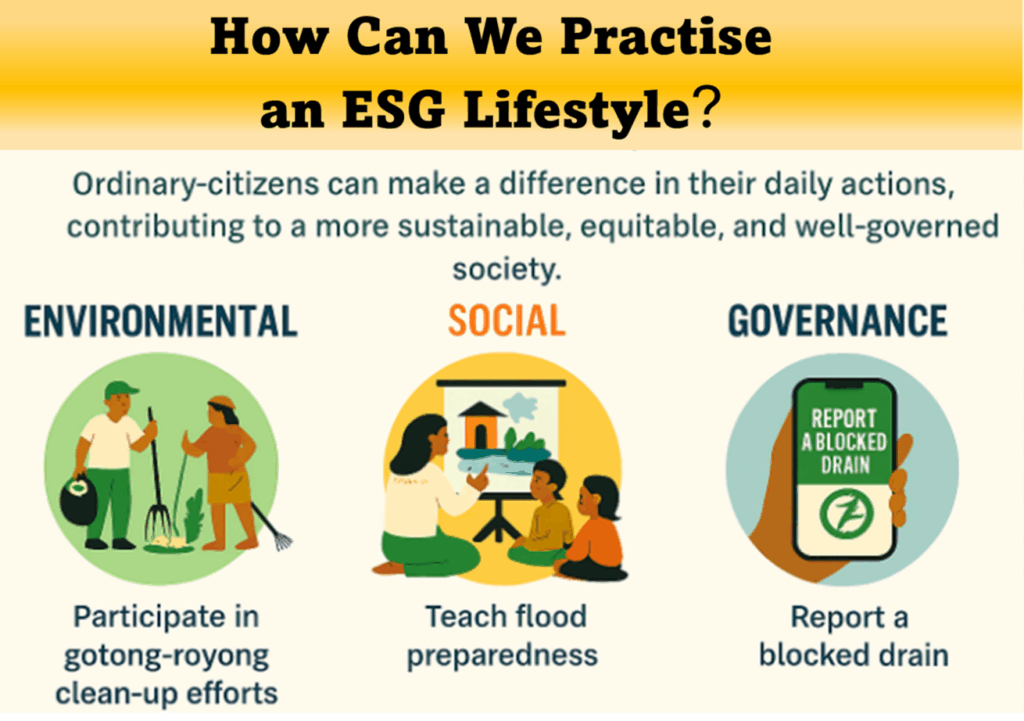
The views expressed here are those of the writer and do not necessarily represent the views of Sarawak Tribune. The writer can be reached at drjohnlau@gmail.com. Figure 1: How can we practise an ESG lifestyle?