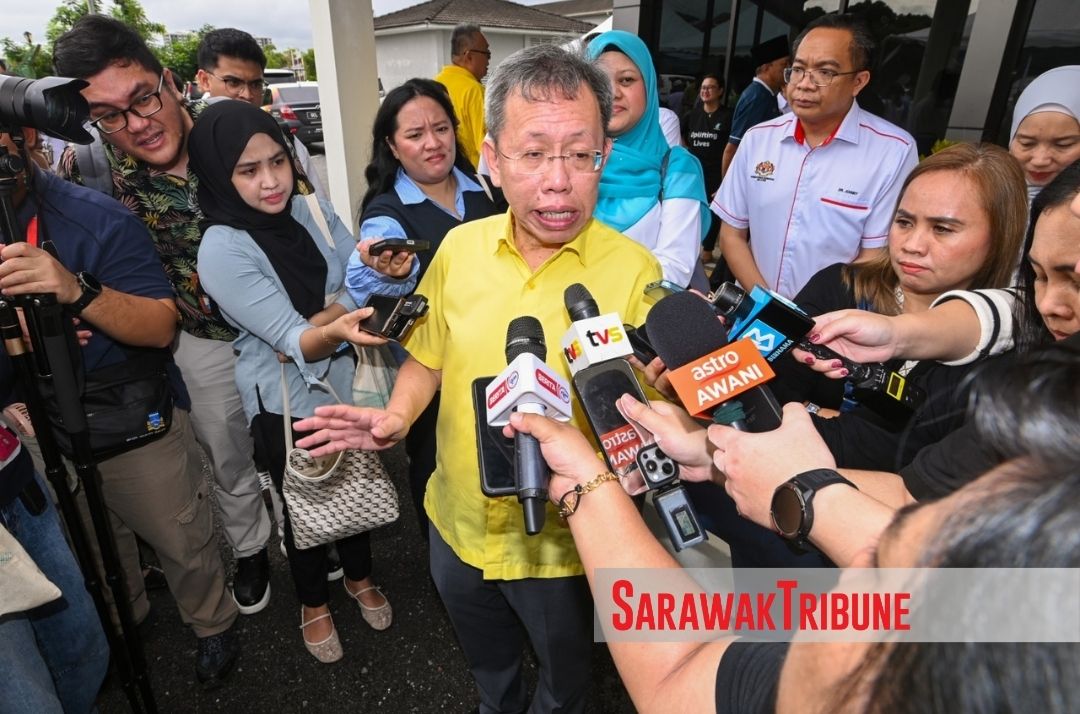
KUCHING: Deputy Premier Datuk Amar Dr Sim Kui Hian has called for a reshuffle of the Technical Committee under the Malaysia Agreement 1963 Implementation Action Council (MTPMA63) to include key federal decision-makers, saying this is critical to resolving long-standing healthcare issues affecting Sarawak.
He said the proposed restructuring would see the technical-level discussions elevated to involve senior representatives from the Ministry of Finance, the Economic Planning Unit (EPU) and the Public Service Department (JPA), instead of matters being repeatedly deferred between agencies.
“The problem is when we talk about healthcare, it is always JPA, then EPU, then Ministry of Finance.
“We keep meeting, but nothing moves because the real decision-makers are not all at the table,” he told reporters this after officiating the PETRONAS Handover Ceremony of Basic Medical Equipment to the Batu Kawa Health Clinic on Wednesday (Jan 7).
Dr Sim said the reshuffled technical committee would be chaired by Deputy Prime Minister Datuk Amar Fadillah Yusof and function as a high-level platform under MTPMA63 to focus specifically on healthcare autonomy and implementation issues.
He said the move is aimed at ending bureaucratic delays and developing a clear five- to 10-year healthcare roadmap for Sarawak.
Dr Sim said having all key ministries involved from the outset is necessary to stop what he described as bureaucratic “passing the ball” and to ensure that healthcare decisions under MA63 can be made decisively.
Under the proposed roadmap, Dr Sim said Sarawak would prioritise long-term solutions, including phased recruitment, structured training programmes and expanded scholarships for doctors and nurses to address critical manpower shortages.
“This is not something you can fix overnight. You don’t suddenly find 4,000 doctors or nurses.
“We need a proper plan year one, year five, year 10 — and that plan must continue regardless of who is in office,” he said.
Reiterating Sarawak’s position on MA63, Dr Sim said the state is pushing to take back greater control over healthcare matters, noting that federal authorities has prioritise 13 states and three Federal Territories, which often results in delays for Sarawak.
He cited the Sarawak cancer hospital as an example, saying projects in Kuala Lumpur tend to move faster as the capital already has multiple specialised healthcare facilities, while Sarawak continues to wait.
“It’s not that they don’t care, but their priorities are spread out. That is why we keep saying: give it back to us, so we can decide what is urgent for Sarawak,” he said.
On recent developments, Dr Sim said the Sarawak Medical Committee was established on January 1 under the Malaysian Medical Council framework, giving the state a greater role in doctor registration and regulation.
He added that Sarawak is also seeking to renegotiate several federal decisions affecting private healthcare facilities, particularly proposals to corporatise certain regulatory functions.
“We don’t want corporatisation that ends up costing Sarawak more. Healthcare is already complex and expensive, and any decision must ultimately benefit the people of Sarawak,” he said.
Dr Sim emphasised that while funding is important, healthcare reform is fundamentally a human resource issue that requires long-term planning, cooperation and political will at both the state and federal levels.