KUCHING: Malaysia’s plan to align its plant variety laws with the International Union for the Protection of New Varieties of Plants (UPOV 91) could affect Sarawak’s indigenous seed systems and traditional farming practices.
Friends of the Earth Malaysia (SAM) and the Malaysia Food Sovereignty Forum (FKMM) said the federal government’s move to amend the Protection of New Plant Varieties (PNPV) Act 2004 to meet UPOV 91 standards represents a major shift in how seed rights and plant varieties will be regulated in Malaysia.
They said the UPOV 91 convention, which grants exclusive rights to commercial plant breeders, may limit farmers’ long-standing practices of saving, reusing and exchanging seeds across rural communities in Sarawak.
“If Malaysia joins UPOV 91, farmers and indigenous communities – the true guardians of our biodiversity – could lose their right to save, share and exchange seeds of protected varieties freely.
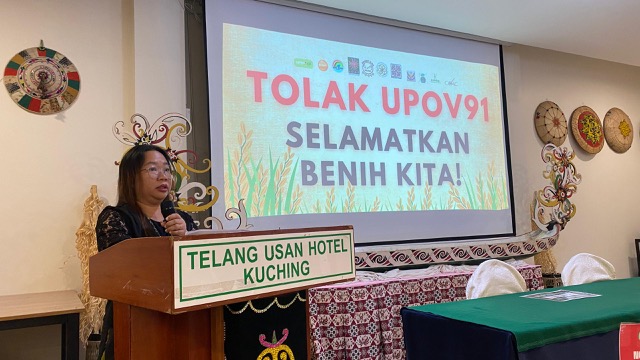
“This means a farmer in Sri Aman, Serian or Baram could face legal risks simply for sharing farm-saved seeds with a neighbour.
“Such restrictions not only threaten livelihoods but also dismantle the cooperative seed systems that have kept rural Sarawak resilient through floods, droughts and economic hardship,” SAM’s research and field officer Rety Sendi said during a press conference here today.
UPOV 91 is an international treaty that gives plant breeders exclusive rights over new varieties they develop, including control over seeds and harvested materials.
In July, Agriculture and Food Security Minister, Datuk Seri Mohamad Sabu, told Parliament that Malaysia’s commitments under the Comprehensive and Progressive Agreement for Trans-Pacific Partnership (CPTPP) required the country to be prepared to join UPOV 1991 within four years of the agreement taking effect.
He said the Protection of New Plant Varieties Act 2004 must therefore be reviewed and aligned with UPOV 1991 requirements.
While the framework is intended to encourage commercial breeding, it also restricts farmers’ traditional practice of saving and reusing seeds, in some cases requiring the payment of royalties.
In Sarawak, seeds form part of the state’s cultural heritage, shaped by generations of farming traditions.
From hill rice fields in the highlands to pepper gardens and fruit orchards statewide, indigenous seed knowledge carries both cultural and economic value.
As such, Rety said adopting UPOV 91 could open the door to biopiracy, the taking of genetic resources from local communities without consent or benefit-sharing.
She said the model favours commercial breeders and multinational seed corporations, granting monopoly rights over new varieties that may be developed using Indigenous genetic resources.
She added that the proposed amendments to the PNPV Act would remove key safeguards under Section 12, which require disclosure of genetic source material, prior informed consent from local and Indigenous communities, and compliance with laws governing access to biological resources and genetically modified organisms (GMOs).
“Sarawak has always protected its autonomy, especially over land, forests and native resources,” she stressed.
“Stripping these provisions undermines the implementation of Sarawak’s Biodiversity Regulations 2016 and the Biodiversity Centre Ordinance 1997, and erodes the state’s constitutional rights over its natural resources.
“Joining UPOV 91 would hand over power to external entities and commercial breeders, allowing them to claim monopoly rights over new plant varieties developed using local seed varieties and to sell them back at higher prices to the very communities that have cultivated them for centuries.”
Rety asserted that civil society groups hoped that any legal adjustments would continue to recognise indigenous seed systems as a vital part of Sarawak’s food security.
“We should defend Sarawak’s heritage from being signed away in the name of trade and ‘modernisation’,” she said.
“Once control over seeds is lost, control over food, and eventually the community, will follow.”