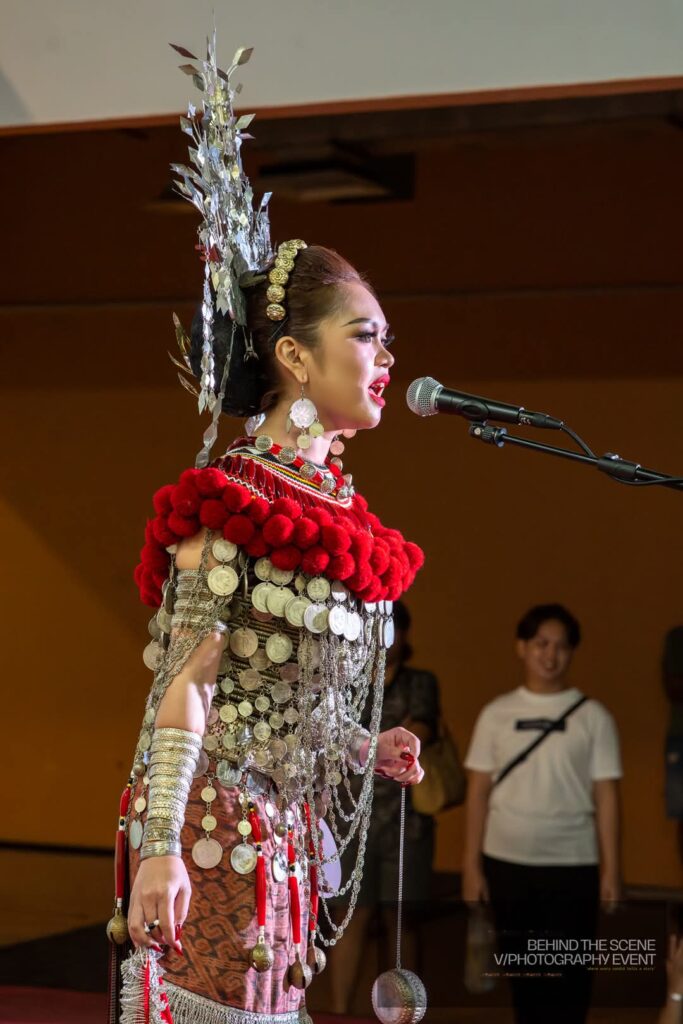
At ‘Pekit Kumang Gawai Dayak Stutong 2025’, Sharmin Dara breathed new life into the ancient Iban ritual of ‘bejawang’, stirring the soul of Gawai with her heartfelt performance and deep connection to tradition.
The spirit of Gawai, spoken in verse
EVERY Gawai season, we talk about tradition. But some traditions speak more softly than others – tucked between rituals, heard only in the pauses between celebrations. Bejawang is one of them.
Once a powerful form of Iban poetic speech used to welcome guests or honour ancestors, bejawang has slowly faded into the background, overshadowed by the louder rhythms of modern festivity.
But at Pekit Kumang Gawai Dayak Stutong 2025, Sharmin Dara Mellia John Meling brought it back – not just as a performance, but as a personal act of remembrance and revival.
She is doing something few her age have dared: reviving the ancient Iban art of bejawang – a ceremonial oral tradition once central to Gawai, now rarely performed by the younger generation.

“It took courage to step onto the pekit kumang stage, but the decision came from a quiet, persistent longing deep within me.
“To be honest, it felt like a calling – something that stirred inside me, sparked by memories of watching others perform in the past,” Sharmin told the Sarawak Tribune.
Sharmin’s cultural spirit is rooted deeply in Sarawak. Her father hails from Saratok, and her mother from Balai Ringin.
Born on March 3, 2006, she is the only daughter among six siblings – but her gentle nature and fierce pride in Iban heritage have long set her apart.
Learning culture in a digital age
Without access to formal training or traditional mentors, Sharmin turned to an unlikely teacher: the Internet.
“I learnt about Iban customs and traditional performances mostly through social media – searching through Google, YouTube, TikTok and Facebook.
“I’ve always been drawn to learning about main asal (traditional Iban performing arts) in any way I can. Besides that, I also enjoy making my own handmade tango earrings in my free time,” she explained.
This digital self-study eventually led her to pekit kumang – a cultural pageant typically held in the lead-up to Gawai Dayak as part of the pre-Gawai celebrations, where participants are judged not only on their traditional attire but also on their understanding of Iban customs, values, and language.
“When I was preparing for my first competition, I didn’t even have a proper tukang kebat – someone with the traditional know-how to assemble a complete Iban costume – like the others had.
“It was challenging to compete with those who had sponsors and support, but I relied entirely on my own efforts and what I could present sincerely, from the heart,” she said.
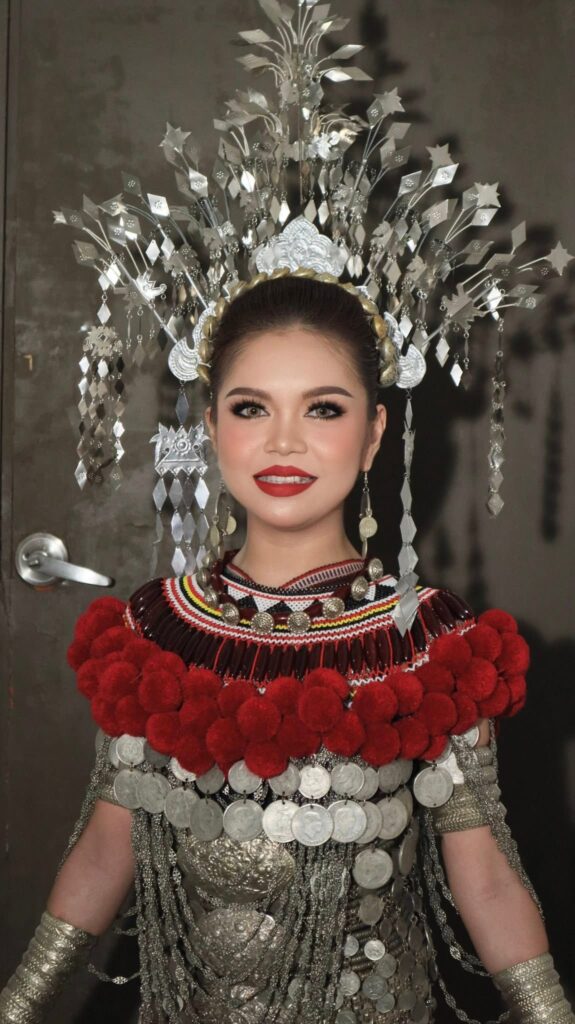
This time, with the support of a proper tukang kebat – Harryson Unchau – Sharmin was finally able to wear a complete ngepan with pride.
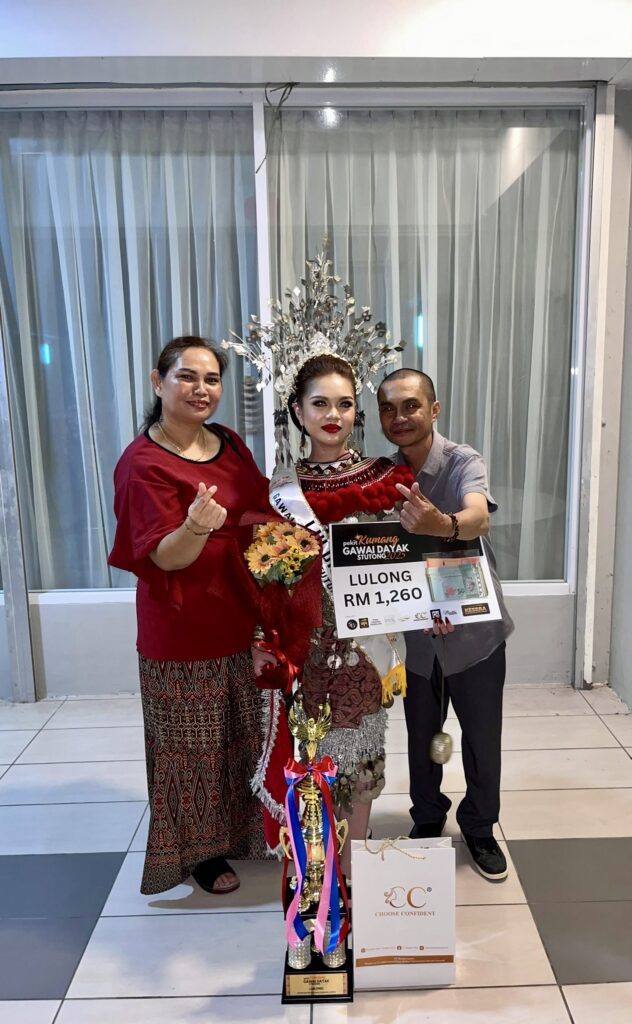
And it showed – her performance stood out. Her bejawang flowed with ceremonial rhythm and emotional depth, earning her second place (Lulong) at the competition.
“I felt proud. That moment only deepened my passion and strengthened my desire to continue learning about Iban culture and traditions,” she said softly.
Speaking through ‘bejawang’
For Sharmin, learning bejawang is more than a personal passion – it’s her way of ensuring the tradition survives for the next generation.
“It makes me happy and proud to speak in bejawang. Even if I’m not perfect, at least I’m doing my part to keep it alive,” she shared.
Indai tinda,
tau digelar indai endu,
Nya alai naka tu dulu,
Enda mayuh engkemulu ngagai kitak ti begempuru wai selamat lemai,
La jawang wai
By Sharmin Dara Mellia
Yet, the path hasn’t been easy. Without traditional mentors, Sharmin had to learn mostly on her own.
“It would be so much better to have a mentor who can guide me face-to-face. I sincerely hope that one day, Kelab Seni Budaya Anak Sarawak (KESERA) can help make this a reality. I truly believe they can,” she said.
Sharmin believes more showcases dedicated to main asal are needed to ensure these traditions aren’t lost to time.
She also credits platforms like pekit kumang for keeping culture alive.
At the recent competition at Aeroville Mall in Stutong, where performing a main asal was required, she didn’t hesitate – it was the perfect opportunity to share the tradition she had come to cherish.
Carrying culture forward
For Sharmin, Gawai is more than just a harvest celebration. It’s a time to reconnect with identity, honour ancestors, and inspire others to embrace their roots.
“By entering this competition, I’ve been able to highlight and breathe life into fading Iban customs and traditions, so they aren’t lost amid the fast pace of modern development,” she explained.
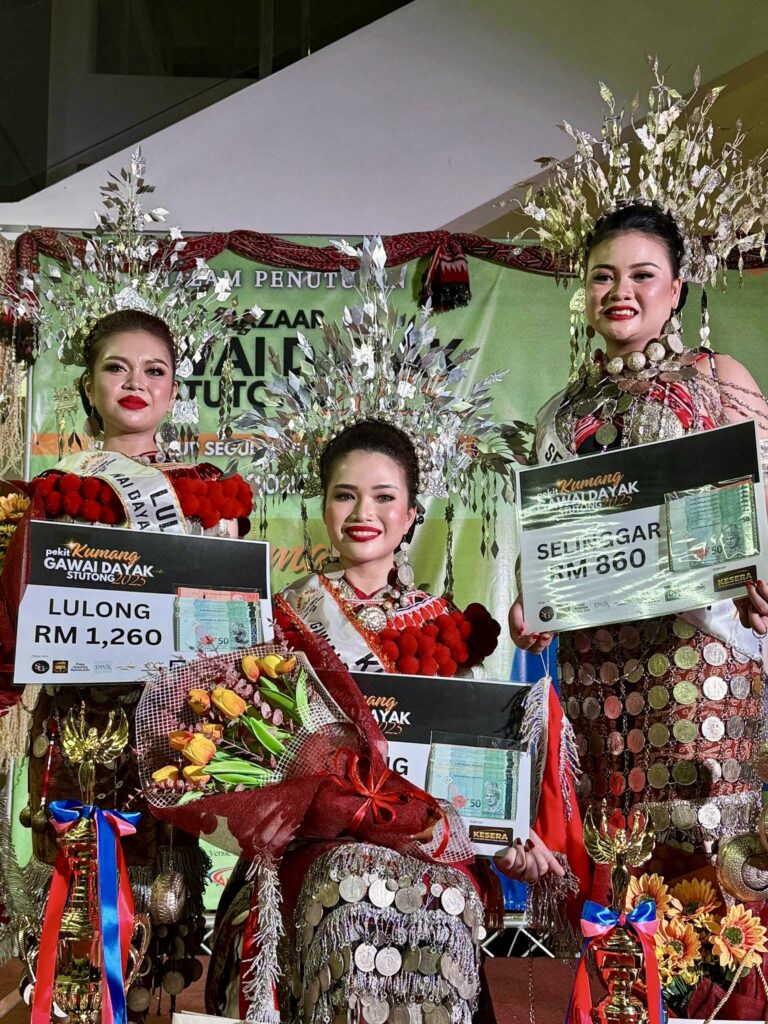
Her dream does not stop at the local level. Sharmin hopes to one day represent Iban culture on national and even international stages.
“I want to bring pride to Saratok and stand equally among other regions. That’s one of the reasons I keep pushing myself – to understand my culture even more deeply and share it with a wider audience,” she emphasised.

To her fellow Iban youth, she offers this message: “Take pride in and elevate our culture, traditions, and identity – especially through participating in cultural pageants like pekit kumang and other traditional competitions.”
Sharmin doesn’t just say this – she lives it. Standing at just 153 centimetres, she may not be the most imposing figure on stage, but her presence speaks volumes. It’s not spectacle that sets her apart, but soul.
She is living proof that you don’t need a big team, sponsors, or perfect circumstances to carry something powerful forward.
All you need is a calling – and the courage to answer it.
As Gawai comes and goes each year, it’s easy to be swept up in the music, the laughter, and the food. But somewhere between the rhythm of the gong and the smoke of the offerings, voices like Sharmin’s remind us of something deeper.
Bejawang may no longer fill the longhouse the way it once did – but in the hands and heart of this young woman, it is finding its voice again.
For Sharmin, every verse is a thread back to her roots. For the rest of us, it is a quiet call – to remember, to learn, and to carry our stories forward.