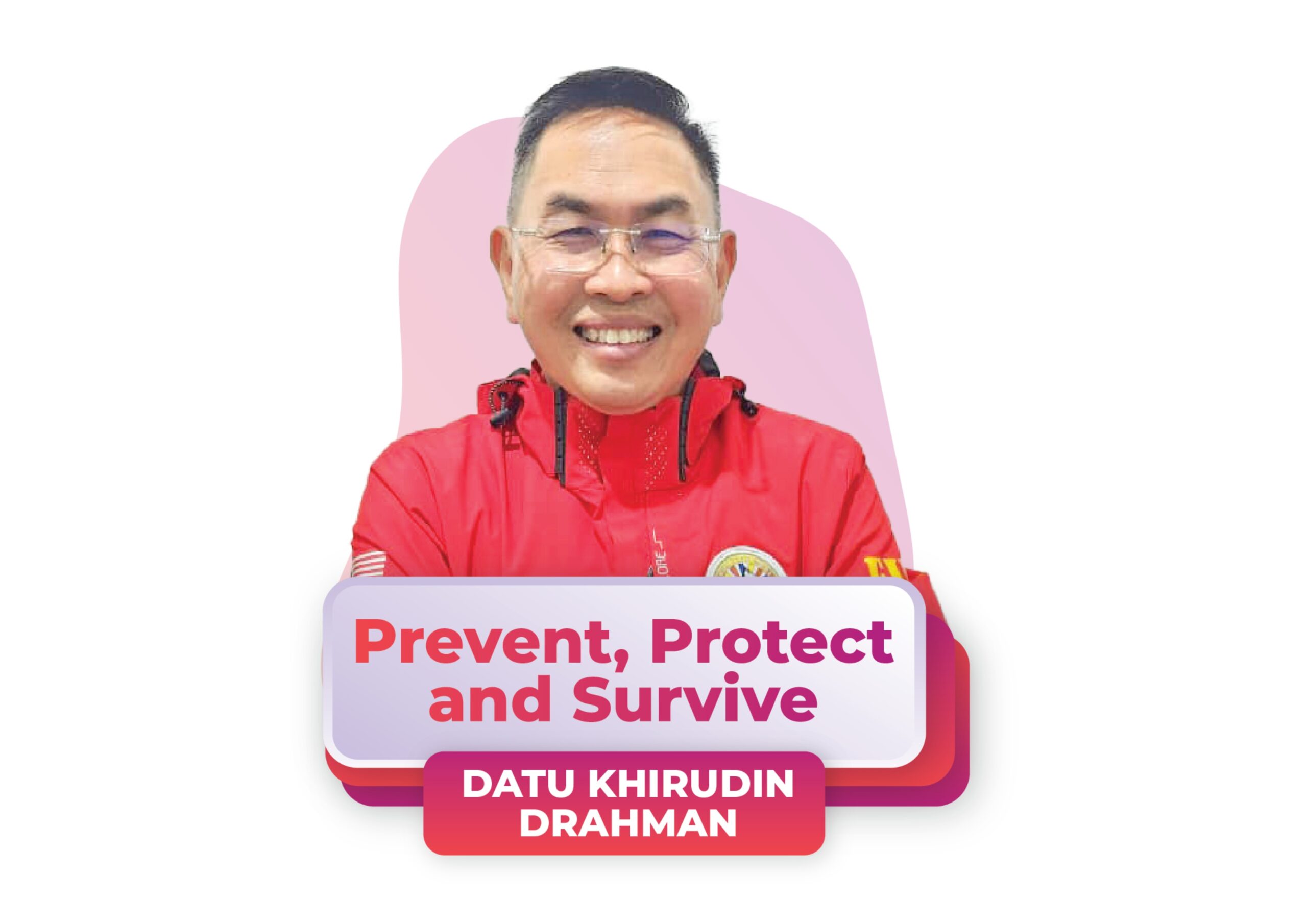
IT often takes a tragedy to remind us of something we should never have forgotten in the first place – that every worker deserves to return home safely at the end of the day.
Yet, as highlighted recently by Alliance for a Safe Community chairman Tan Sri Lee Lam Thye, compliance with Occupational Safety and Health (OSH) standards in Malaysia remains worryingly low, especially among small and medium enterprises (SMEs).
This is not just a statistic. It is a reflection of a deeper issue – how workplace safety is still, in some quarters, treated as optional rather than essential.
And that should concern all of us.
Because behind every lapse in safety is a human story waiting to unfold – a worker injured, a family affected, a life changed forever.
For many SMEs, the challenges are real. Limited financial resources. Lack of technical expertise. Uncertainty about regulatory requirements.
These are not excuses – but they are realities that must be acknowledged.
Running a small business is never easy. Margins are tight. Survival often takes priority.
In such an environment, safety measures may be seen as an added cost rather than a necessary investment.
But this is precisely where the mindset needs to change. Because the cost of neglect is always higher.
A workplace accident does not just stop operations for a day. It can disrupt an entire business. It can lead to compensation claims, legal liabilities, reputational damage, and long-term financial strain. More importantly, it can cost a life.
Safety is not about ticking boxes or passing inspections. It is about culture.
A safe workplace is one where employers take responsibility, where workers are empowered to speak up, and where risks are identified and addressed before they turn into incidents.
It is about leadership – setting the tone from the top that safety is non-negotiable.
And it is about awareness.
If, as Lee pointed out, many SMEs do not fully understand their OSH obligations, then the issue is not just enforcement – it is education.
Improving workplace safety cannot rest on employers alone. It requires a collective effort.
Government agencies must continue to strengthen enforcement – not just through penalties, but through guidance and support.
Industry associations and chambers of commerce have a role to play in outreach, helping businesses understand what is required in practical, simple terms.
Training must be made accessible, relevant, and tailored to the realities of SMEs.
At the same time, incentives can make a difference.
Tax deductions for safety investments. Grants for upgrading equipment. Lower duties on protective gear. These are not handouts – they are enablers.
Because when safety becomes affordable, compliance becomes achievable.
Perhaps the most important shift needed is this:
To stop seeing safety as a cost.
And start seeing it as an investment.
An investment in people.
An investment in productivity.
An investment in sustainability.
A safe workplace is a productive workplace. Workers who feel protected are more confident, more focused, and more committed. In the long run, safety is not a burden – it is a competitive advantage.
We are also living in a time where technology can bridge many gaps.
Tools such as digital reporting, self-assessment platforms and data-driven risk monitoring are transforming how safety is managed.
These solutions are no longer luxuries reserved for large corporations. With the right support, they can be adapted for SMEs, making compliance simpler, more practical and more efficient.
There is little doubt that, when used well, technology can turn safety from a complex obligation into a manageable, even seamless, process.
At its core, however, this issue is not about policies, guidelines, or enforcement. It is about people.
A father who wants to return home to his children. A mother who works hard to support her family. A young worker just starting out in life.
Their safety should never be compromised. Not for profit. Not for convenience. Not for lack of awareness.
So perhaps the question is not whether we can afford to invest in workplace safety.
It is whether we can afford not to.
Because every accident that could have been prevented is one too many. And every life lost due to negligence is a failure we must not accept.
Workplace safety is not optional. It never was. It is a responsibility. A duty.
And above all, a commitment – to ensure that at the end of every working day, every worker, regardless of where they are employed, has the same simple right fulfilled: To go home safely.
—————————————————————
DISCLAIMER:
The views expressed here are those of the writer and do not necessarily represent the views of Sarawak Tribune. The writer can be reached at drnagrace@gmail.com.