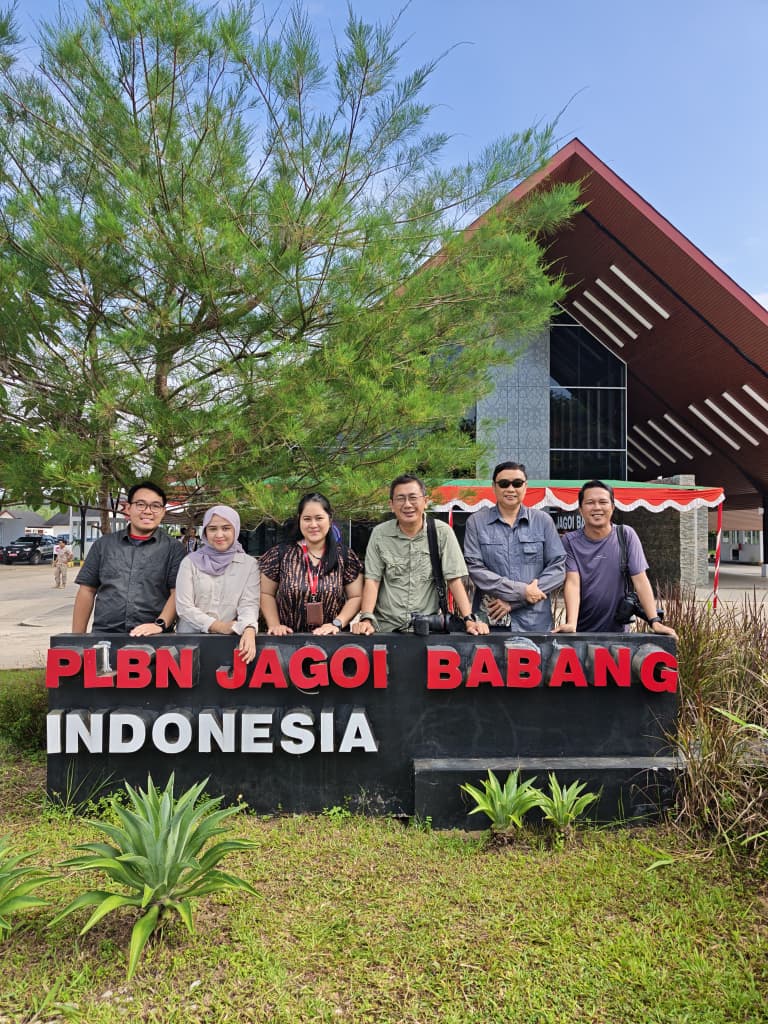
WHEN the opportunity arose to cover Deputy Minister of Transport (Riverine and Marine) Datuk Henry Harry Jinep’s visit to Jagoi Babang, Indonesia, for the Gawai Sowa celebration, I saw it as a chance to report on a unique cross-border cultural event.
As a journalist, assignments often take me to places I have never visited before.
However, I did not expect that a trip to another country would leave me feeling as though I had never really left home.
The journey from Kuching began early on Wednesday morning (June 3).
As our convoy travelled through Bau and Serikin before reaching the Malaysia-Indonesia border, I found myself reflecting on how borders are often associated with differences – different countries, different systems and different cultures.
Yet, the moment I arrived in Jagoi Babang, those differences seemed to fade into the background.
The language sounded familiar. The food looked familiar. The smiles and laughter that filled the celebration grounds felt no different from those at any Gawai gathering in Sarawak.
Had it not been for the Indonesian flags and the immigration procedures we had completed earlier, I might have forgotten that I was no longer in Malaysia.
That was my first impression of Jagoi Babang.
I was there to cover the Gawai Sowa celebration, an annual event that brings together members of the Dayak Bidayuh community from both sides of the border.
This year marked the 186th edition of the celebration, underscoring its long-standing significance to the community.
As the day unfolded, it quickly became clear that this was more than a cultural festival – it was a reunion.
Throughout the celebration, I met people who spoke fondly about relatives living in Sarawak.
Some shared stories about family members in Bau, while others talked about regularly visiting Kuching and other parts of Sarawak.
Although the Dayak Bidayuh communities in Jagoi Babang and Bau now live in different countries, they continue to share the same ancestry, traditions and cultural heritage.
Long before Malaysia and Indonesia emerged as modern nation states, these communities were already connected through family ties, customs and shared history.
That connection remains remarkably strong today.
One of the most memorable moments of the trip happened away from the main celebration grounds.
While exploring the area, I stopped at a modest coffee shop operating from the car porch of a family home opposite the Komplek Balai Adat Jagoi Babang.
Known among locals as Kedai Kak Subat, the shop has become a popular stop for both residents and visitors.
There, I discovered something that many Malaysian visitors find surprising.
The shop accepts Malaysian Ringgit.
Its owner, Subatriati Syl Jombian, told me that many of her customers come from Sarawak, making the practice perfectly normal.
According to her, Malaysian visitors are often surprised when they learn they can use Ringgit to pay for their drinks and meals.
For her, however, it is simply part of daily life.
The exchange may seem like a small detail, but I found it fascinating.
For most travellers, one of the first things they do before heading overseas is exchange their money for the local currency.
Yet, there I was, sitting in Indonesia and paying with Malaysian Ringgit.
It was a simple but powerful reminder of how closely connected these border communities remain.
The relationship between Jagoi Babang and Bau extends far beyond official boundaries.
It exists in everyday interactions, family relationships, business transactions and cultural traditions.
Later in the day, as speeches were delivered and cultural performances took place, Henry, who is also the Tasik Biru assemblyman, spoke about the importance of preserving these longstanding ties while strengthening cooperation between Sarawak and West Kalimantan.
Among the matters he highlighted was the proposed Immigration, Customs, Quarantine and Security (ICQS) complex in Serikin.
Like many infrastructure projects, discussions surrounding the proposed ICQS often focus on economic growth, trade opportunities and border management.
Those are undoubtedly important considerations.
A fully operational ICQS facility would improve accessibility, facilitate smoother travel, and support tourism, trade and business activities between both regions.
It would also strengthen regional connectivity and contribute to broader efforts to enhance economic integration along the Malaysia-Indonesia border.
However, after spending a day in Jagoi Babang, I found myself viewing the project from a different perspective.
For the people living along the border, the proposed ICQS is not simply about creating connectivity because, in many ways, that connectivity already exists.
Families have maintained relationships across the border for generations.
Communities continue to celebrate together despite living in different countries.
Visitors regularly travel between both sides for cultural events, family gatherings and social occasions.
What the proposed ICQS would do is make those connections easier to maintain.
It would allow relatives to visit one another more conveniently, support local businesses that depend on cross-border visitors and encourage tourism while strengthening cultural exchanges between communities that already share so much in common.
Most importantly, it would acknowledge a reality that local residents have long understood – that the border is not merely a dividing line; it is also a meeting point.
As the celebration drew to a close and we prepared for the journey home, I found myself reflecting on everything I had seen throughout the day.
Technically, I had spent the day in another country.
Yet at no point did it truly feel that way.
Perhaps that is what makes Jagoi Babang unique.
It is a place where borders exist on maps, but where relationships continue to transcend them.
A place where Ringgit and Rupiah coexist, traditions remain shared, and communities separated by nationality continue to gather as one family.
As I crossed back into Sarawak that evening, I realised that the most memorable part of the assignment was not the border itself.
It was discovering how little that border seemed to matter to the people who call this region home.
In a world where borders are often viewed as barriers, Jagoi Babang offers a different perspective – one where history, culture and kinship continue to unite communities despite the lines drawn on a map.
The views expressed here are those of the writer and do not necessarily represent the views of Sarawak Tribune. The writer can be reached at sarahhafizahchandra@gmail.com.