‘Modern leadership, therefore, is no longer about maintaining the centre; it is about navigating the volatile space between what is and what could be.’
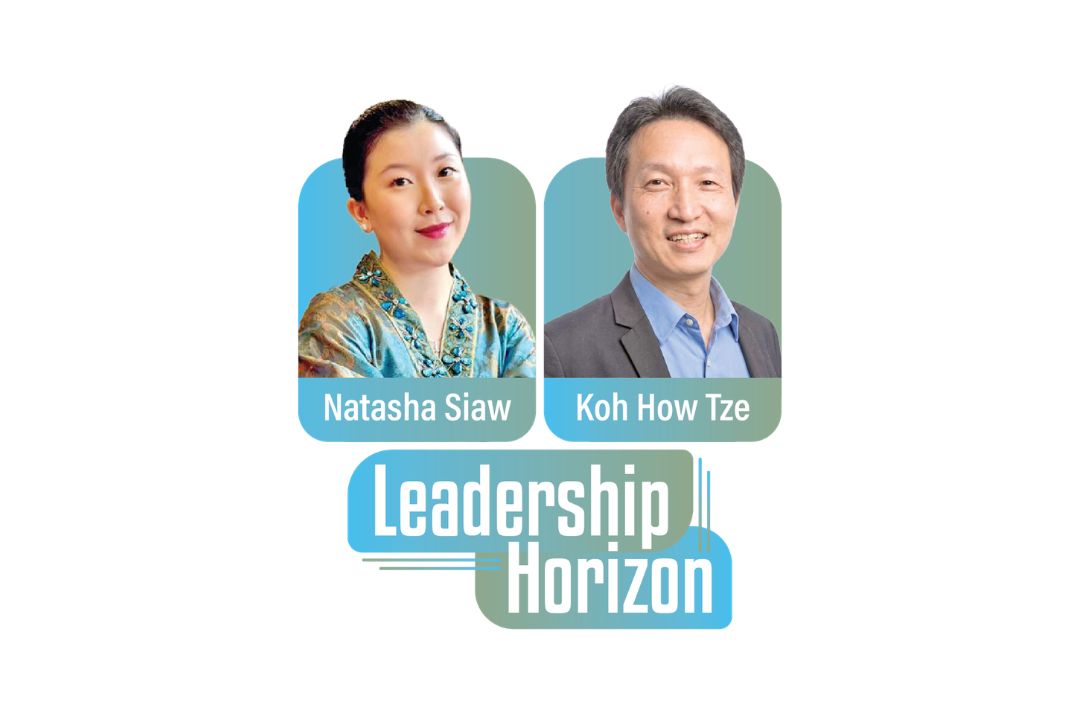
● Natasha and Koh examine how leadership is evolving from managing organizations to shaping the future at the intersection of human values and advancing technology.
For generations, the definition of leadership was comfortably predictable. A leader was the solitary figure at the top — the one who made the calls, carried the weight, and pointed the organization toward its finish line.
Today, we are navigating an era of unprecedented acceleration. Artificial intelligence can now create, analyse, and communicate.
Automation is actively dismantling traditional work structures. Data has become our most critical strategic currency, and hyper-connectivity has permanently erased geographical borders.
Entire industries are being rewritten overnight by tools that barely existed a decade ago.
Yet, as this rapid technological shift completely redefines what we can do, a far more fundamental question remains: Who must we become to lead it?
Leadership Is No Longer Just About Managing the Present
Traditional leaders managed existing systems; tomorrow’s leaders must manage possibilities, anticipate uncertainty, and make decisions whose effects extend beyond their organisations.
As automation accelerates and machines increasingly “think” for us, we face a dangerous risk that as our technology grows infinitely smarter, our own cognitive muscles atrophy — the defining paradox in the AI era.
In an age where algorithms can easily optimize the known, the ultimate human competitive edge lies in critical, unconventional thinking; it is the ability to challenge the accepted norm and connect seemingly unrelated dots that a machine cannot see.
Modern leadership, therefore, is no longer about maintaining the centre; it is about navigating the volatile space between what is and what could be.
And perhaps most importantly, it requires the rare ability to remain deeply grounded in our shared humanity while steering through extraordinary technological change.
The Humanity Lens
As the world rapidly changes, we are confronted by a simple but profound question: How do we remain human?
In an era defined by automation, being human has become a fundamental value in and of itself.
Technology can accelerate communication, but it does not inherently deepen relationships, especially in an era where we are talking ‘to’ technology, rather than talking ‘through’ it, we are quietly stripping away the meaning of human connection.
While AI engines may be able to describe in words a physical sensation, a particular scent or human emotions, AI will never be able to replace us in experiencing something.
Hence, the more powerful our tools become, the more vital our human qualities will be, for they are the defining currencies of the future.
We can deploy artificial intelligence to generate words, images, and ideas, but meaning remains exclusively a human domain.
The Technology Lens
The primary utility of technology lies in its capacity to build resilience, generate opportunity, and optimize human outcomes.
Functionally, technology provides unprecedented operational leverage, allowing resources to be scaled with high efficiency.
However, the expansion of technological capability introduces complex governance and risk management requirements.
Every new operational advantage produces a corresponding systemic vulnerability that leadership must actively mitigate:
- Algorithmic Accountability
- Information Integrity
- Workforce Transition
- Data Governance
Ultimately, technology dictates the scale of organizational capability, but leadership determines the ethical and strategic application of that capability.
Where Humanity Meets Technology
This is where the two perspectives finally meet.
Without technology, our capacity to solve tomorrow’s challenges is fundamentally limited. But without humanity, technology alone increases our risk of pursuing the wrong objectives.
Consider the current narrative around artificial intelligence. We are collectively obsessing over how intelligent our machines are becoming.
Yet, we may be ignoring a far more fundamental question: How intelligent must humans become in response?
With the aid of technology, the cognitive threshold may have just been raised; when you have infinite access to information, having more answers does not necessarily equate to having the right solution to the problem at hand.
If one lacks the critical comprehension to understand the context, a surplus of data becomes entirely useless, if not misleading.
It is a profound collaboration between machine capability and human judgement, and this is exactly where we stand today.
- If AI can generate an answer in seconds, the ultimate human advantage will no longer be having the right answer—it will be knowing which questions are worth asking.
- If machines can instantly calculate a thousand different possibilities, the leader’s mandate is the courage to choose which possibility deserves to become reality.
- If technology can flawlessly optimize a process, leadership must fiercely protect what that process is ultimately meant to achieve.
From Technology to Transformation
There is another distinction we must confront: true digital transformation does not begin with software. It begins with people.
Before a single line of code is written or a new system is launched, people must believe in the necessity of change. Technology may give us the speed to move forward, but it is people and process that ensure we are heading in the right direction.
This is why, within the Leadership Horizon vision, the future of leadership must be engineered across three non-negotiable dimensions: People. Process. Technology.
These are not separate initiatives; they are an interconnected ecosystem.
A Conversation Across the Horizon
This is the type of conversation we aim to spark through the Leadership Horizon.
From the humanity lens, we ask: “What must we preserve as humanity?” From the technology lens, we ask: “What can we build with technology?”
The vast and uncharted landscape lies between these questions. The challenge ahead is not merely advancing technology, but ensuring that wisdom, ethics, and responsibility keep pace.
As we stand on the edge of this new horizon, the most urgent question for a leader is no longer: “What will the future become?”, but rather “Who will we become as we create it?”
The Horizon Question
As technology gives humanity more power than ever before, what kind of humans — and what kind of leaders — will we choose to become?
The views expressed here are those of the writer and do not necessarily represent the views of Sarawak Tribune.