
There are some things the human brain decides are worth remembering.
For me, apparently, the names of all six of Henry VIII’s wives are among them.
Catherine of Aragon, Anne Boleyn, Jane Seymour, Anne of Cleves, Catherine Howard and Catherine Parr.
I did not have to look that up.
Ask me to name all the rulers of the Melaka Sultanate, however, and suddenly my memory becomes remarkably selective. I may need a glass of water, a moment of silence and, if we are being completely honest, Google.
One might reasonably ask how this happened.
I am Malaysian, after all.
My fascination with history probably began during family holidays to Europe. Walking through centuries old castles, royal palaces and medieval towns made history feel much more alive than it ever did in a classroom. A textbook can tell you that someone was imprisoned in a castle, but standing inside the actual castle makes you think, “Oh. So this is where they kept people. Rather grim.”
The Tower of London was one of those places that stayed with me. Behind its stone walls were imprisoned princes, palace conspiracies and executions. Anne Boleyn and Catherine Howard, two of Henry VIII’s wives, were both beheaded on his orders.
There is something about standing in the very place where two of a king’s wives met such a grisly end that makes a history lesson considerably harder to forget.
Henry, meanwhile, continued through his six marriages with what can only be described as remarkable commitment to the institution of marriage.
Then I discovered Philippa Gregory, and things became considerably worse.
Suddenly, the Tudors and the Wars of the Roses were no longer a collection of names and dates. They were full of ambition, jealousy, betrayal, complicated marriages and people making spectacularly questionable decisions.
History had become gossip.
And Henry VIII was, naturally, one of the main characters.
He wanted a male heir. His marriages became matters of state. His break with the Roman Catholic Church changed England forever. Then came Edward VI, Mary I and Elizabeth I, and the family drama continued long after Henry was gone.
Really, it was excellent television before television existed.
But then there was my own history.
Parameswara.
The Melaka Sultanate.
The Brookes.
I learnt all of them in school. I knew they mattered. Yet somehow, they never occupied quite as much space in my brain as the Tudor family tree.
Take Parameswara. For years, he was simply the name I associated with the founding of Melaka. But when you actually stop and consider his story, it is rather extraordinary.
Here was a ruler navigating political uncertainty who eventually established Melaka in the early fifteenth century. What followed was the rise of one of Southeast Asia’s most important trading centres, attracting merchants from across the region and beyond.
There was trade, diplomacy, religion, ambition and power.
In other words, everything one could possibly want from a historical drama.
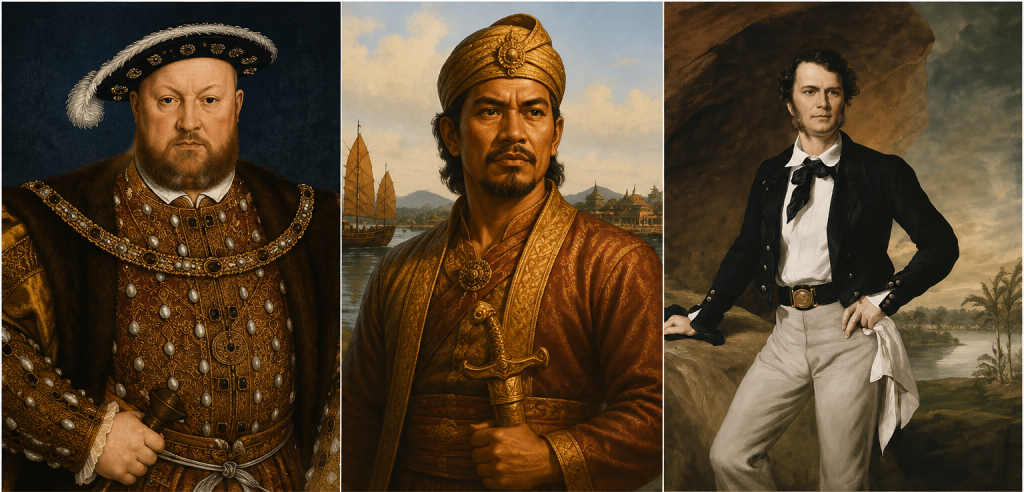
Except Parameswara never got the Henry VIII treatment.
Maybe Parameswara is not less interesting than Henry VIII. Maybe he simply had a less aggressive public relations team.
Henry had six wives, two of whom were beheaded on his orders, a religious revolution and enough family drama to keep historians employed for centuries.
Parameswara founded Melaka and helped establish one of Southeast Asia’s great trading centres.
Yet one became a historical celebrity, while the other became a chapter in our Sejarah textbook.
I think we know who won that particular public relations battle.
Then there is James Brooke.
Growing up in Sarawak, I have heard his name so often that James Brooke sometimes feels less like a historical figure and more like someone who ought to be running a slightly expensive hotel.
Yet his story is extraordinary.
A British adventurer arrived in Sarawak and eventually established a dynasty that ruled the state for more than a century. There was expansion, resistance, political manoeuvring and conflict.
Sharif Masahor opposed Brooke’s growing influence. Rentap resisted Brooke expansion. These were not merely names printed in a textbook. They were people fighting over authority, territory and the future of Sarawak.
Again, we had all the ingredients.
Rivalries? Yes.
Power struggles? Certainly.
Resistance? Plenty.
Drama? We have barely scratched the surface.
So why did I find Henry VIII more interesting?
Perhaps the problem is not our history. Perhaps it is the way we have told it.
At school, history can sometimes feel like an exercise in remembering. Dates, names, events and examinations. We are told what happened, but not always encouraged to wonder about the people behind those events.
And people are what make history interesting.
Living abroad a few years probably added another layer to this. When you live away from home for a long time, you absorb another country’s history and become familiar with its leaders, wars, scandals and historical figures.
Then you return home and realise there are parts of your own history you have never properly explored beyond what you were taught at school.
You leave home thinking you are going away to learn about the world.
Then you come back and realise you still have plenty to learn about home.
Perhaps that is the real lesson here.
History does not have to be a list of dates we memorise for an examination and promptly forget afterwards. It can be stories about ambition, betrayal, love, war, power, survival and people making decisions that changed the lives of everyone around them.
In other words, history has everything.
We just need to tell it like it does.
And perhaps if we did, I might finally be able to name the rulers of the Melaka Sultanate without consulting Google.
That would be a personal victory.
Although, for the record, if anyone ever needs to know Henry VIII’s six wives, I remain at your service.
The views expressed here are those of the writer and do not necessarily represent the views of Sarawak Tribune.