Keeping Screens Alive: A TV Repairman’s Story
For over three decades, Mokhsen Zainudin has been repairing televisions, witnessing the evolution from bulky CRTs to sleek QLEDs. On World Television Day, he reflects on a craft that keeps screens — and memories — alive in an era dominated by smartphones and streaming.
OLD TECH, NEW TRICKS
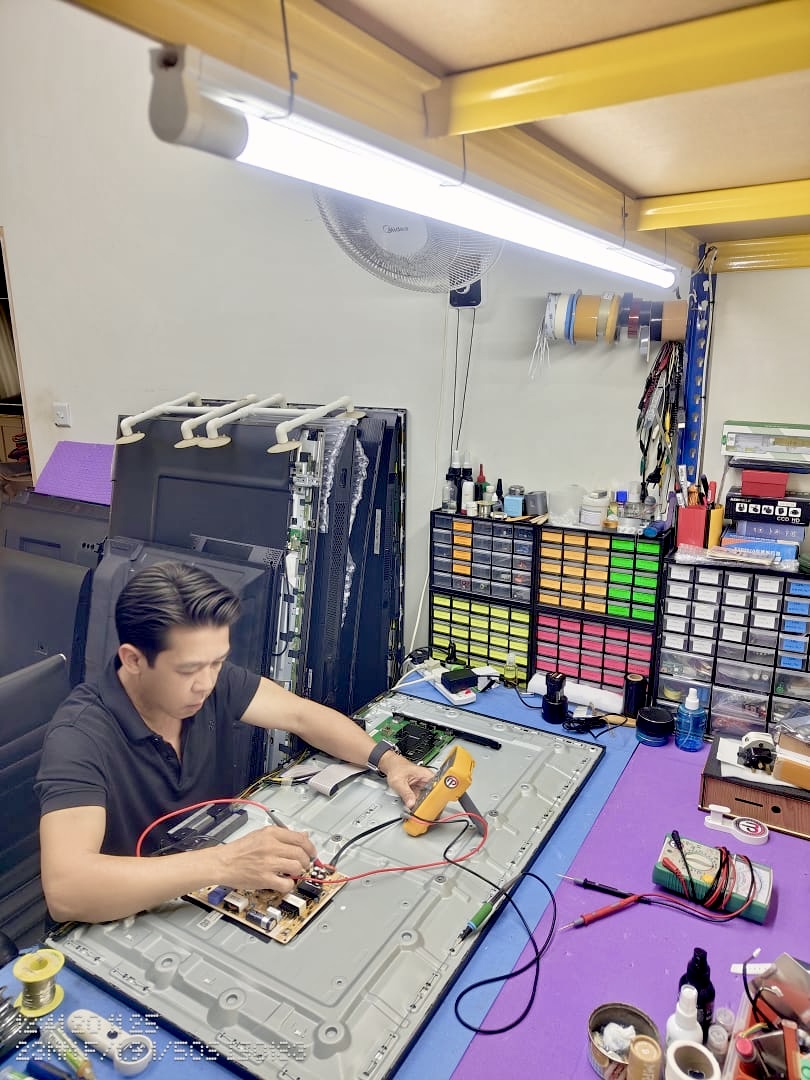
THERE is a man whose life has revolved around a glowing box that once brought families together — the television. For more than three decades, Mokhsen Zainudin has lived among circuit boards, cables, and flickering screens, keeping them alive long after the world moved on to smartphones and streaming services.
While televisions in many homes have become background noise, for Mokhsen they are a craft, a challenge and a source of quiet pride.
Since 1991, he has dedicated his life to repairing televisions — not for entertainment but for the skill, patience, and satisfaction each repair brings.
“I studied electronics at Vokasional Kuching.
That’s how I started repairing televisions, and I’ve been doing it ever since,” the 52-year-old said, beginning a story shaped by decades of dedication.
Thirty-four years in the trade is no small feat but for him, every fixed screen tells a story: of families, of memories and of a man quietly keeping alive a craft that connects past and present.

Changing times, changing screens
Mokhsen has watched televisions evolve from bulky, boxy CRT sets to sleek, ultra-thin screens.
CRTs, with their deep backs and heavy frames, once dominated living rooms.
Then came plasma — a technology that first brought flat screens into homes, offering brighter colours and sharper images.
Today, he works on LED televisions lit by backlights, OLED panels where each pixel shines independently, and QLED displays enhanced with quantum dots for vivid colour.
“All of them are thinner, sleeker, and far more complex than anything I repaired in the ’90s. Electronics always change with the times and technology.
From CRTs back then to all sorts of models today,” he said. With complexity comes challenge.
For Mokhsen, plasma televisions remain the easiest to repairvwhile Sony LED sets often “cause the most headaches.”
“The components are so tiny now. Hard to inspect and the motherboard is more sensitive than ever,” he explained.
Repair or replace?
In today’s consumer world, more people choose to buy new televisions rather than repair the old. Spare parts are expensive and labour costs have risen, making replacement seem more practical than restoration.

Yet Mokhsen still sees the importance of repair, especially for those who cannot afford a new television or who have an emotional attachment to an older set.
He recalled one moment fondly: helping a customer who could not afford a new TV. When they finally managed to get an affordable one, their satisfaction stayed with him long after the repair was done.
Even when repairs are routine or technical, Mokhsen never runs out of stories — some that bring a smile, others that remind him of the strange, wonderful ways people interact with their televisions.
“The funniest is when people bring in a television with an obviously cracked or shattered screen, yet insist it’s not cracked — even after I explain it clearly,” he said, amusement dancing in his eyes.
He laughed — a warm, knowing laugh born of decades witnessing human quirks and contradictions. When asked about the most common causes of television damage, Mokhsen leaned back thoughtfully, ready to share the lessons learned from years of repairing screens.
“People leave their televisions running for hours, forget to switch off the main socket, and, most often, they don’t unplug the HDMI cable during thunderstorms.
Many don’t realise lightning can travel through the signal cable. It’s amazing how such small oversights can cause so much trouble inside these delicate machines,” he pointed out.

Patience and people
Television repair, Mokhsen explained, was not just about soldering and screwdrivers.
It’s also about understanding people and managing expectations.
“Most customers ask the same two questions: how much will it cost and how long will it take?” he said.
Some are patient when he explains that parts must be ordered from overseas, often from China while others grow frustrated when repairs take time.
“For models older than eight years, spare parts are often difficult to find. Sometimes they aren’t even produced anymore,” he added. Still, the joy of reviving a television that others have given up on makes every challenge worthwhile.
“I feel very happy and proud when I can fix a television that other places couldn’t repair,” he said, his eyes lighting up.
These moments — small victories, solved problems, happy customers — are what keep him going.
Yet Mokhsen has noticed a shift among younger generations: fewer young people are interested in repairing televisions, most preferring gadgets like phones and PC games, leaving the craft at risk of fading away.
The trade, he worries, may gradually disappear unless it is nurtured. He hopes that support from the government or other organisations — especially in providing modern tools and equipment — will help preserve this craft for the future.
What TV means today For this World Television Day, Mokhsen reflects on how television has changed the way people interact with media.
Families rarely gather around the television anymore; smartphones and tablets dominate attention.

Yet television remains meaningful for him, not as a form of entertainment, but as the pulse of his work.
“I’m always busy repairing, delivering and collecting customers’ televisions.
While they may no longer bring families together, television remains central to my life and my craft,” he reflected.
Even in an era dominated by smaller, portable screens, Mokhsen believes the craft of television repair will endure.
“Repair work won’t disappear.
Technology keeps evolving and people will always need someone who knows how to fix their devices,” he stressed.
In a world where television is sometimes dismissed as “old tech,” Mokhsen stands as proof that behind every lit screen, there is a pair of hands keeping it alive, a mind understanding its language, and a human story reminding us that every device deserves a second chance — as long as someone is willing to try.
On this World Television Day, his story serves as a quiet tribute to the people behind the screens — those who keep our windows to stories, news, and entertainment working and in doing so, remind us that every craft and every glowing screen has a story to tell. For enquiries about Mokhsen’s television repair services, please contact him at 014-2242511.