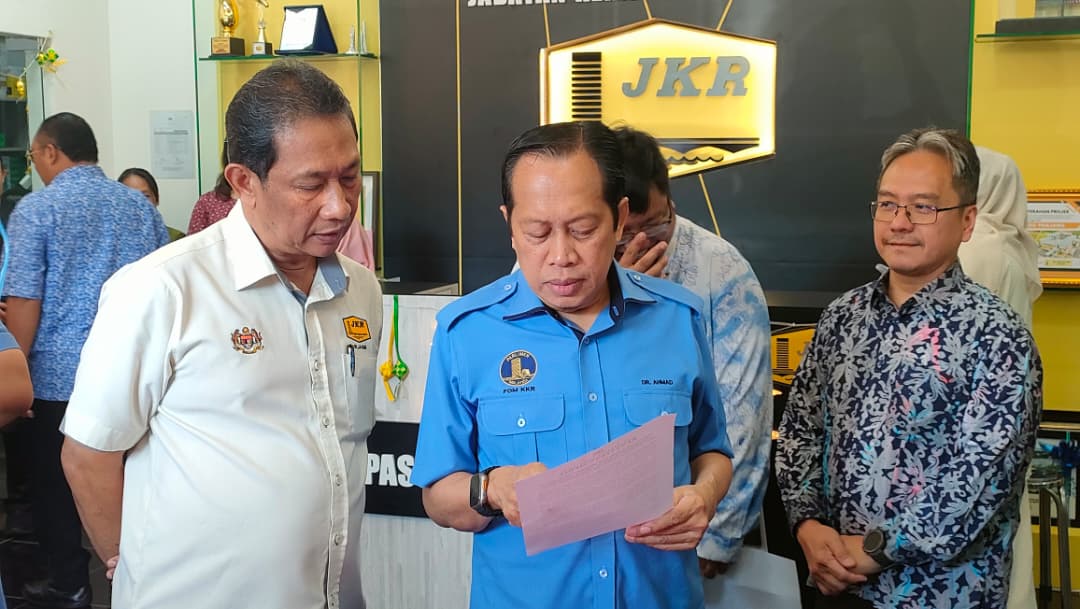
KUCHING: Federal projects worth worth RM7.38 billion are currently being implemented in Sabah and Sarawak under Pasukan Projek Khas 2 (PPK-2), said Deputy Works Minister Datuk Seri Dr Ahmad Maslan.
He said of the total 122 projects, 54 are in Sarawak with a combined value of RM3.323 billion, while 68 projects are in Sabah valued at RM2.805 billion.
“Although Sabah has more projects, it is largely due to a higher number of school projects there.
“In Sarawak, the overall project cost is higher due to the implementation of large-scale developments such as hospital projects,” he said during a press conference following his working visit to the PPK-2 Sarawak office at Wisma Hong here today.
On project monitoring, Ahmad said 167 PPK-2 officers have been tasked with overseeing the implementation of projects across both states.
He noted that the majority of the projects are progressing smoothly, with only three classified as “sick projects” — defined as those delayed by more than 20 per cent — involving two in Sabah and one in Sarawak.
However, he highlighted several challenges affecting project implementation, particularly the shortage of construction materials and suppliers.
“There is a critical lack of Industrialised Building System (IBS) suppliers.
“In Sabah, there are only two companies, while in Sarawak there is just one,” he said.
He added that several key construction materials — including tiles, fire-rated doors, roofing, aluminium frames, autoclaved aerated concrete (AAC) blocks and ironmongery — are largely sourced from Peninsular Malaysia, contributing to supply constraints.
“At the same time, local supplies of essential materials such as cement, timber, steel and finishing products remain insufficient to meet high demand.
“This shortage has led to higher costs, slower project timelines and reduced competitiveness in the construction sector, particularly in Sabah and Sarawak,” he said.