PART 2
PONTIANAK, the capital of West Kalimantan, is best known for its equatorial charm, but for a visitor like me, its most defining flavour is coffee.
Much like the rest of Indonesia, Pontianak is deeply passionate about coffee, and I mean that in the best way possible.
Here, coffee shops aren’t just a part of daily life; they define it. Some cafés even run 24 hours a day, their tables constantly filled with patrons sipping dark brews, chatting, or simply people watching under the city’s warm glow.
The legend of Warung Kopi Asiang

One of the most unforgettable stops on my journey was Warung Kopi Asiang, a humble yet iconic coffee shop that has become a local institution.
The man at the helm, or more accurately in front of the stove, is Gouw Tahi Siang, fondly known as Asiang. He told us he is 70 years old, though he also mentioned he was born in 1952.
“But people said it was not a lucky year, so they changed it to 1958,” he said with a grin.
His casual humour suggests he has plenty of stories and perhaps a few flexible facts to share.
Watching him work — scooping, pouring, chatting — it’s easy to understand why people from all over the country, and now even from abroad, make a pilgrimage to his warung.
A palace brew with a royal claim
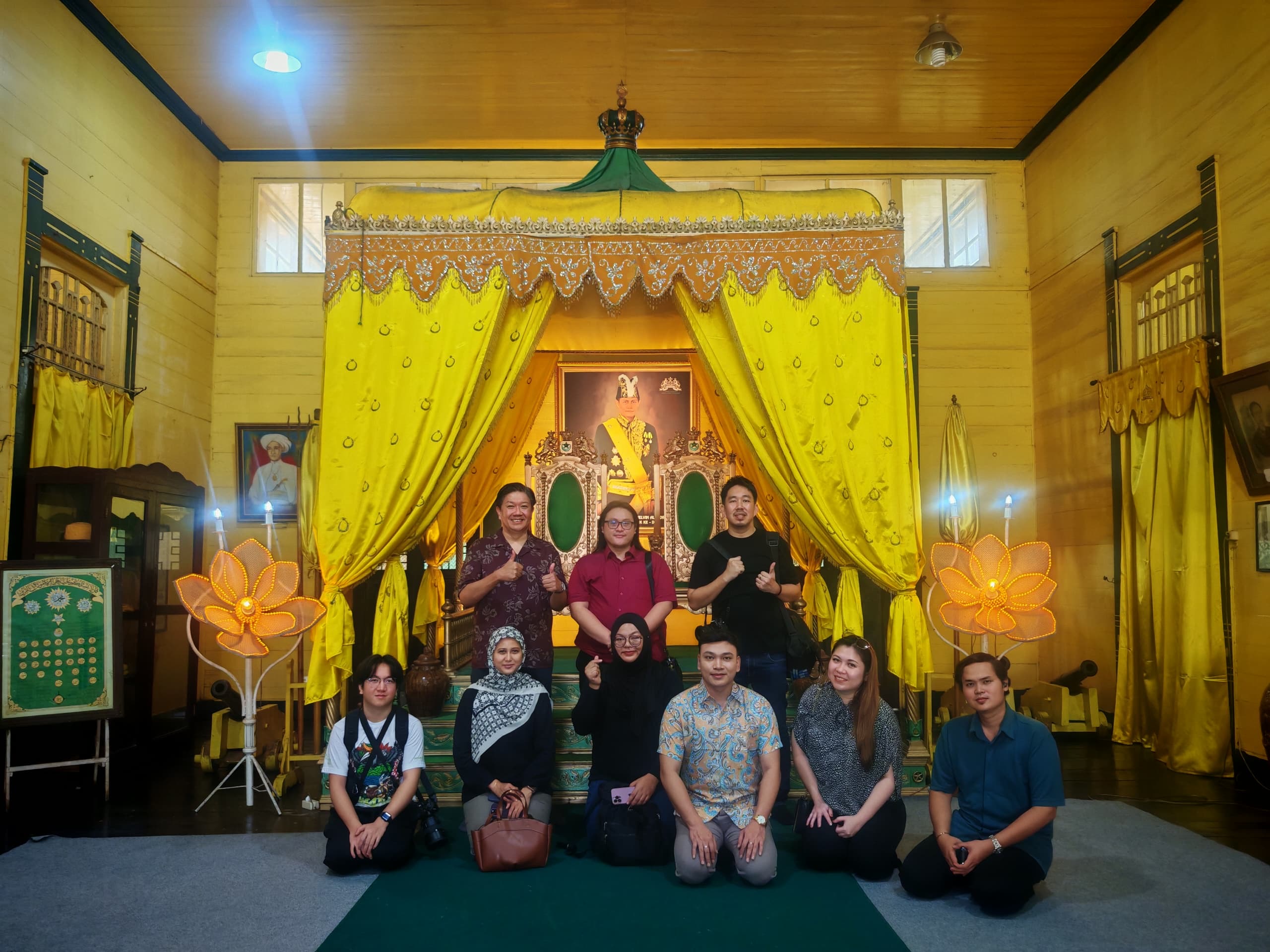
But our caffeine adventure did not stop there. Further along our itinerary was a visit to Istana Kadriah, Pontianak’s royal wooden palace.
Yes, the city has a Sultan, and his heritage is proudly preserved in this yellow-painted building dating back to the 18th century.
Inside, a striking relic caught my eye — a mirror known as the Thousand Mirror, a gift from France in 1823.
It reflected not just faces but the unexpected European threads in Pontianak’s royal history.
As we explored the palace, we were welcomed by a lively guide, a spirited woman full of stories and, surprisingly, coffee sales pitches.
She introduced us to Kopi Istane, a royal brew produced by a member of the Sultan’s family and sold only at the palace.

One sip, a thousand stories
Packaged in a round plastic container, this blend promised more than just a caffeine boost.
According to the guide, it could aid weight loss, cure HIV and cancer, and was infused with tongkat ali, a local herb famed for its health benefits.
She eyed the women in our group as she praised its slimming powers, clearly expecting someone to give it a try.
Though I am not a coffee drinker, even one sip gives me heart palpitations, I bought a container for my partner. Out of curiosity, I had a small taste.
It was dark, strong, with earthy undertones and a faint trace of ginger that lingered long after the first sip.
It was unlike any coffee I had ever tasted — intense, almost medicinal, and certainly not your typical café blend.
Of sandals and silent gestures

Before entering the palace, we were asked to remove our footwear at the bottom of the steps, a common practice in traditional homes and sacred spaces across Indonesia.
Nearby stood an elderly man, thin and frail. He looked like a guard or perhaps a caretaker, though he wore no uniform or badge.
After the tour, we descended the wooden stairs to find our sandals and shoes lined up perfectly in a neat row, side by side like soldiers.
As we reached down to put them on, the old man approached and politely asked for a small tip, not for guarding them but for having arranged them so thoughtfully.
It was such a simple act that a few of us laughed in response. In Pontianak, even the simple act of arranging shoes carries its quiet economy — and a certain undeniable charm.
On the equator, exactly
Another highlight was our visit to the Equator Monument, known locally as Tugu Khatulistiwa.
This landmark stands proudly atop the imaginary line that splits the Earth into its northern and southern halves.
Built on the precise point where the equator passes through Pontianak, it stands as both a geographical marvel and a source of civic pride.
Standing at latitude 0°0′0″ and longitude 109°20′0″, we were officially on the equator, a rare geographical moment for most travellers. The monument itself is modest but memorable, crowned with a globe sculpture.
After our visit, each of us received a certificate to mark the occasion, a small but meaningful souvenir that declared we had stood on the centre line of the Earth.
The moment may not have felt dramatic, the equator is, after all, invisible, but there was a quiet thrill in knowing we had experienced perfect geographical balance.


Heritage threads across borders
Inside the monument’s gallery, we found several cultural displays that felt remarkably familiar.
One in particular stood out, a beautifully woven textile called Kain Corak Insang, inspired by fish gills. It closely resembled our own Pua Kumbu in Sarawak, highlighting the shared Dayak heritage across the border.
There were also traditional Dayak handbags, intricately designed and visually similar to those made by our communities in Sarawak.
They were a reminder of the deep cultural ties that connect us. Different in language or detail, but united in spirit and identity.
Sunday streets and jogger jams

On the day we were due to leave, a Sunday, we awoke to a transformed scene outside our hotel. Jalan Ayani had been closed off for the city’s weekly car-free morning, and the entire stretch was flooded with people jogging, walking and stretching in every direction.
Food stalls popped up along the road, selling breakfast and drinks, and even our hotel had set up a stall for hungry passersby.
It was a cheerful scene — until we remembered we had a border to catch. The Tebedu checkpoint closes at 4 pm (Indonesian time), and for a brief moment, we feared we might be stuck in this fitness fiesta. Fortunately, a hotel staff member tipped us off to a back route, allowing us to slip past waves of Sunday joggers and arrive just in time.
The hazy blame game
Back in Kuching, the haze had once again blanketed the skies, prompting local authorities to point fingers at Kalimantan. Not to be outdone, the West Kalimantan Governor, when our group of reporters interviewed him the day before about the haze in Kuching, quickly suggested that it might have come from Riau Province, as if the haze had taken a connecting flight through Sumatra.
Fires, fields, and denial
But on our drive home, the mystery only deepened, or rather, thickened. At one point, flames were burning right beside the road.
No firefighters, no officials, not even a wandering chicken in sight, just thick smoke and a welcome party of fire. If Riau were responsible, then it must have very long arms.
The surrounding land was charred black, a clear sign of farm fires. It made one wonder if the haze was a diplomatic puzzle or simply a case of open-air denial.


Crossing the border, casually
Crossing back into Malaysia felt incredibly relaxed, as if the border had decided to take Sunday off too.
At the Indonesian checkpoint, there were no bag scans this time — just a quick passport scan and a welcoming smile.
At Malaysian immigration, it was just as easy, a quick passport tap, and we were back on home soil.
No car checks, no bag inspections. If someone had smuggled in ten sacks of mystery powder or even a Sumatran tiger in a duffel bag, no one would have noticed.
The process was impressively fast, though perhaps built more on trust than vigilance.
Where coffee meets memory
In the end, Pontianak proved to be far more than a city on the equator. It is a place where stories steep like strong coffee, where culture and community thrive in the details, from a shirtless coffee legend and royal brews to sacred shoes and smoky roadsides.
Even brief encounters here leave lasting impressions, stitched together by history, humour and the unmistakable spirit of Kalimantan.
Whether you are sipping something strong or standing at the centre of the Earth, Pontianak reminds you that sometimes, the most memorable journeys begin with a cup of coffee and an open mind.