BY SITI NURAIN RATANI
KUCHING: Every durian season, the road leading to Kampung Pasir Pandak here becomes filled with the unmistakable aroma of the “king of fruits”.
From afar, small canopies can be seen lined up along the roadside leading into the village located about 30 minutes from Kuching city centre.
Among the stalls that often attract the most customers is one run by Nur Rawaida Yakob, 33, a housewife who continues her family’s legacy of selling durians, a trade that dates back to her grandmother’s time.
For Nur Rawaida, affectionately known as Aida, durian is more than just a seasonal fruit. It is a symbol of family love, years of hard work, and a source of livelihood passed down through generations.
“I’ve been around durians since I was little. My mother and grandmother used to sell them too I would help fill baskets and count the fruits.
“Now, my cousins take care of harvesting in the orchard, while I handle sales and promotions.”
Aida started helping her family sell durians at the age of 16 while she was still in school in 2008.
Today, as a mother of four, her passion remains strong. Together with her two sisters, she continues the family routine every durian season.
“There are four of us siblings, one is still in school, and two others are also selling durians. So you could say we’ve all grown up with this work,” she said.
The family’s orchard is located in the hilly area of Pasir Pandak. Although its exact size is uncertain, the yield is sufficient to sustain their business every season.
“The old trees in the orchard produce various varieties, including durian susu, tembaga, and kuning, which are among the favourites of our regular customers.
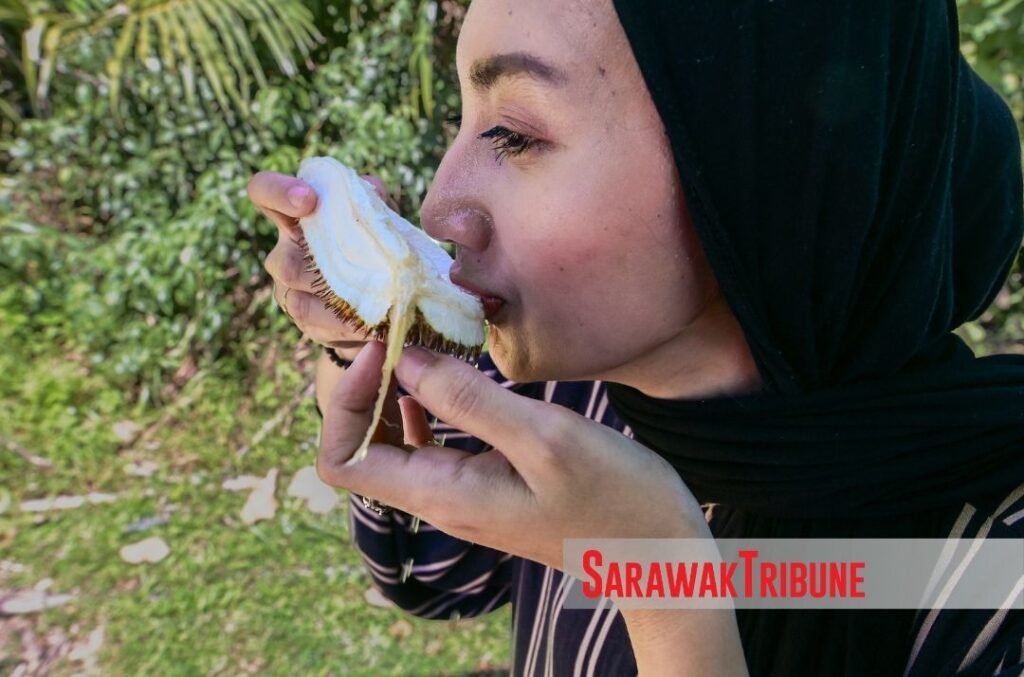
“Durian susu is the most sought after. It’s creamy, soft, and tastes different from durians elsewhere. Our regulars can tell the difference.”
According to Aida, the durian season in the area usually begins around July and lasts until the end of the year, though the fruits don’t ripen all at once, depending on weather conditions and location.
“Sometimes the orchards in Pasir Pandak bear fruit earlier, while areas like Serian follow later.
“Whenever the season starts, my cousins will collect the fruits from the orchard and send them to my house for sale.
“On weekdays, I do deliveries around Kuching, Samarahan, and Batu 7, using the cash-on-delivery (COD) system, while on weekends we set up a roadside stall in Pasir Pandak.
“Every Saturday and Sunday, I open the canopy at around 11am, and usually everything sells out in less than an hour.
“Sometimes, customers even wait in front of my house because they already know my location.”
The price of Pasir Pandak durians, she explained, depends on the type and size of the fruit ranging between RM25 and RM35 each.
“Pre-packed durians in boxes are sold at RM35 each.
“Interestingly, our regular customers are not just from nearby villages but also from other areas. Many of them are Chinese customers who love to buy in bulk for family feasts.
“They say Pasir Pandak durians are different, maybe because of the soil and the way the trees grow. Many say the flesh is sweeter.”
Besides fresh durians, Aida also sells homemade tempoyak (fermented durian) for RM10 per container.
“When there’s a surplus, I’ll organise a durian buffet. People can eat as much as they want but it usually sells out fast too.”
In addition to selling durians, Aida also handles the family’s social media promotion, where photos of freshly harvested durians posted on Facebook and WhatsApp quickly draw attention from loyal customers.
“I write my own captions and take the photos myself. Sometimes I post in the morning, and by evening, all the orders are in. Nowadays, people prefer to buy online so I have to adapt to that.”
While many see selling durians as a temporary job, for Aida, it means so much more.
“Durian is not just our livelihood, it’s our family story. From my grandmother’s time, to my mother’s, and now ours,” she said with a smile.