After more than a century of serving as a colonial administration office and later Malaysia’s superior courts, the Sultan Abdul Samad Building has reopened to the public following meticulous restoration. With its Moorish-inspired architecture, copper domes, modern cafés, exhibition galleries and heritage spaces, the historic landmark offers visitors a chance to experience Kuala Lumpur’s rich past from the inside.
The revival of the Sultan Abdul Samad Building
IF you are visiting Kuala Lumpur as a tourist, one of the most popular stops is the historic precinct around Dataran Merdeka. Each day, coaches arrive in droves, releasing thousands of visitors eager to photograph the open square and its surrounding architectural gems.
Adding to this constellation of iconic landmarks is the grand, elongated building along Jalan Raja, now welcoming visitors in an entirely new way. While many have long admired its stately façade from Dataran Merdeka, stepping inside was once a privilege reserved strictly for officials and court proceedings.
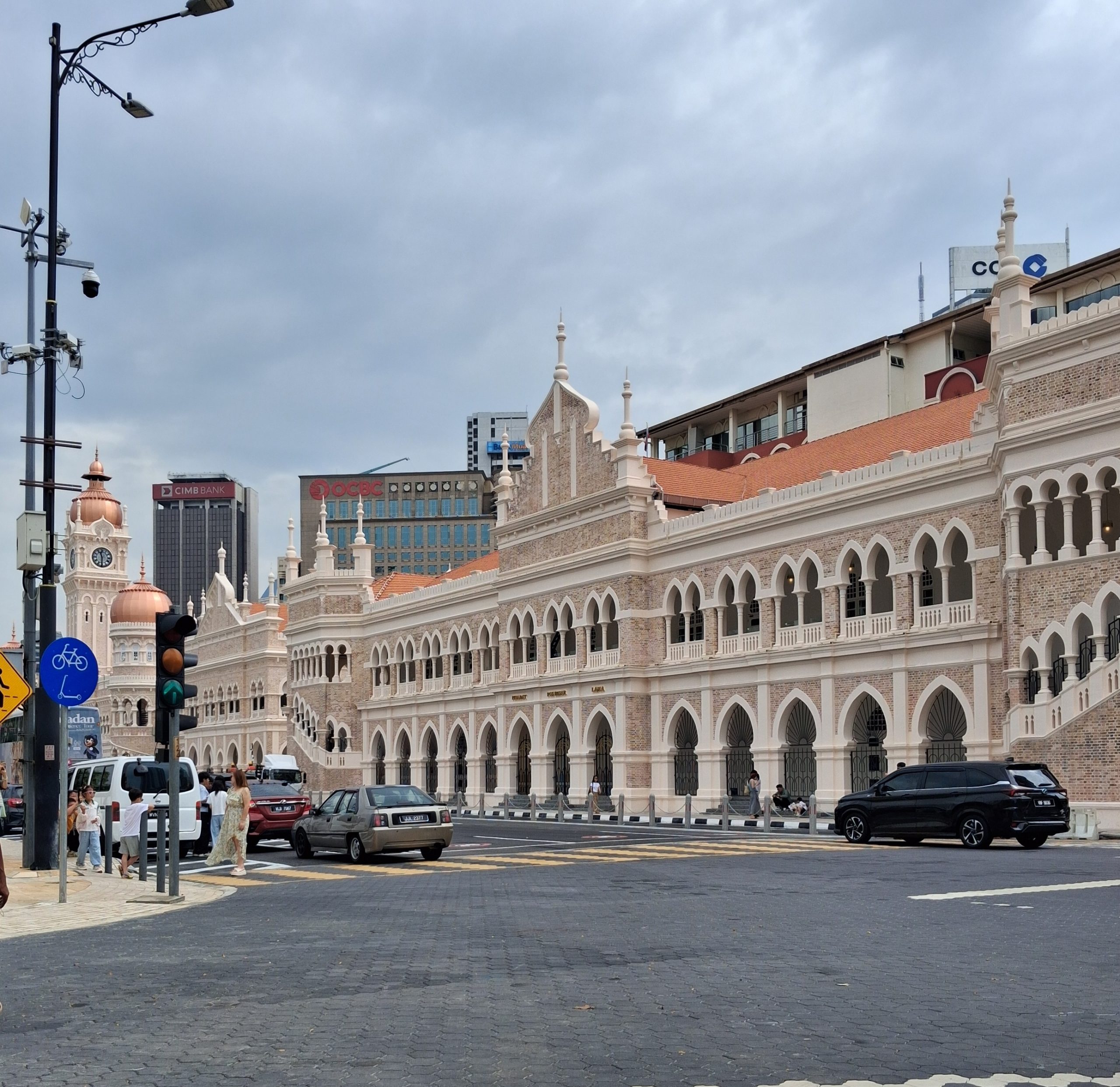
The Sultan Abdul Samad Building, a late-19th-century architectural masterpiece, stands proudly facing Dataran Merdeka and the Royal Selangor Club. Revered for its Moorish-inspired design and copper domes, the building has served many roles over time, from housing British colonial administrative offices to becoming the seat of Malaysia’s superior courts. Today, it has been given renewed purpose – and the public is finally invited in.
Following a meticulous restoration, the building officially reopened its doors to visitors in February 2026, marking a new chapter in its long and storied history.
During my ten years living in Kuala Lumpur, I walked past this building countless times. My workplace is nearby and, on many occasions, I wandered into its surrounding garden areas, which connect seamlessly to the River of Life and Masjid Jamek. I often tried to peer inside, snapping photographs of its courtyards and architectural details from whatever angles were possible.
Now that it is finally open to the public, you can imagine my excitement. I have already returned three times – not only for its galleries, but to sit, dine and enjoy a perfectly brewed cup of tea at its stylish modern cafés. Experiencing this historic space from within, not merely as an observer but as a guest, feels nothing short of extraordinary.
The Sultan Abdul Samad Building was originally designed by A. C. Norman and his assistant R. A. J. Bidwell in a Classical Renaissance style. However, under the direction of C. E. Spooner, Bidwell reworked the design into what is now variously described as Indo-Saracenic, Neo-Mughal or Moorish.
The two-storey structure follows a floor plan roughly resembling the letter F, with the extended upper bar forming its long frontage along Jalan Raja.
Wide verandas run along both floors, providing rhythm and balance to the elongated form. Rising at the centre is the iconic clock tower, often likened to Big Ben, though interpreted here through an Indo-Saracenic lens.
Flanking the clock tower are two lower towers, each housing a staircase. Their design is believed to reflect architectural influences from India, further enriching the building’s hybrid character.
All three towers are crowned with copper-clad onion domes, now weathered into a striking patina. Completing the visual composition are the building’s distinctive red-brick walls, accented by white plaster banding and arches, creating a colour contrast that has become one of Kuala Lumpur’s most recognisable architectural signatures.
Construction of the Sultan Abdul Samad Building began in September 1894 and was completed in 1897. Its foundation stone was laid on October 6, 1894 by Sir Charles Mitchell, then Governor of the Straits Settlements.
Set on a substantial 1.034-hectare site and built at a cost of 152,000 Straits dollars, the building was conceived as a powerful symbol of governance and authority during the colonial era.
Adding a personal note to this architectural story, I was delighted to learn that the clock itself was manufactured by Gillett & Johnston of Croydon, an English clockmaker and bell foundry responsible for more than 14,000 tower clocks.
Having studied my A Levels in Croydon during my early years in England, this small detail created an unexpected and meaningful connection across time and place.
More than a century after its completion, the Sultan Abdul Samad Building underwent a major conservation and restoration programme under the Warisan KL initiative, beginning in 2025. After approximately 11 months of meticulous work, Phase One was completed, with Block One officially reopening to the public on February 2, 2026.
The restoration not only preserved the building’s architectural integrity but also reintroduced it as a living heritage space for a new generation of visitors.
Beyond its elegant cafés and food-and-beverage outlets, the building now houses a Tourist Information Centre, a Royal Selangor pewter showroom, immersive exhibition galleries and curated spaces showcasing Malaysia’s history, archival materials and stories closely tied to the nation’s development.
Purpose-built venues and event spaces further enhance its appeal, ensuring the building continues to draw diverse crowds beyond the usual heritage enthusiasts.
On a personal note, I found myself lingering over a cup of premium tea from BOH Tea, thoughtfully served in proper porcelain teacups – a small but meaningful detail that elevated the experience. I was equally drawn to the beautifully packaged Malaysian products, handcrafted items and, especially, the exquisite Peranakan wear by Biku Biku, founded by Ang Eng.
I even had the pleasure of meeting Yu Lin, the third generation of Ang Eng, who shared that “biku” is a term commonly used by Nyonya kebaya tailors to describe the simple scalloped edging on a kebaya. Some of the exclusive pieces on display are truly one of a kind. For those who prefer not to purchase, rental options are also available. It is indeed a wonderful opportunity to dress up and pose for photographs.
With its arches, corridors and richly textured architecture, the building offers a near-perfect setting for photography, where history and elegance meet at every turn.