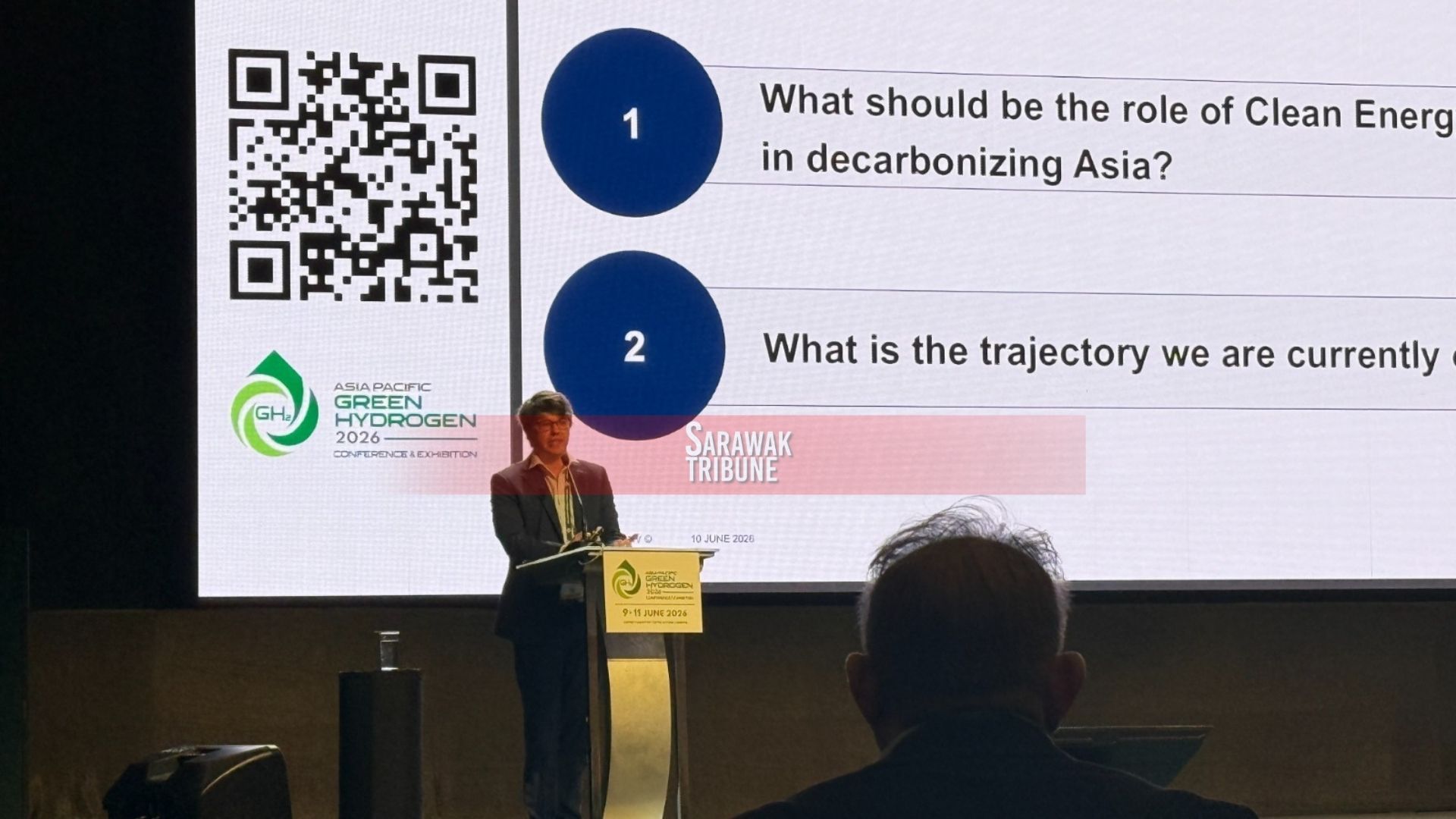
KUCHING: Global hydrogen demand is projected to grow by 170 per cent by 2050, with the strongest acceleration expected in the 2030s, signalling increasing momentum for clean energy adoption across multiple industries despite challenges in meeting global decarbonisation targets.
Head of Energy Markets and Strategy APAC at DNV, Mats de Ronde, said the forecast reflects growing demand from sectors that are traditionally difficult to decarbonise, including steel production, aviation and manufacturing.
“The good news is that hydrogen demand is expected to still increase quite rapidly, especially accelerating in the 2030s, and the total demand growth that we are expecting right now is about 170 per cent,” he said during his plenary session titled ‘The Role of Clean Energy Commodities in Decarbonising Asia Pacific’ at the Asia Pacific Green Hydrogen (APGH) Conference and Exhibition 2026 held here today.
Mats said the projected growth is a positive sign as it is driven by a diverse range of sectors, demonstrating broader acceptance of hydrogen as a clean energy solution.
However, he cautioned that the anticipated increase remains insufficient to achieve global climate ambitions.
According to DNV’s latest hydrogen forecast, hydrogen is expected to account for only about five per cent of total energy use by 2050, far below the level required to support meaningful decarbonisation.
“We really need to be closer, or at least above 15 per cent, in order to achieve our decarbonisation ambitions, but there’s still quite a long way to go,” he said.
Mats identified hydrogen production costs as one of the main barriers slowing adoption, noting that government intervention will be crucial in narrowing the cost gap between renewable hydrogen and conventional alternatives.
He said policy support mechanisms such as subsidies, carbon taxes and other regulatory instruments can significantly improve the commercial viability of renewable hydrogen projects.
Without such support, he said, most regions are unlikely to achieve cost competitiveness for renewable hydrogen even by 2050 or 2060, with China being among the few exceptions approaching parity.
“However, if you do include potential policy support, which can come from subsidies, taxation or other instruments, then you are able to close that cost gap,” he said.
Mats pointed to Europe as an example where strong carbon pricing and policy incentives could help close the cost gap between 2030 and 2035 despite higher production costs, while China could potentially achieve similar competitiveness by 2040.
He added that the challenge becomes even greater when hydrogen is converted into derivatives such as ammonia, as additional investments and processing costs must be taken into account.
These include capital expenditure for conversion facilities, chemical processing costs and, in some cases, additional carbon-related expenses.
Nevertheless, he said hydrogen and its derivatives remain essential components in the transition towards a lower-carbon economy, particularly in sectors where direct electrification is difficult to implement.