KUCHING: Sarawak has become the first state in Malaysia to join the World Economic Forum’s (WEF) Transitioning Industrial Clusters (TIC) initiative, connecting Bintulu to a global network of industrial regions driving low-carbon growth and industrial transformation.
Premier Datuk Patinggi Tan Sri Abang Johari Tun Openg said Bintulu’s participation in the initiative links Sarawak to 39 industrial clusters across 20 countries that are working towards building cleaner, more competitive and sustainable industries.
He said the TIC initiative recognises that future industrial competitiveness will not be built by individual companies acting alone but through collaboration among industries, governments, financiers, technology providers and research institutions.
“The TIC network collectively represents approximately USD808 billion in economic output, supports 6.6 million jobs and has the potential to abate 870 million tonnes of carbon emissions.
“This gives us access to international expertise, proven solutions and strategic partnerships in areas such as clean energy, industrial symbiosis, digitalisation, hydrogen, carbon management, circular systems and workforce development,” he said.
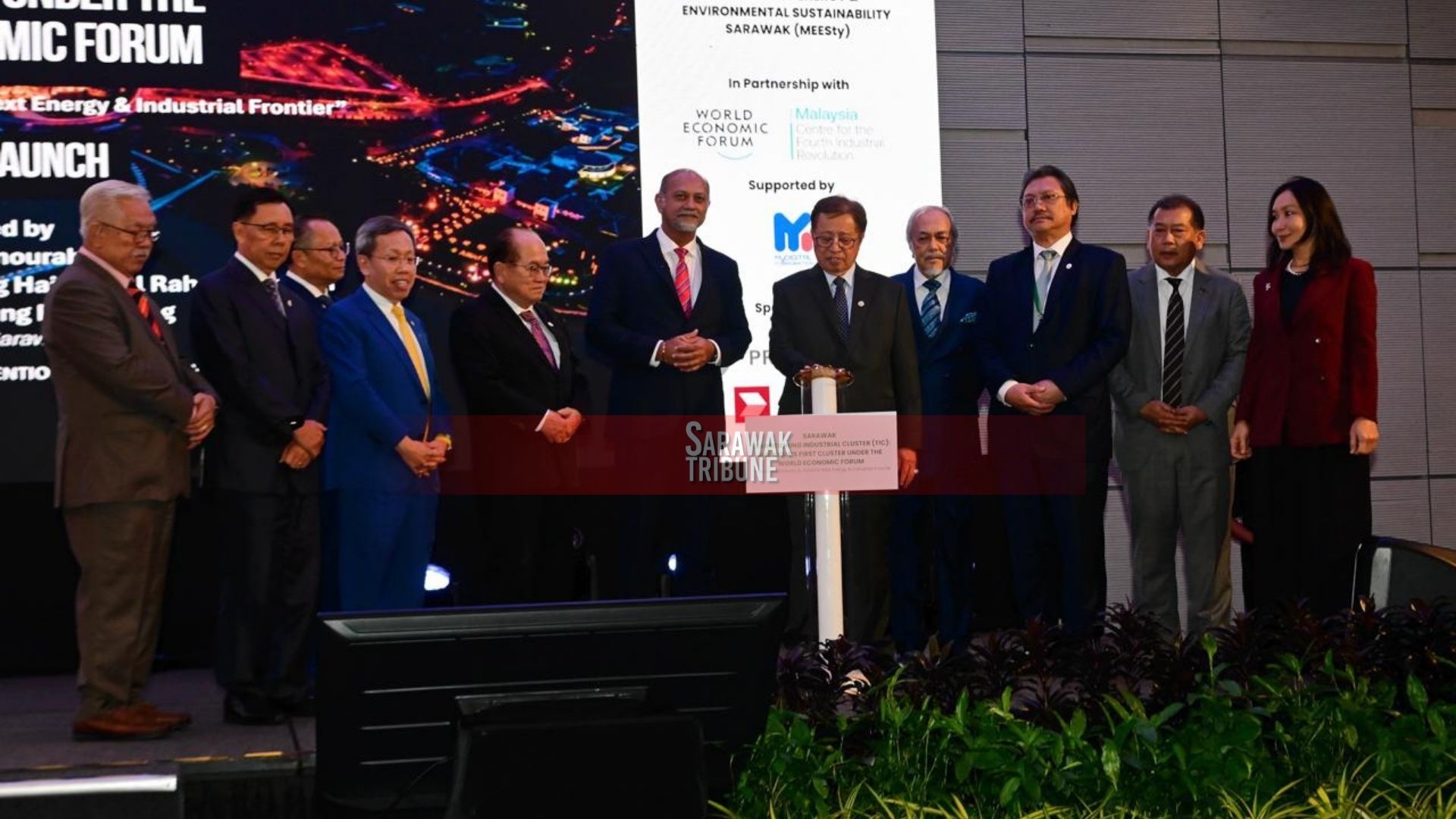
He said this during the launching ceremony of the ‘Sarawak Transitioning Industrial Cluster (TIC): Malaysia’s First Cluster Under the World Economic Forum – Bintulu: A Gateway to ASEAN’s Next Energy and Industrial Frontier’ at the Borneo Convention Centre Kuching (BCCK) today.
Abang Johari pointed out that the significance of the initiative was not simply that Sarawak is the first in Malaysia to participate.
He said its real value lies in connecting Bintulu to a global movement that is redefining how industrial regions grow, compete and decarbonise.
“Industrial clusters are the cornerstone of economies, generating meaningful jobs. At the same time, they account for some of the toughest emissions to abate.
“These figures demonstrate that industrial clusters are where the greatest opportunities for rapid, shared decarbonisation lie, while protecting industrial competitiveness and accelerating Sarawak’s green growth agenda,” he said.
The TIC initiative is built around five pillars, namely policy, finance, technology, partnerships and infrastructure.
Abang Johari said Sarawak already has a strong foundation through policies and strategies such as the Energy Transition Policy, Hydrogen Economy Roadmap, Sustainability Blueprint, Sarawak Net Zero Strategy, and Carbon Plan.
“The TIC therefore does not create a new direction. It helps operationalise the direction we have already chosen,” he said.
On finance, Abang Johari said the initiative helps translate ambition into investable opportunities by strengthening governance, planning and project development needed to attract capital and accelerate implementation.
He said pilot projects under the initiative would serve as an important step in turning strategy into action.
On technology, the TIC connects Bintulu to a global network of industrial innovation, ranging from digitalisation and artificial intelligence to hydrogen technologies, carbon management and circular industrial systems.
“This allows us to learn from leading industrial clusters around the world, adapt proven solutions to our own context and move faster,” he said.
Abang Johari said partnerships and shared infrastructure would be critical in enabling industrial decarbonisation at scale.
He said Sarawak’s industrial sector remains a major driver of economic growth, but the challenge is ensuring industrial expansion continues while reducing emissions.
“Achieving net zero does not mean we stop growing. It means we change how we grow by making our industries cleaner, more efficient, more resilient and more competitive.
“And the most effective way to do this is not company by company, but cluster by cluster,” he added.