By Norhidayyu Zainal
SUNGAI PETANI: Although more than two decades have passed since the tsunami struck Kuala Muda, Kedah, the impact of the disaster remains deeply etched in the memories of the local residents and continues to be reflected today through the Kuala Muda Tsunami Gallery.
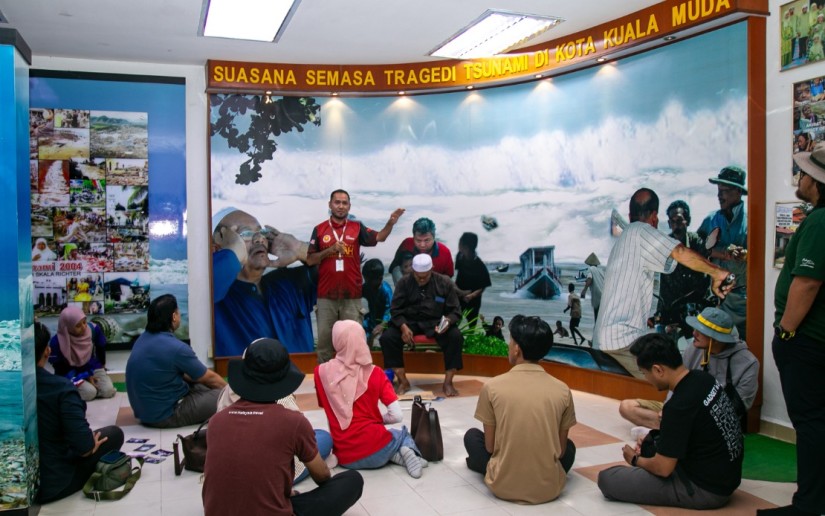
Located about 25 kilometres from the Sungai Petani town centre, the gallery was built on the site of a family home that was affected by the tsunami on Dec 26, 2004.
Managed by the Sungai Petani Municipal Council (MPSPK), the gallery houses a wide range of documentation, including photographs, videos and information related to the disaster. It also serves as an educational and reference centre for visitors seeking to understand the tsunami’s impact on the local community.

Pertubuhan Komuniti Dataran Tsunami liaison and tourism committee member Anas Ismail said the gallery was established to ensure that the incident would not be forgotten by future generations. (Pertubuhan Komuniti Dataran Tsunami is a local community association dedicated to managing, promoting and organising activities at the tsunami memorial site in Kuala Muda.)
“The story of the tsunami is not confined to the gallery alone. We also have Dataran Tsunami and the boat monument, which were created to ensure that people continue to remember what happened on Dec 26, 2004.
“The gallery showcases photographs, videos and various forms of documentation collected from government agencies and the local community, providing visitors with a comprehensive picture of the disaster’s impact,” he told Bernama during the recent Surreal Experience in North Kedah & Perlis programme organised by Tourism Malaysia Northern Region.

He said MPSPK also built the Tsunami Monument, featuring 26 fishing boats as a symbolic representation of the date the tsunami struck Kuala Muda. The monument stands at the junction leading to Kampung Kepala Jalan in Kota Kuala Muda.
Anas, who was among those affected by the tsunami, said the area has since become a popular destination for both local and international visitors, including participants of academic and research programmes interested in studying the disaster’s impact on coastal communities.
“We’ve even had people from countries such as Poland, Greece and the United States coming here to see the effects of the tsunami firsthand and hear the experiences of the local residents,” he said.

A Jerai Geopark licensed tour guide, Anas added that the gallery also functions as a disaster education centre, helping raise public awareness about tsunami risks and preparedness measures.
“Kuala Muda is now equipped with a tsunami warning siren system that is tested regularly as part of ongoing efforts to improve community preparedness,” he said.
Meanwhile, Kampung Kepala Jalan Village Head Council chairman Idris Husin, 73, said the disaster left a profound impact on the community, many of whom lost family members, homes and sources of income.

He recalled that before the tsunami struck, residents witnessed several unusual phenomena, including a dramatic retreat of seawater that exposed the riverbed and coastal areas, something they had never seen before.
“Many residents went out to observe what was happening because they had never witnessed anything like it. Not long afterwards, huge waves came crashing in, sweeping everything away and changing the landscape of our village in an instant,” he said.
Triggered by a magnitude 9.3 earthquake off the western coast of Sumatra, Indonesia, the Dec 26, 2004 tsunami generated massive waves that swept across several countries, including Sri Lanka, India, Thailand and Malaysia. In Kuala Muda alone, the disaster displaced 4,278 residents and damaged 87 homes, 309 fishing boats and 173 vehicles. — BERNAMA