PUTRAJAYA: The nation’s biodiversity management requires a “whole-of-nation” approach involving close cooperation among all stakeholder groups to ensure it can be implemented effectively and sustainably.
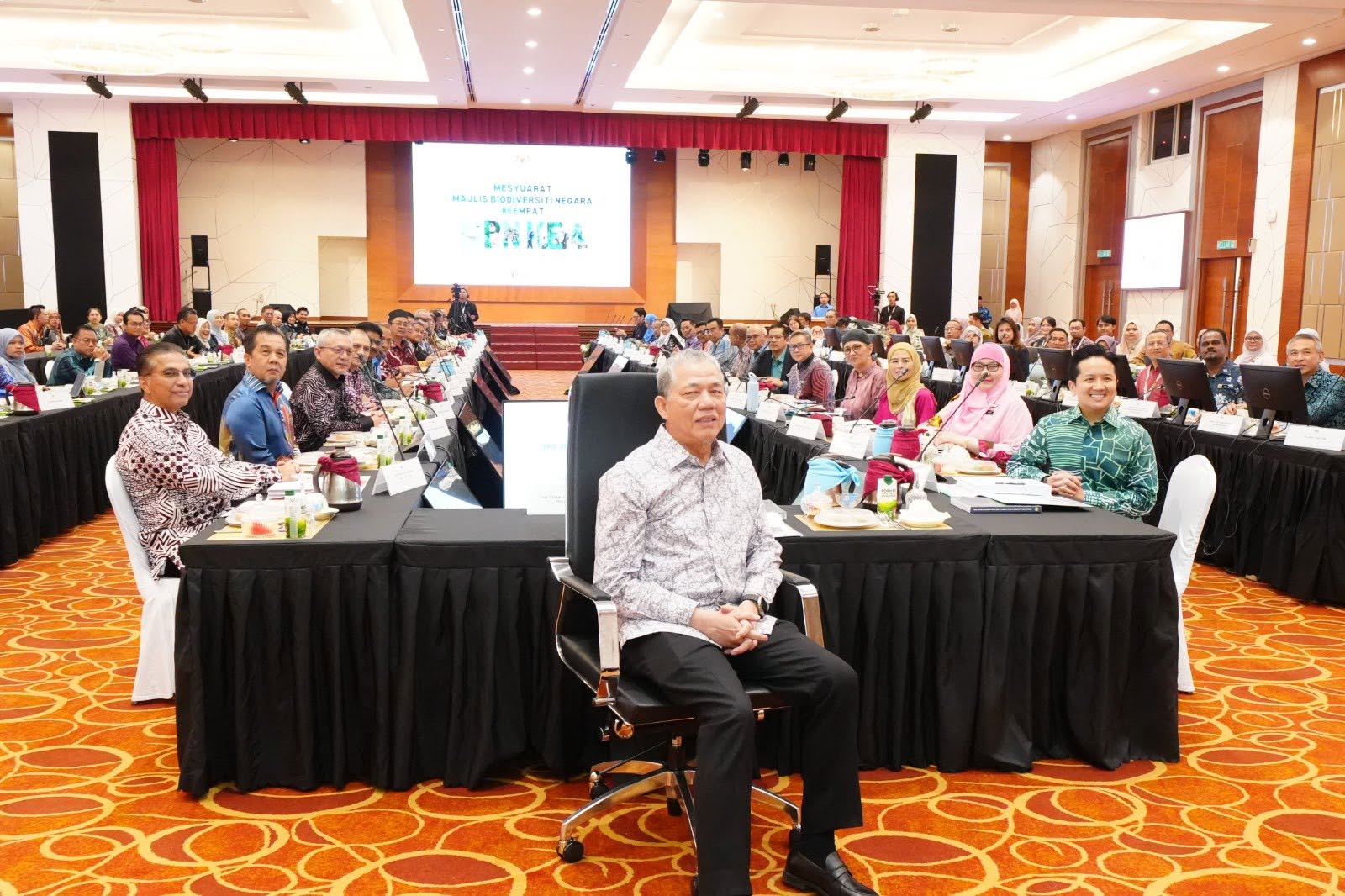
The Ministry of Natural Resources and Environmental Sustainability (NRES) said in a press release that this matter was emphasised by Deputy Prime Minister, Datuk Amar Fadillah Yusof, while chairing the 4th National Biodiversity Council Meeting (4th MBN) on Thursday.
“Cooperation between the Department of Wildlife and National Parks (PERHILITAN), the Royal Malaysian Customs Department (JKDM), and the Royal Malaysia Police (PDRM) through the implementation of Operasi Bersepadu Khazanah (OBK) is an example of an integrated approach to combating wildlife crime and protecting the nation’s biodiversity treasures.
“He (Fadillah) also hopes that this same spirit of cooperation will continue to be strengthened to ensure that the national biodiversity agenda can be carried out effectively and continuously,” the statement read.
NRES reported that three consideration papers and four information papers were presented at the MBN, which was also attended by the Minister of Natural Resources and Environmental Sustainability, Datuk Seri Arthur Joseph Kurup.
The MBN serves as the primary platform for the Federal Government and state governments to discuss biodiversity directions and strategies at the national level, with NRES acting as its secretariat.
Among the decisions agreed upon during the 4th MBN was the development of the National Framework for Other Effective Area-Based Conservation Measures (OECM), which encompasses the criteria, recognition mechanisms, and governance structures for OECM in Malaysia.
Also agreed upon were the mitigation direction and population management of wild elephants in the State of Johor – aimed at strengthening efforts to resolve human – elephant conflicts – and efforts to preserve the National Acid Stone (Asam Batu) Heritage through the implementation of conservation activities for the Begonia herveyana species in the State of Melaka.
Furthermore, the 4th MBN took note of several key initiatives and achievements in biodiversity conservation, including the 7th National Report to the Convention on Biological Diversity (7NR) and wildlife conservation efforts by the PERHILITAN Department.
NRES added that the Deputy Prime Minister also launched the 7th National Report, which was successfully submitted by Malaysia to the Secretariat of the Convention on Biological Diversity (CBD) on February 28, 2026.
The report is an official national document detailing the progress of implementing the National Policy on Biological Diversity (DKBK) 2022-2030, as well as Malaysia’s efforts to fulfill international commitments under the Kunming-Montreal Global Biodiversity Framework (KMGBF).
The preparation of this report reflects the close cooperation between the Federal Government, state governments, and various stakeholders in strengthening the execution of the country’s biodiversity agenda.
The report can be accessed through the new user interface of the Malaysia Biodiversity Information System (MyBIS) at www.mybis.gov.my, which was also launched today.
In a Facebook post on Thursday, Fadillah said that since the third MBN meeting on May 27, 2025, various significant achievements have been successfully recorded as a result of close cooperation between the federal government, state governments, non-governmental organisations (NGOs), and local communities.
Among them is the Biodiversity Protection and Patrolling Programme (BP3), which recorded the arrests of 942 Malaysian citizens and 318 foreign nationals up to April 2026, with the value of seizures reaching RM417 million.
“The country’s forested area also increased by 30,389 hectares compared to 2022, thereby maintaining Malaysia’s forest cover above 50 per cent at a rate of 54.4 percent,” he said.
Fadillah stated that federal government spending on biodiversity conservation also increased by 64 per cent between 2021 and 2025, including the distribution of RM1.05 billion through the Ecological Fiscal Transfer for Biodiversity Conservation (EFT) to state governments since 2019.
He added that a development allocation of RM140 million has also been approved for the physical development of the Malaysia Biodiversity Centre (MBC) under the 13th Malaysia Plan (RMK13).
“The number of recipients for the Property and Crop Loss Assistance Due to Wildlife Attacks (BKHT) increased by nearly 30 per cent to 314 recipients in 2025,” he said.
According to Fadillah, three national protected areas have also been recognised as ASEAN Heritage Parks, namely the Tengku Hassanal Wildlife Reserve in Pahang, Bako National Park, and Bukit Lambir National Park in Sarawak.
At the same time, Kinabatangan in Sabah was recognised as Malaysia’s fourth Biosphere Reserve Site under the UNESCO Man and the Biosphere (MAB) Programme, while the Sarawak Delta Geopark received recognition as a UNESCO Global Geopark on April 23 last year.
Fadillah said these achievements prove the effectiveness of joint efforts in strengthening the nation’s biodiversity management as well as fulfilling Malaysia’s commitments at regional and international levels. – BERNAMA