MARUDI: Sarawak’s rapid progress in areas such as renewable energy, digital economy and strategic assets has drawn the envy of some quarters, but the state will continue moving forward to ensure its development benefits all communities.
Premier Datuk Patinggi Tan Sri Abang Johari Tun Openg said Sarawak’s achievements were the result of careful planning, strong financial management and the unity of its people.
“Now there are people who are envious of us because they say we are moving too far ahead.
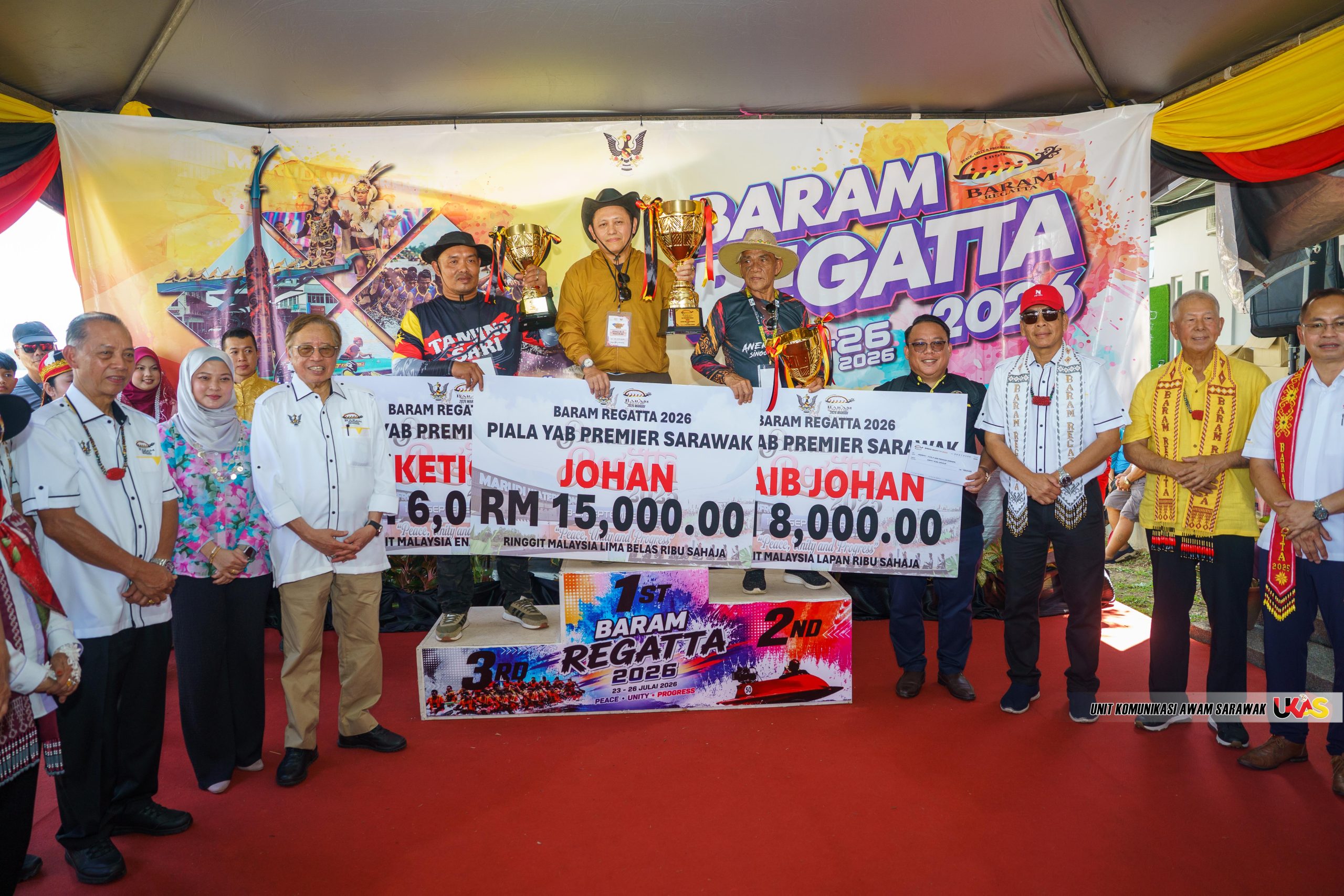
“Today, Sarawak has its own state television station while others do not. We already have a renewable energy economy and carbon trading, while others have yet to do so. We also have technology supporting the expansion of information and the digital economy,” he said at the launching ceremony of the Baram Regatta at Dataran Marudi here today.
Abang Johari said Sarawak had also strengthened its position by taking control of strategic assets, including Bintulu Port, which is now under Sarawak’s administration instead of being managed by the federal government.
He said these achievements reflected Sarawak’s determination to build its own economic future while adapting to global changes.
However, he stressed that economic progress must translate into improved household incomes and a better quality of life for the people.
He said while Sarawak had been recognised by the World Bank as a high-income economy since 2022 and remained among Malaysia’s top five largest economic contributors, more efforts were needed to ensure families benefited from the growth.
“Although the World Bank has recognised Sarawak as a high-income economy, I am not satisfied. GDP can show the strength of an economy, but household income must also increase.
“How do we raise household income? By giving our children knowledge and equipping them with the latest technologies,” he said.
Abang Johari said the Gabungan Parti Sarawak (GPS) government is preparing the younger generation for future industries through initiatives such as free tertiary education for Sarawakian students.
He said students would be equipped with knowledge in key areas including semiconductor technology, climate science, data transformation and artificial intelligence (AI).
“By 2030, if our children have these skills, we aim to launch Sarawak’s own nano satellite into space, which can collect and analyse data from the Earth,” he said.
He added that Sarawakian students had already demonstrated their capability through exposure to satellite technology, including training at the University of Southern California, where a Sarawakian student participated in launching a satellite from the United States alongside university peers.
“This means our children can do it. We can compete in this changing economy,” he said.
Abang Johari said Sarawak is able to implement free tertiary education because of its sound financial position, forward-looking leadership and the unity of its people.
“There is no other government in Malaysia providing free tertiary education. Only GPS in Sarawak has the courage to provide free education.
“We can do this because our leaders understand the future, and our people are united. Together, we are finding ways to elevate Sarawak,” he said.
Despite Sarawak’s economic achievements, Abang Johari said the state would continue investing in infrastructure, including improving water and electricity supply, to ensure no one was left behind.
He said that Sarawak’s income had doubled compared with 2017, but additional funding was still needed to address infrastructure needs across urban, semi-urban and rural areas.
“We in the GPS government do not want anyone to be left behind from the development we are carrying out, whether they are in cities, semi-urban areas or rural areas,” he said.
Abang Johari also highlighted the importance of addressing challenges in renewable energy development, particularly energy storage, noting that solar power generation depends on battery technology and its lifespan.
“We must continue looking at these issues because development is not only about having resources, but also about having the knowledge and technology to manage them,” he added.