PUTRAJAYA: Universiti Kebangsaan Malaysia (UKM) and the University of Yamanashi, Japan, have established the Japan-Malaysia Hydrogen Hub (JMH2) to strengthen research, innovation, talent development, industry collaboration, and technology transfer in hydrogen and fuel-cell technologies.
Established under Japan’s Programme for Forming Japan’s Research Universities (J-PEAKS), the hub is located at UKM’s Fuel Cell Institute (SELFUEL).
It is expected to serve as a regional platform for collaborative research, researcher and student mobility, professional training, industry engagement and the commercialisation of clean-energy technologies.
JMH2 was announced at the 4th Symposium on Fuel Cell and Hydrogen Technology and the 2nd International Symposium on Solar Hydrogen 2026 (SFCHT–SSH 2026), a two-day event which started today.
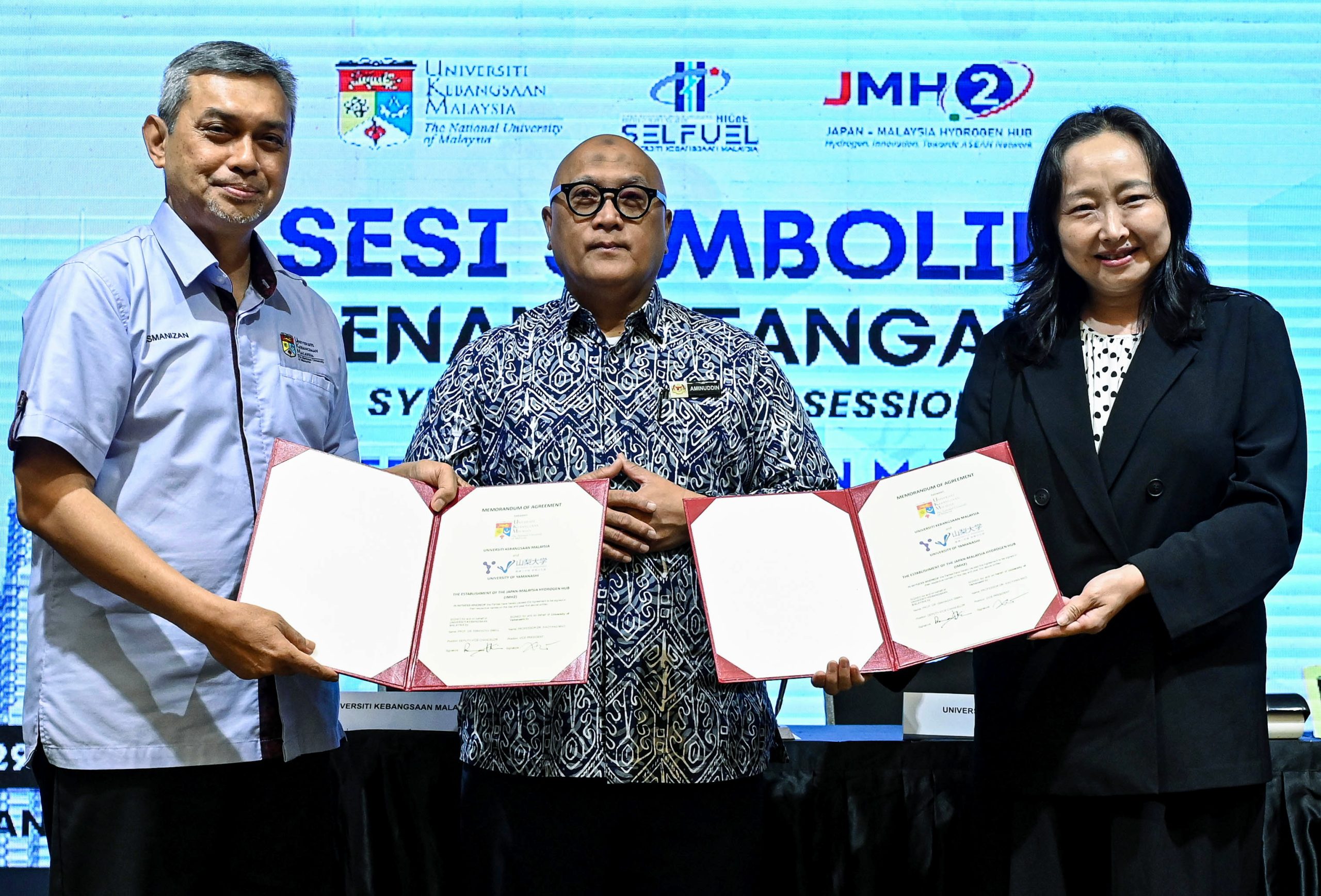
The Memorandum of Agreement (MoA) for the project was exchanged by UKM’s Deputy Vice-Chancellor (Research and Innovation), Prof. Dr Ismanizan Ismail, and University of Yamanashi’s Vice-President, Prof. Dr Xiaoyang Mao, and witnessed by the Higher Education Ministry’s Secretary-General, Datuk Dr Aminuddin Hassim.
Ismanizan said the hub’s establishment demonstrates UKM’s commitment to advancing high-technology industries and enhancing Malaysia’s clean-energy capabilities, in line with the government’s aspirations.
He said UKM’s Fuel Cell Institute has built strong capabilities in green technology, sustainable technology, hydrogen production, and fuel-cell applications, positioning the collaboration with the University of Yamanashi as a strategic move forward.
“This is the way forward for us to support the government’s agenda in advancing alternative energy and renewable energy, reducing dependence on fossil fuels and contributing towards the net-zero carbon aspiration,” he told reporters after the ceremony.
Ismanizan said JMH2 is the only hub in Malaysia focusing exclusively on hydrogen and fuel-cell technologies and has the potential to become a major platform for ASEAN collaboration.
He added the initiative would benefit not only researchers and postgraduate students but also industry players through research collaboration, technology transfer and innovation.
Meanwhile, Mao said UKM was chosen as the University of Yamanashi’s ASEAN partner because of its established expertise in hydrogen and fuel-cell technologies, coupled with the longstanding research ties between the two universities.
She said the global nature of energy challenges requires strong international collaboration, with JMH2 forming part of the university’s effort to expand its global research network.
“We call it a hub because we expect it to connect not only Malaysia and Japan, but also researchers, industries and institutions across ASEAN,” she said.
The collaboration, she elaborated, would focus on high-level academic research, innovation, social implementation of technology and the development of future human resources.
Mao added that both universities are also exploring the establishment of dual-degree programmes to cultivate the next generation of hydrogen experts.
“We are honoured to collaborate with UKM and look forward to expanding this cooperation for the benefit of the region and contributing to the global energy transition,” she said, describing UKM as a leading university in the region.
Meanwhile, UKM in a statement said the JMH2 initiative would be implemented in phases beginning in 2026, and is expected to expand its collaborative network across ASEAN by 2029.
Through this expansion, JMH2 seeks to establish Malaysia as a leading regional centre for hydrogen knowledge, talent development, and technological innovation, while bolstering Southeast Asia’s role in the global energy transition. – BERNAMA