Somewhere in your house, right now, there’s a hard drive. Maybe several. External ones in a drawer, old phones in a box, a laptop you haven’t opened since last year. We treat all of it like it weighs nothing. Empty folder, full folder — same drive, same weight, right?
Wrong. Or at least — not quite.
The Man Behind the Name
Claude Shannon, 1948, Bell Labs. He’s why your phone can send a photo without turning it into static — and, trivia worth knowing, why the AI you may be reading this with is named Claude.
Shannon built the mathematics of information around one idea: entropy. Not disorder, but surprise.
A blank hard drive — all zeros or ones — is predictable, so it has low entropy. Fill it with photos, messages, or this column, and the pattern becomes unpredictable: high entropy.
Shannon showed that, mathematically, meaningful information and noise can look identical: both are simply entropy encoded as bits.
Where It Gets Physical
Now here’s where a second scientist walks in — Rolf Landauer, at IBM, over a decade after Shannon. Landauer asked a different question: does “erasing” a bit cost anything?
Turns out, yes. Wiping a single bit releases a tiny amount of heat. Physicists calculated the minimum, depending on the temperature around the drive. Heat is energy. And Einstein already told us energy and mass are two sides of the same coin — E equals mc². So if erasing a bit releases energy, and energy has mass, then somewhere in that transaction, mass moves too.
Which means, technically, a full hard drive weighs more than an empty one.
Don’t reach for your bathroom scale. One bit at room temperature carries a theoretical mass of roughly 3 × 10⁻³⁸ kilograms. Fill a terabyte drive with data and the added weight remains unimaginably tiny, far beyond anything we could measure. But “too small to measure” and “not real” are different sentences. Landauer’s answer was clear: the physical cost is real. Data has mass, just not a mass you or I will ever feel.
As usual, I like looking at matters through the lens of the ancients. And wu wei walks back in, right on cue. The Daoists never fought entropy — they simply gave it a friendlier name: change.
Water doesn’t struggle against gravity. It goes downhill and calls it flow. A hard drive dying, a file format becoming obsolete, a cloud company disappearing — none of that is an emergency if you stop treating stillness as the natural state and decay as the interruption.
Decay was never the interruption. It was always the current. Fighting it is like punching your way through a river.
Nothing you store stays stored forever. Drives fail. Formats die. Clouds fold. Even our brains, carrying trillions of pieces of information, will one day return to the earth.
Nothing stays stored. Not really.
Ashes to Ashes, Bits to Bits
Here’s the part worth taking home. The second law of thermodynamics says entropy in a closed system only moves one direction: up. Disorder increases. Order is temporary, borrowed and spent down over time. Every hard drive, server farm and backup quietly obeys that law.
Heraclitus said it plainly: you can’t step into the same river twice. Not because the river moves, but because you do too. By the time your foot returns, both river and person have changed. He wasn’t talking about hard drives, but the pattern is the same. Nothing hoarded stays hoarded. Nothing stored stays stored.
Amor fati isn’t about liking that fact. It’s about accepting it.
Why This Actually Matters
Here’s the part that should bother you a little, in a good way: we never talk about any of this.
Every video call, forwarded voice note, and TikTok you scrolled past and forgot sits on a physical drive somewhere, taking up real space, using real electricity, and generating real heat that must be cooled with real water.
We call it “the cloud” because that makes it sound weightless and distant, like someone else’s problem.
It isn’t.
It’s a warehouse. A very cold, very loud, very real building, usually nowhere near us—especially here in Kuching. And those warehouses are filling with more and more machines, storing more and more data.
Maybe some of the environmental pressures we see around the world are connected to this growing appetite for data, especially as technologies like quantum computing demand ever greater resources. Maybe not. But one thing is certain: nobody measures this for us.
No bill tells you how much of your monthly data usage is sitting in a server farm overseas, adding its tiny, physical weight to a drive somewhere.
It simply accumulates, quietly, like debt or dust—unseen until someone asks the question out loud.
So the next time you hit delete and feel like you’ve freed something up, you have—just a little.
The world is still holding onto more of your old stuff than you think.
Somewhere, it’s sitting there.
Real. Measurable. Just never measured.
Our Paradox
Here’s where it gets interesting — and where I’ll leave you hanging until next time.
If data — pure information — carries real physical mass, even mass too small for any scale to detect, then somewhere out there may be a universe filled with things whose mass we simply can’t see. We already know one candidate: dark matter.
Astronomers are certain dark matter exists, not because they’ve seen or touched it, but because galaxies behave as though something invisible is holding them together — something our visible numbers can’t explain. Nobody has photographed it. Nobody has touched it. It simply is: unmeasured, unseen, yet leaving its fingerprints everywhere.
I’m not saying your old photos are dark matter. Nobody serious would say that. But here’s my challenge to every tech-savvy know-it-all: if you’re smart enough to build the app, mine the crypto, and talk down to the uncle who still can’t master the voice command on his smartphone — are you smart enough to explain dark matter to a five-year-old?
Not with jargon. Not with “rotation curves” or “gravitational lensing.” Explain it in words a child in a longhouse in Kapit could actually understand.
Because that’s what real understanding means. If you can’t make an idea small enough for a child, you don’t truly own it yet. You’re only borrowing the vocabulary.
So let me try, in the little space I’ve got left.
Dark Matter For a five-year-old
A group of scientists watched the stars at the edge of galaxies spinning around, fast — so fast that, by the rules we know, they should go flying off into space, the way you’d fly off a merry-go-round spun too hard. They don’t fly off. Something invisible is holding them on. Nobody’s ever seen it, touched it, or taken its picture. We just know, from how tightly it’s holding on, that it must be there.
That’s the whole idea. That’s dark matter, told to a child, in four sentences.
That’s next week’s Digital Zen. Bring your questions — I’ll answer the best ones in print.
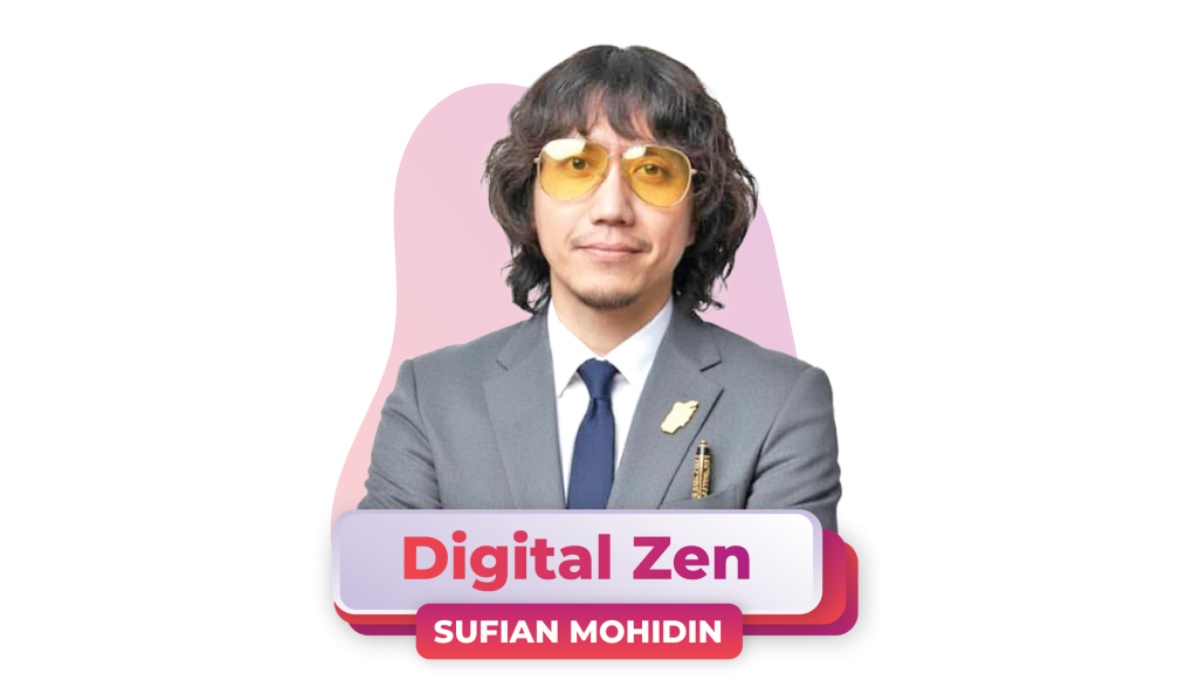
►Digital Zen writes on where Sarawak meets the machine.
The views expressed here are those of the writer and do not necessarily represent the views of Sarawak Tribune.