KUCHING: Malaysia is taking a step up the electric vehicle (EV) value chain with the launch of small-scale production of its first homegrown graphene-enhanced EV battery this month.
NanoMalaysia Berhad chief executive officer Rezal Khairi Ahmad said the country is close to operationalising its first factory producing locally developed battery technology, marking a milestone in Malaysia’s efforts to strengthen its advanced manufacturing capabilities.
“We are on the verge of operationalising Malaysia’s first local battery technology production factory,” he said.
He described the project as likely the first of its kind in ASEAN, saying no other country in the region is producing homegrown battery technology.
The battery, developed at a cost of about RM20 million, will be manufactured by Gigafactory Malaysia, a wholly owned subsidiary of NanoMalaysia under the Ministry of Science, Technology and Innovation.
Small-scale commercial production is expected to begin this month, while the factory is targeting megawatt-hour production capacity as early as September 2026.
Located at Suria Industrial Park in Sepang, the 15,000-square-foot (1,394-square-metre) facility will be capable of producing about one megawatt-hour of battery capacity annually at full scale, equivalent to around 92,000 battery cells.
The company has already secured its first order for a 25-kilowatt-hour battery from a local organisation, while discussions with several other potential customers are in the final stages.
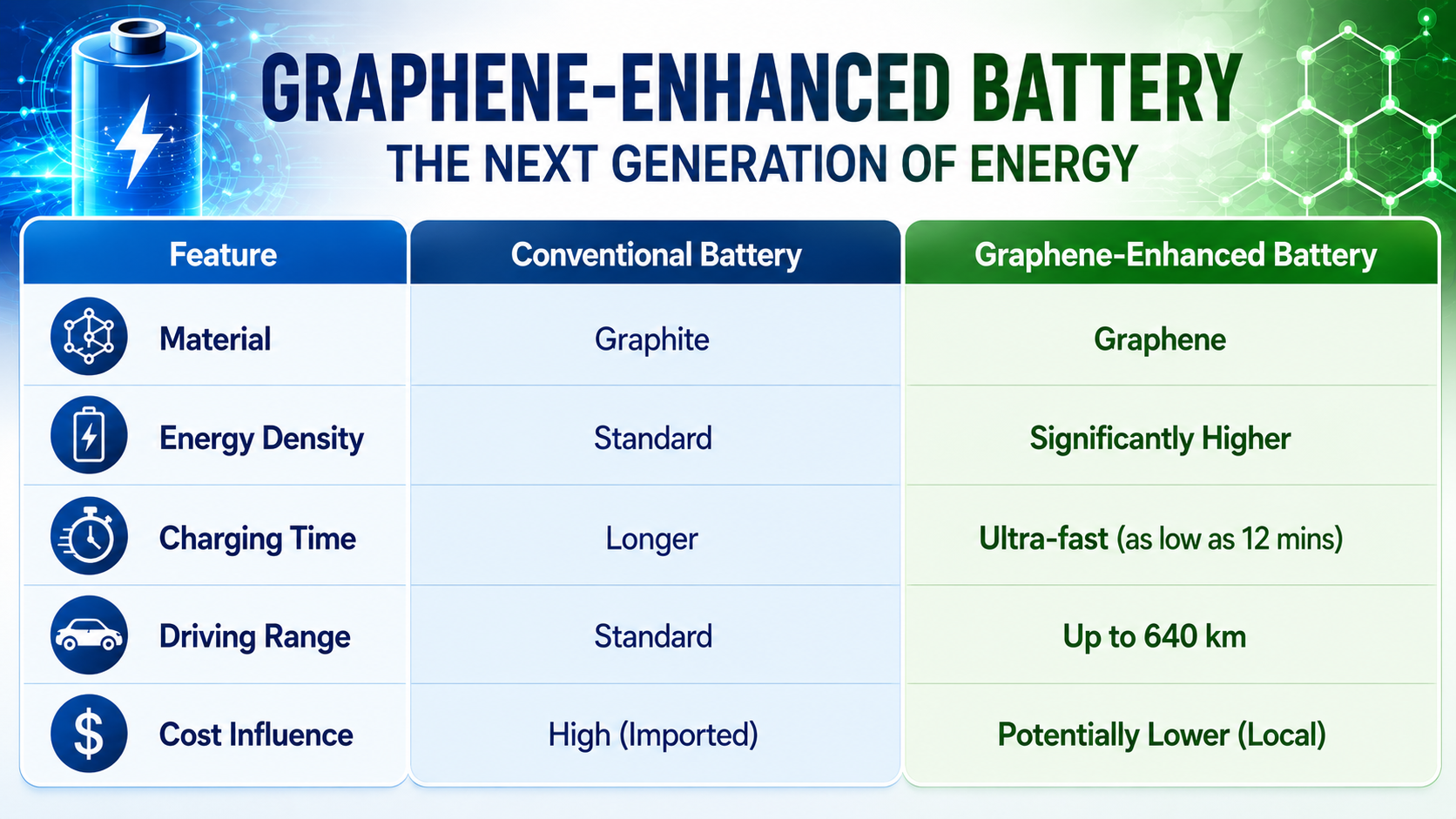
Although pricing has yet to be disclosed, Rezal said local production could lower EV costs by reducing import duties, logistics expenses and storage costs.
“Batteries account for at least 40 per cent of an EV’s cost.
“Both local and international EV manufacturers stand to benefit from these advantages, making locally manufactured or assembled EVs significantly more affordable and accessible,” he said.
The battery uses nickelmanganese-cobalt (NMC) chemistry enhanced with graphene to achieve higher energy density than conventional lithium-ion batteries.
Rezal said graphene can increase energy storage capacity by up to three times compared with graphite because its nano-structure provides a much larger surface area for storing electrical charge.
Using a proprietary manufacturing process, the company incorporates only a small amount of graphene while increasing electrode-level energy density by about 60 per cent over commercially available battery cells.
“This positions the product as a highly competitive premiumperformance battery cell,” he said.
The battery is expected to provide a driving range of up to 640km on a single charge and support fast charging in as little as 12 minutes under optimal operating conditions.
Its high energy density makes it suitable for EVs requiring battery performance above 200 watt-hours per kilogramme.
Looking ahead, NanoMalaysia is exploring a strategic partnership with Indonesia to secure longterm nickel supplies, building on a memorandum of understanding signed with Indonesia’s National Battery Research Institute.
“We are planning for the long term. Given Indonesia’s abundant nickel resources, we are looking at a strategic partnership for bulk supplies, especially once we scale up to gigafactory level,” Rezal said.
Potential export markets include Indonesia, South Korea, India and Pakistan. NanoMalaysia is also developing plans to recycle end-of-life batteries to strengthen long-term raw material security.
Sunway University economics professor Yeah Kim Leng said the homegrown lithium-ion battery could become a major milestone in Malaysia’s industrial development.
“It could help Malaysia move further up the manufacturing value chain and strengthen its position in fast-growing, high-technology industries,” he said.
Yeah added that locally developed batteries could support wider EV adoption by lowering costs while strengthening supply chain resilience amid volatile fossil fuel prices and the country’s transition to clean energy.
“Automakers are also paying closer attention to Malaysia’s potential as an EV market.”