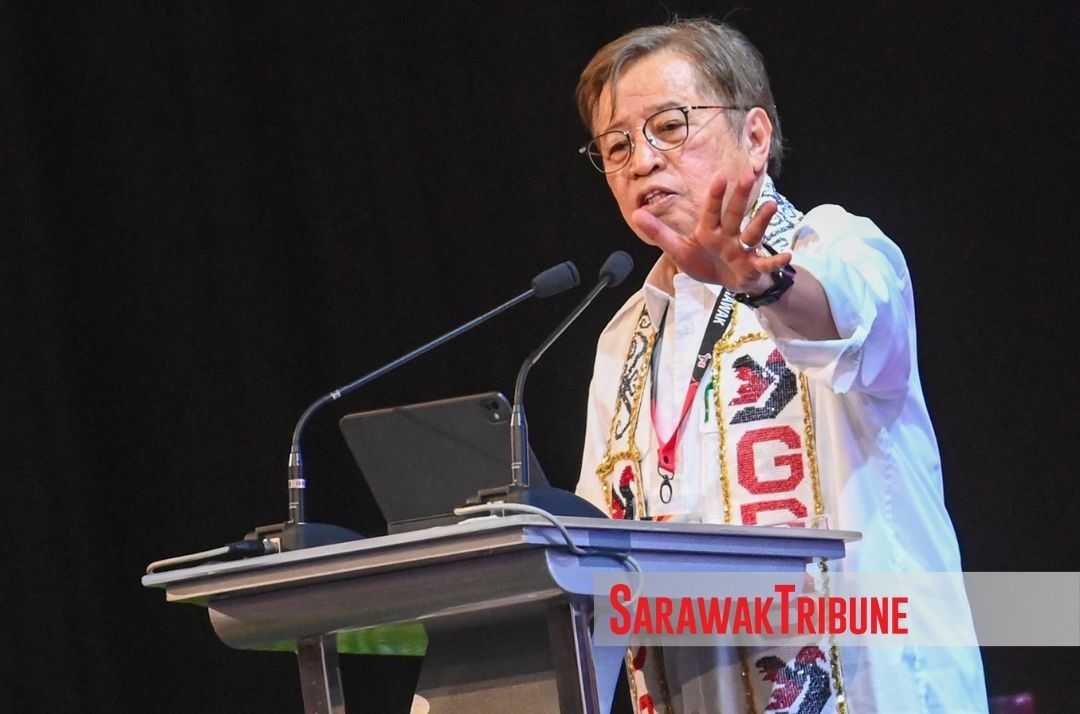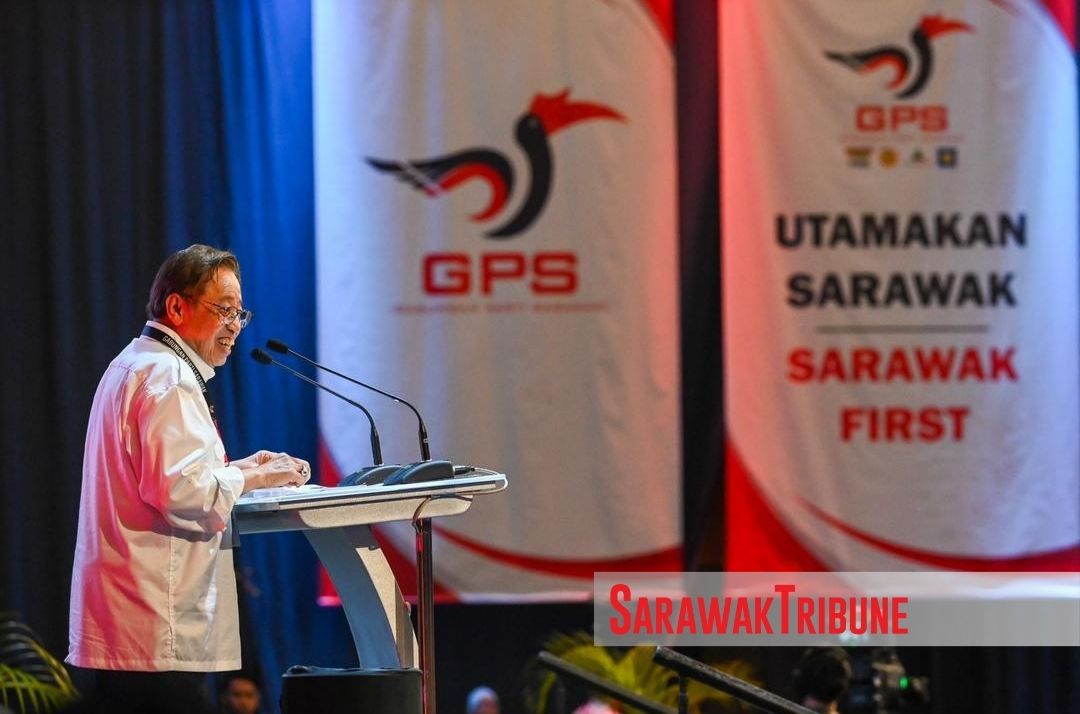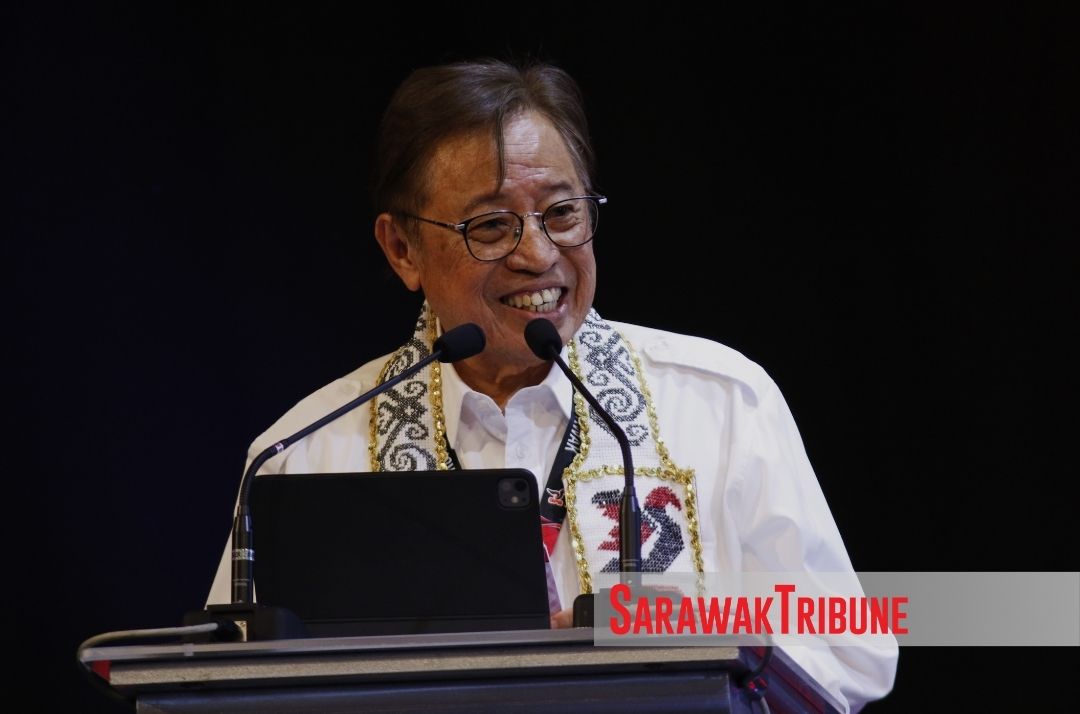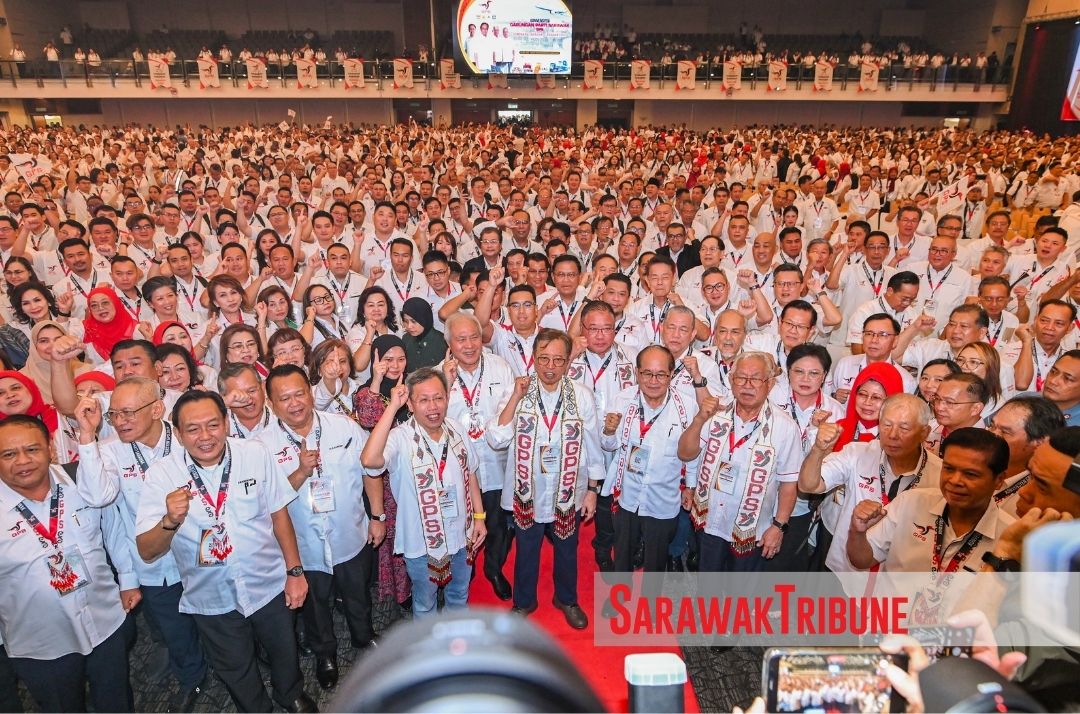
First and foremost, I offer my gratitude to Allah SWT, the Almighty, for allowing us to gather this morning with GPS leaders from across Sarawak to reflect on our achievements and discuss the future direction of GPS.
I would also like to thank all party presidents and leaders who have worked closely with me. The success we enjoy today is not the result of any one individual, but the collective effort of everyone present here and the people at large.
Indeed, many speak about Sarawak — that it is doing well, progressing rapidly, with clear direction and a strong economic performance. Even Prime Minister Anwar Ibrahim has described Sarawak as one of the most advanced states in Malaysia.
That is the reality. However, it has not been easy to achieve. We have gone through many major challenges.
In 2018, we established Gabungan Parti Sarawak. At that time, the question was whether we could survive. But we remained determined.
We defended our rights, developed Sarawak, and fought for this state. As the late Adenan Satem once said, no one can take care of Sarawak better than Sarawakians themselves.
As successors to the previous leadership, I am confident that we can safeguard this state, provided we remain united. After that political transition, we began to reorganise our political and administrative strategies.
However, the next challenge came with the outbreak of the COVID-19 pandemic. Many lives were lost, and those infected had to remain isolated.
This situation had a major impact on people’s lives. As leaders, my colleagues and I searched for solutions. We gathered economic experts, NGO leaders and community representatives to deliberate. From these discussions, the Post-COVID-19 Development Strategy (PCDS 2030) was formulated — a comprehensive policy framework.
This policy is anchored on several key strategies, including six core sectors: agriculture, tourism, forestry, mining, manufacturing and others, supported by seven key enablers. These form the pillars of our development agenda for Sarawak. Today, what we need is an effective mechanism to realise all that we have planned.
Various initiatives have been introduced, including assistance for mothers, incentives for childbirth, and education support such as loans from Perbadanan Tabung Pendidikan Tinggi Nasional (PTPTN), to ensure our children are not burdened to the extent that opportunities such as obtaining passports are restricted.
Ultimately, we realised that the economy must evolve. We can no longer rely on the old economic model — we must embrace technology. That is why we introduced the digital economy, including cashless payment systems such as S Pay Global.
During the pandemic, without such systems, the situation would have been far more difficult. Initially, when GPS introduced the digital economy, many were sceptical. However, after the pandemic, people began to recognise its importance.
Today, Sarawakians at all levels are proficient in using technology, including cashless payments.
Moving forward, Sarawak must find ways to increase revenue. In the past, our revenue stood at only RM6 billion — barely enough.
At that time, revenue was limited, and I sought ways to increase it. RM6 billion was insufficient — it could barely cover civil service salaries, leaving very little for development. Through studying the Constitution, I discovered that we could impose a sales tax.
We implemented this for the first time on PETRONAS. They resisted, saying we had no right to impose such a tax. So we took the matter to court, defended our constitutional rights, and ultimately won.
With just a five per cent tax, we generated approximately RM4 billion annually, raising our total revenue to about RM14 billion.
Over the past six years, we faced many challenges. But because of the sincerity and unity of GPS leadership — PBB, PRS, SUPP and PDP — we have achieved success.
Today, we have our own airline, our own television station, and a commercial banking presence through a majority stake in Affin Bank. Even the TRX tower in Kuala Lumpur is linked to our ownership through this acquisition.
We have taken over Bintulu Port Holdings Berhad, despite initial demands for RM4.8 billion in compensation. After negotiations, we secured it for RM1.8 billion — and it now belongs to the people of Sarawak.
Earlier, we also took over the Bakun Dam. If we had not done so, electricity tariffs would have been determined by the federal government. With this acquisition, we now control our energy policy.
We have since diversified into renewable energy — hydro, solar and biomass (biochar). Today, about 60 per cent of our energy comes from renewable sources, while 40 per cent comes from low-carbon gas turbines.
We are also promoting reforestation, which reduces carbon emissions and creates opportunities for carbon trading — a new source of income for the state.
Every state depends on energy. Without stable energy planning, economic development will face serious constraints.
While the world faces uncertainty, we acted early by not relying solely on fossil fuels. We are now developing hydrogen energy. With improvements in electrolysis technology, production costs have dropped significantly — making hydrogen even cheaper than diesel in some cases.
Six years ago, GPS began transitioning rural areas from diesel generators to solar under the SARES programme. If we had continued relying on diesel, many longhouses would still be in darkness today. Instead, they now enjoy 24-hour electricity.
On natural resources, Sarawak holds about 62 per cent of Malaysia’s methane gas reserves. We seek fair participation in managing these resources — not monopolised by PETRONAS alone.
We are exercising our legal rights under existing laws and MA63. If challenged in court, we will defend our position. We are not being greedy — we simply want fairness.
Sarawak has a clear gas roadmap. We are among the largest methanol producers in the region, particularly in Bintulu, which has been recognised by the World Economic Forum as an emerging low-carbon industrial cluster.
This gas cluster will create new jobs and opportunities for Sarawakians.
We are also developing a new deep-sea port and gas terminal in Tanjung Embang, along with a new airport. These are not just mega projects — they are long-term investments to drive economic growth, much like how Lee Kuan Yew developed Changi Airport.
To improve connectivity, we launched AirBorneo, enhancing direct routes such as to Jakarta, which is only about one hour and 20 minutes away.
At the start the PM (Prime Minister Datuk Seri Anwar Ibrahim) actually said, if possible, Abang Jo, you take over together with Sabah. We were sincere. We told Sabah, you take 30 per cent with us, but Sabah said wait first. Sabah waited.
So we took AirBorneo, 100 per cent owned by Sarawak. Yes, some people have already complained, why haven’t fares gone down? Of course, we were tied to Maswings before. We couldn’t lower them, we didn’t have full authority. Transition period. Once it’s 100 per cent, we’ll know how I’ll do it for the people of Sarawak.
Today diesel prices are bad, we added aid for the people. It’s not a small amount, over RM800 million. We’re helping people this time, and it’s not final yet because I believe those in industry are also affected by diesel prices.
So every day I discuss with the Chamber of Commerce how to help the business community. And we’ve built the roads, and now we’re focusing on our energy.
What I want to say is that people recognise us. Our economy is moving forward. So in this regard, I want to share with you, by 2030 we will have 10 gigawatts of power. Right, Datuk Ibrahim? Take care of SEB. By 2035, 15 gigawatts, 1,500 megawatts.
We’re adding power. We in Sarawak don’t even use up to 7. The rest we share within ASEAN. Singapore 1 gigawatt, Peninsular Malaysia 1 gigawatt. Now we’ve gone into Kalimantan. They’ve asked to increase it to Kalimantan, so we’re connecting to Kalimantan.
This means our energy reserve is more than that. If we sell it, it means new revenue for Sarawak. So energy is very important. And we also have resources. According to statistics, we can generate 22,000 megawatts, meaning 22 gigawatts from what we have. But maybe if you diversify our sources, it could be more than that.
What I want to say here is that our economic resources are strong. But many countries have strong economic resources yet they have problems, high poverty.
Look at Africa, look at Nigeria, look at Sudan. They have oil, they have resources, but the country is poor. Why? Because there is no sincere struggle from their leaders.
We in Sarawak have resources. We need a clean leadership party.
The intention is one: to serve the people. Today we are only 6 years into GPS. That is our success. Can we continue this culture for the future? Can we pass this on for our children’s future?
Today we give allocations. Registered with our own university, RM260 million. Up to today, Yayasan Sarawak has recorded 5,000 students from all ethnic groups. Even though our budget is RM10,000, but these are opportunities for Sarawak’s children to come up.
Yes, our GDP per capita income has reached above what has been set by World Bank, high income, but families aren’t there yet. How to fight poverty? The only way is through knowledge. If in a family of five there’s one graduate with a salary of at least RM5,000, two people RM10,000, if income is RM15,000, you are above poverty line.
We need IT. IT now, everything uses AI. The latest AI now is agentic AI. The old one we saw before was AI, artificial intelligence, generative, agile process.
Now there’s the new agentic one. It can break down data processes. Five years from now, I’m telling people, data centres are no longer relevant because by then what’s called an AI grid will come out. It only needs a server, all data can come in.
So ladies and gentlemen, that’s why we’re moving toward a new economy, including aerospace. That’s why I asked for the establishment of a Faculty of Aerospace. Because IT now, the signals go through space. We must have control in the aerospace industry.
Previously, to send up a satellite cost at least 600 million euros for a conventional satellite. Today there’s new technology producing what’s called nano satellites or cubesats that only cost 60 million euros, and we launch them into low earth orbit, LEO. So it can capture at low altitude what’s on earth.
Sarawak will launch our own satellite. Maybe not in my lifetime, maybe 10 years from now we have our own satellite. It’s not that hard to make a satellite. I’m serious about this. It’s not that hard. So we establish the faculty so our children can study this new economy, because the new economy will depend on data, and data can be retrieved from the earth through the new chip.
That’s why our minerals, our natural resources, we must guard carefully. When there was a signing of an ART with the United States regarding rare earth, I issued a statement from Sarawak: we will not export rare earth. We will process rare earth.
Rare earth produces super quality magnets, and these magnets are used in sophisticated equipment. We must learn from what happened in the war between Iran and the United States.
I want to share with you a view from Harvard Business about what’s happening in the book The Year In Tech 2026.
This is their record and their rendition of what will happen. 2025 is all about technology upskilling. Now we want to upskill all our people. That’s why we send them to university so they can improve their way of life, because the situation has now changed to using high-tech tools. Cars don’t even have drivers now. In the past, if we saw a car with no driver, we’d think there was a ghost inside.
Now, because of methods and technology and so on, 2025 is like that. We are now in 2026. That’s why cars now have no driver, it’s automated. Besides that, much of our production is all automated. That’s why I once said, we apply fertilizer, we put fertilizer like that. Now we use drones. These drones are automated. That’s why our farmers, GPS must teach our farmers to use automated systems to apply fertilizer. This is our work, this year 2026. According to them, 2029j new technology creates new types of occupations and industries. If the situation has changed, there are new jobs.
If many are using AI tools, you need different mechanics. If cars use hydrogen, you need different mechanics because the engine is different. That means you create new jobs. That’s 2029, 2030. More and more occupations are augmented by AI, helping people work more efficiently and productively.
It’s the same with society. If some are knowledgeable and others aren’t, those who aren’t will fall behind. So there will be inequality. What do we do? Before 2030, we must raise the people’s income through more knowledge. That’s for 2035.
By 2037: People work alongside robots. We’ll be working with robots. I saw a picture from China, robots can already do martial arts.. You see that. Soon robots will be performing lion dances, but the problem is if robots have hair and look attractive, that becomes an issue. Colleagues, they say, over there. We’re finished. If robots are that handsome, because robots don’t age. This will happen by 2037. Whether you and I are still alive or not, but that’s the trend up to 2030. This is from experts in what they call Imagining the Distant Future of Work, Academy of Management Discoveries 2034. These are experts.
So it gives us a picture, and we need to adjust. Whether it’s true or not, the trend is already here. If we want to follow or adopt it, it’s also hard. Therefore, we do research. This is GPS’s job. We in GPS must conduct research for the future of GPS’s children who will govern Sarawak.
Today we have an energy problem, but Sarawak, Alhamdulillah, we can solve this energy issue by using alternative energy. And the Prime Minister has asked us to play a role in the ASEAN grid. The Deputy Prime Minister is here. He’s been tasked with it, and we, the people of Sarawak, will help him to become the market for the ASEAN Grid.
This is our future. In facing this challenging future, we need stability. GPS has provided that stability for the past 7, 8 years, and to achieve our 2030 goals, we must have this stability. Other states are in turmoil, we must not be in turmoil. Let them be in turmoil, but Sarawak is Sarawak, and it’s ours.
If the late Adenan said no one can govern Sarawak except Sarawak’s own people, then let us improve the quality of Sarawak’s people to govern Sarawak, and we must have sincerity. Datuk Sri Tiong mentioned trust. I agree with him. Trust is important. We must not have elements of distrust. Saying one thing in front, another behind.
We are very lucky. Even when praying to God, we do it in three languages. God listens fairly to GPS too. There are Iban prayers, there are Malay prayers, there are Chinese prayers. Just give it to them, because of sincerity. Whoever is capable rises up. Our friend, a woman, was promoted to become CEO, an Iban, at Miri Port, which has transformed the port out at sea. We did that. An Iban woman is the CEO. At PETROS, the CEO is also Iban, based on merit. Same with the Chinese community, we place them there too, and Malays as well, because we depend on each other for the sake of Sarawak.
I’ve been in politics for 40 years, from the beginning until now. Me, with Uggah and Tengah. Tengah joined in ’87, I in ’78. He in ’87, me in ’78. And we had George Chan and Alfred Jabu who taught us. They equipped us with our methods. Our turn is the same, only the methods are different from before. In the past we did sites and services housing, Land Survey. Today I’ve changed that. Why? Because we have the capacity. SPK, retaining walls, utilities included, all covered by GPS. You just pay for the house. Where else can you find that? Children are given free education, no strings attached with scholarships. Take it or not, it’s up to you. For all races. This is what we do sincerely, not for personal gain. We look at Sarawak’s future. Sarawak must be strong.
Indeed, some people are jealous. Some don’t want Sarawak to be strong. If they’re jealous, they’ll tell us to break apart. Breaking apart is easy. As long as there’s no trust between us, we’ll break, just like that. No matter how strong our party is, if there’s no trust between one another, it breaks. Fortunately, Sarawak hasn’t broken apart until today.
Because we have a responsibility up to 2037, we must sharpen our leadership. I’m already 75, in 3 months I’ll be 76. My wife passed away at 76. If I’m as strong in love as with my wife, then 76 it is.
But for those left behind, don’t let Sarawak break apart. Today even Sabah’s election follows Sarawak. On social media, it’s all about Sarawak. Why is Sarawak so advanced? We’re advanced because you are the ones who told Sarawak to advance. Because we are sincere in leading. If not, where would this come from? Without this, we can’t move. GPS has this, so GPS can move. And finally, the heart must be clean. When we die we take nothing with us. We Muslims just take a white cloth. Tomorrow there might be technology that can see it. Other communities are the same. If we keep ashes, that’s all we take. Abang Jo, what did you do when you were alive? I had free education, could speak English too. I get rewards, we Muslims, that’s our belief, to enter heaven. That’s all. Money, everything, you leave behind. If you have a beautiful wife, she remarries. That’s the trouble with a beautiful wife. When we die, she remarries and takes our pension. Everything is left behind. If you’re too rich, the children fight. The children fight over who gets what. We live and die, and while alive we help people. That’s why GPS helps people. We build new villages, build new houses, new ways using new technology. So we serve. If Sarawak advances, we all prosper.
You know countries like Norway, Finland, and Sweden. Those countries aren’t big, about the same size as us, and population not even 5 million. They’re the most advanced in Europe. What’s wrong with Sarawak being the most advanced state in Malaysia?
But the foundation must be there. So we hold this convention today. We look at where we’re heading, what our achievements are, what the economic standing is, the position of the poor and rich, and we plan what we will do for the future. That’s why I shared about Harvard Business. They are experts who do studies up to 2037. What response can we give to those changes? Our strategy must be right, our economy must be right, and we give more revenue to our state to govern, and then provide infrastructure development. As mentioned earlier, water, we need money. We build bridges, we need money. We build electricity, we need money. We build hospitals, we need money. As Dr Sim said, I told PMX: as long as you agree to pay me back, never mind, we advance you 1 billion to build a cancer hospital. Because many people are sick with cancer.
Our strategy must be right, our economy must be right, and we give more revenue to the state for us to govern and build infrastructure. We build bridges, we need money. Electricity, we need money. Hospitals, we need money. Like I said, I told PMX, we advance, never mind, as long as you pay back, because many people have cancer. We know, because they write letters to elected representatives and community leaders. We go to Kuala Lumpur, the whole family has to go. How much does it cost? Hotel costs, food costs. That’s why we want to build a hospital here.
The Pan Borneo Highway is already there, the Coastal Road is also being implemented. However, treatment costs, including cancer medication, are still high. If we’re fortunate, we can continue living, but treatment must still be pursued. Therefore, we must introduce the leadership that society wants. GPS must look ahead and ensure orderly leadership continuity.
I replaced the late Adenan, and both of us were mentored by Tun Taib Mahmud and Datuk Jabu. Now it’s our responsibility to guide the younger generation. Don’t reject young candidates. Instead, we must combine the experience of the elders with the energy of the young, including women and men, so the future is more secure. I may not be around much longer, but I can still share experience.
Tun Taib once asked me to look after the Penan community. At that time I was still young, around 30 years old. I had long hair, walked to Long Bawang and Long Jekitan without shoes, lived like the Penan. They accepted me because I respected their culture, and eventually they came to love me.
I also once went with the late Pehin Sri, Gerawat’s father-in-law, to visit areas near Bario, including Pak Berang’s longhouse. When we arrived, the Penan welcomed us saying, “The Penan Minister has come.” They gave me a place to stay and asked me not to go home too soon. But I told them I had a wife in Kuching. She’s from there.
Alhamdulillah, the Penan have now changed. Now it’s easy to become a Resident. It’s easy now. Our Resident in Bintulu, I met him in Marudi, he was DO of Marudi.
He told me, “Sir, you still remember me? Yes, yes. You are the one who encouraged us to pursue education. Now, I am the district officer.” Now we must build schools in our zones. So what I mean is, what is our future? I hope this convention can, even a little, show the future trends in politics and also economic planning using new management with technology. And Sarawak will continue to advance and excel, and no one else can manage Sarawak except Sarawakians ourselves. And our insistence on Sarawak’s rights under the legal parameters of MA63, we will not budge as long as you and I stand united. And our future is bright, and it will bring prosperity to all of us. Come, let us struggle together.
ikan bekut terkonang-konang
anak tani pergi ke ladang
GPS teruskan perjuangan
Sarawak maju dan cemerlang
GPS! Sarawak First!