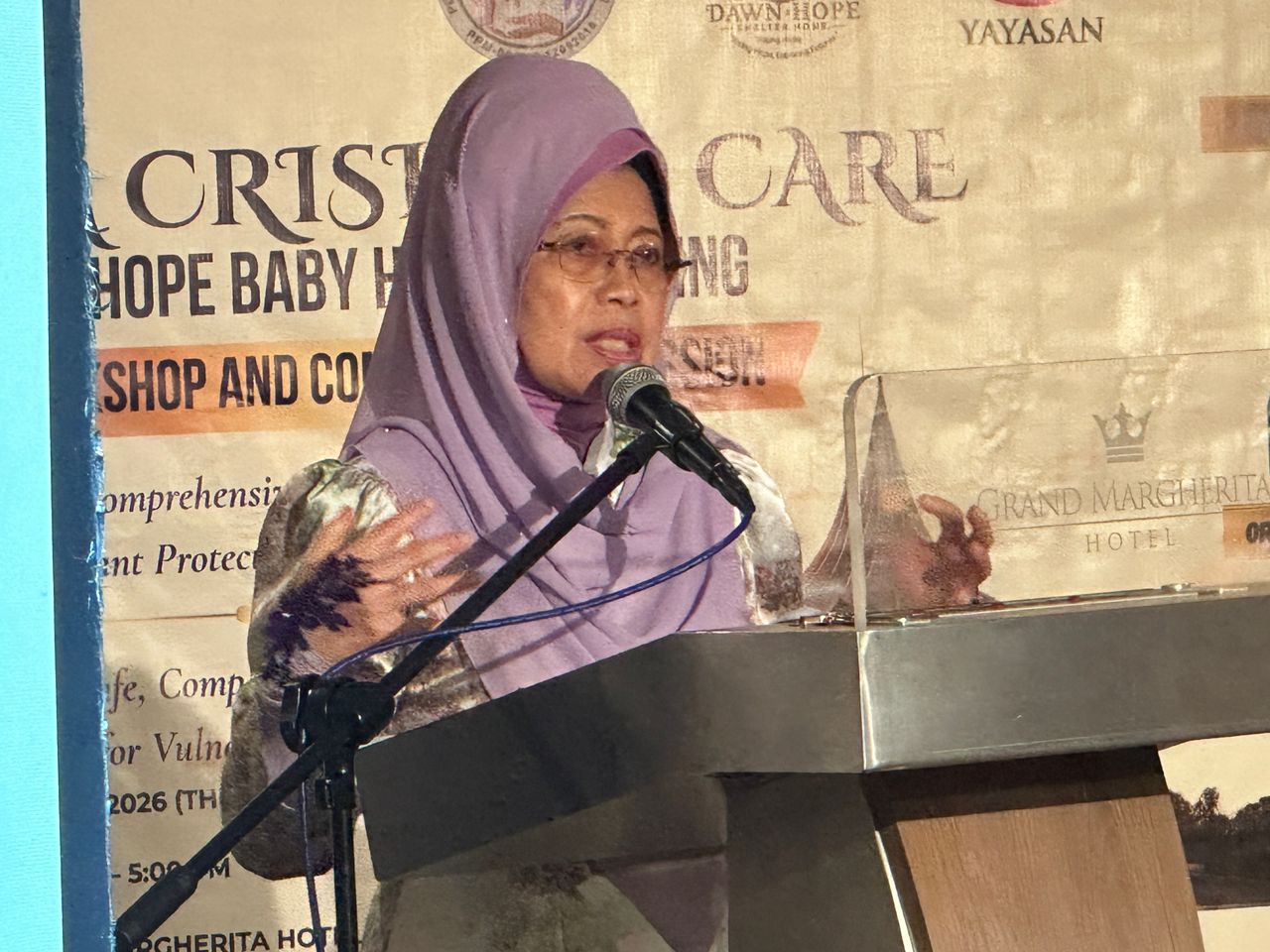
KUCHING: Baby hatches must be viewed strictly as a life-saving, last-resort intervention for infants at risk of abandonment rather than a measure that encourages the act itself, said Datuk Seri Fatimah Abdullah.
The Minister for Women, Early Childhood and Community Wellbeing Development said the facilities provide a safe and anonymous option for mothers in crisis to ensure their babies are protected.
“We want to save two lives – the life of the young mother and the life of the baby born from an unplanned pregnancy,” she told reporters after closing the ‘From Crisis to Care: Dawn Hope Baby Hatch Sarawak SOP Workshop and Consultation Session’ today.
Fatimah stressed that the state does not view baby hatches as the primary solution to baby abandonment, but as an alternative mechanism when all other options have failed.
She said many unwed mothers continue to face stigma, shame and fear of being ostracised by their families and communities, making anonymity an important feature of baby hatch facilities.
“Many of these mothers still love their babies and want them to be safe, even though they are unable to care for them,” she said.
Sarawak’s first baby hatch was established at KPJ Kuching Specialist Hospital in 2017, followed by another facility at Borneo Medical Centre (BMC) Kuching in 2023.
Fatimah said she hopes KPJ can resolve technical issues related to its relocated hospital and resume operations of its baby hatch facility.
She also recounted how she once made a public appeal for the biological mother of a baby left at a BMC baby hatch to contact her, with the aim of facilitating the child’s citizenship and adoption process.
The mother eventually came forward, enabling the child to obtain proper documentation and be adopted by a suitable family.
“If the identity of the mother is known, the child can obtain citizenship status more easily and the adoption process becomes smoother,” she said.
Fatimah added that Sarawak’s efforts to tackle baby abandonment are closely linked to addressing teenage pregnancy through the One Stop Teenage Pregnancy Committee (OSTPC), established in 2014.
The committee adopts a multi-agency approach that includes prevention programmes, healthcare, welfare assistance, educational support and safe shelters for pregnant teenagers.
Since its establishment, teenage pregnancy cases in Sarawak have declined from 3,401 in 2014 to 1,770 in 2025.
“Our focus remains on prevention through education, counselling and support systems, while ensuring that every child born is protected and given the opportunity for a better future,” she said.